Jing Cheng, Dan Tong, Yang Liu, Yu Bo, Bo Zheng, Guannan Geng, Kebin He and Qiang Zhang
{"title":"Air quality and health benefits of China’s current and upcoming clean air policies†","authors":"Jing Cheng, Dan Tong, Yang Liu, Yu Bo, Bo Zheng, Guannan Geng, Kebin He and Qiang Zhang","doi":"10.1039/D0FD00090F","DOIUrl":null,"url":null,"abstract":"<p >China is currently in a crucial stage of air pollution control and has intensive clean air policies. Past strict policies have demonstrated remarkable effectiveness in emission control and fine particulate matter (PM<small><sub>2.5</sub></small>) pollution mitigation; however, it is not clear what the continuous benefits of current policies are for the future. Here, we summarize China’s currently implemented, released, and upcoming clean air policies and estimate the air quality and health benefits of the implementation of these policies until 2030. We found that China’s current and upcoming clean air policies could reduce major pollutant emissions by 14.3–70.5% under continued socio-economic growth from 2010 to 2030. These policies could decrease the national population-weighted PM<small><sub>2.5</sub></small> concentrations from 61.6 μg m<small><sup>?3</sup></small> in 2010 to 26.4 μg m<small><sup>?3</sup></small> in 2030 (57.2% reduction). These air quality improvements will ensure that over 80% of the population lives in areas with PM<small><sub>2.5</sub></small> levels below the current annual PM<small><sub>2.5</sub></small> air quality standard (<em>i.e.</em>, 35 μg m<small><sup>?3</sup></small>) and will avoid 95.0 (95% CI, 76.3, 104.2) thousand premature deaths in 2030. We also point out several inadequacies of current clean air policies, suggesting that more ambitious control actions are needed to better protect public health with an increasing ageing population. Our findings could provide quantitative insights that can be used to better address air pollution issues in China and other developing countries.</p>","PeriodicalId":49075,"journal":{"name":"Faraday Discussions","volume":"226 ","pages":" 584-606"},"PeriodicalIF":3.1000,"publicationDate":"2020-08-12","publicationTypes":"Journal Article","fieldsOfStudy":null,"isOpenAccess":false,"openAccessPdf":"https://sci-hub-pdf.com/10.1039/D0FD00090F","citationCount":"0","resultStr":null,"platform":"Semanticscholar","paperid":null,"PeriodicalName":"Faraday Discussions","FirstCategoryId":"92","ListUrlMain":"https://pubs.rsc.org/en/content/articlelanding/2021/fd/d0fd00090f","RegionNum":3,"RegionCategory":"化学","ArticlePicture":[],"TitleCN":null,"AbstractTextCN":null,"PMCID":null,"EPubDate":"","PubModel":"","JCR":"Q2","JCRName":"Chemistry","Score":null,"Total":0}
引用次数: 0
Abstract
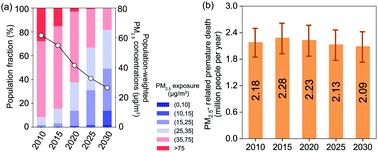
China is currently in a crucial stage of air pollution control and has intensive clean air policies. Past strict policies have demonstrated remarkable effectiveness in emission control and fine particulate matter (PM2.5) pollution mitigation; however, it is not clear what the continuous benefits of current policies are for the future. Here, we summarize China’s currently implemented, released, and upcoming clean air policies and estimate the air quality and health benefits of the implementation of these policies until 2030. We found that China’s current and upcoming clean air policies could reduce major pollutant emissions by 14.3–70.5% under continued socio-economic growth from 2010 to 2030. These policies could decrease the national population-weighted PM2.5 concentrations from 61.6 μg m?3 in 2010 to 26.4 μg m?3 in 2030 (57.2% reduction). These air quality improvements will ensure that over 80% of the population lives in areas with PM2.5 levels below the current annual PM2.5 air quality standard (i.e., 35 μg m?3) and will avoid 95.0 (95% CI, 76.3, 104.2) thousand premature deaths in 2030. We also point out several inadequacies of current clean air policies, suggesting that more ambitious control actions are needed to better protect public health with an increasing ageing population. Our findings could provide quantitative insights that can be used to better address air pollution issues in China and other developing countries.



 京公网安备 11010802042870号
京ICP备2023020795号-1
京公网安备 11010802042870号
京ICP备2023020795号-1

 分享
分享
 求助内容:
求助内容: 应助结果提醒方式:
 扫码关注我们
