Taiqiang Chen, Xinjuan Liu, Lengyuan Niu, Yinyan Gong, Can Li, Shiqing Xu and Likun Pan
{"title":"Recent progress on metal–organic framework-derived materials for sodium-ion battery anodes","authors":"Taiqiang Chen, Xinjuan Liu, Lengyuan Niu, Yinyan Gong, Can Li, Shiqing Xu and Likun Pan","doi":"10.1039/C9QI01268K","DOIUrl":null,"url":null,"abstract":"<p >Metal–organic frameworks (MOFs), self-assembled by metal ions and organic ligands <em>via</em> coordination bonds, have been broadly reported as an ideal template or precursor to design and prepare porous nanostructured materials for battery application, due to their high specific surface areas, porous structures and large pore volumes, as well as diverse and tunable structures. Versatile nanostructures, such as carbon, metal oxide, sulfide, selenide and phosphide, have been fabricated from MOFs through pyrolysis or wet chemistry strategies, which exhibit outstanding electrochemical performances for sodium-ion batteries (SIBs) because of well-defined nanostructures inherited from the starting MOFs. In this review, recent progress on MOF-derived materials for SIB anodes is summarized. The preparation methods, structure design strategies and structure–performance relationships are briefly introduced, and some insights into the future development of MOF-derived electrode materials for SIBs are discussed.</p>","PeriodicalId":79,"journal":{"name":"Inorganic Chemistry Frontiers","volume":" 3","pages":" 567-582"},"PeriodicalIF":6.4000,"publicationDate":"2019-11-26","publicationTypes":"Journal Article","fieldsOfStudy":null,"isOpenAccess":false,"openAccessPdf":"https://sci-hub-pdf.com/10.1039/C9QI01268K","citationCount":"36","resultStr":null,"platform":"Semanticscholar","paperid":null,"PeriodicalName":"Inorganic Chemistry Frontiers","FirstCategoryId":"92","ListUrlMain":"https://pubs.rsc.org/en/content/articlelanding/2020/qi/c9qi01268k","RegionNum":1,"RegionCategory":"化学","ArticlePicture":[],"TitleCN":null,"AbstractTextCN":null,"PMCID":null,"EPubDate":"","PubModel":"","JCR":"Q1","JCRName":"CHEMISTRY, INORGANIC & NUCLEAR","Score":null,"Total":0}
引用次数: 36
Abstract
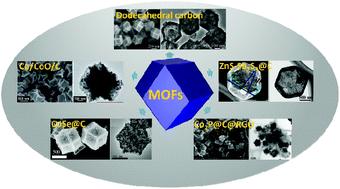
Metal–organic frameworks (MOFs), self-assembled by metal ions and organic ligands via coordination bonds, have been broadly reported as an ideal template or precursor to design and prepare porous nanostructured materials for battery application, due to their high specific surface areas, porous structures and large pore volumes, as well as diverse and tunable structures. Versatile nanostructures, such as carbon, metal oxide, sulfide, selenide and phosphide, have been fabricated from MOFs through pyrolysis or wet chemistry strategies, which exhibit outstanding electrochemical performances for sodium-ion batteries (SIBs) because of well-defined nanostructures inherited from the starting MOFs. In this review, recent progress on MOF-derived materials for SIB anodes is summarized. The preparation methods, structure design strategies and structure–performance relationships are briefly introduced, and some insights into the future development of MOF-derived electrode materials for SIBs are discussed.




 京公网安备 11010802042870号
京ICP备2023020795号-1
京公网安备 11010802042870号
京ICP备2023020795号-1

 分享
分享
 求助内容:
求助内容: 应助结果提醒方式:
 扫码关注我们
