Sai Sudha Mannemuddhu, William Clapp, Renee Modica, Melissa E Elder, Kiran Upadhyay
{"title":"End-stage renal disease secondary to anti-glomerular basement membrane disease in a child with common variable immunodeficiency.","authors":"Sai Sudha Mannemuddhu, William Clapp, Renee Modica, Melissa E Elder, Kiran Upadhyay","doi":"10.5414/CNCS109510","DOIUrl":null,"url":null,"abstract":"<p><strong>Background: </strong>Anti-glomerular basement membrane (GBM) disease is caused by autoantibodies against the α3-chain of type IV collagen in the GBM. Common variable immunodeficiency (CVID) is a primary immunodeficiency manifested by hypogammaglobulinemia, inability to make functional antibody, and recurrent infections. This report extends the phenotype of CVID-associated autoimmune diseases to include anti-GBM disease.</p><p><strong>Case presentation: </strong>A 15-year-old Caucasian female with prior normal renal function presented with nephrotic proteinuria, pedal edema, oliguria, acute kidney injury, and was found to have positive serum anti-GBM antibody. She had been diagnosed with CVID at 3 years of age. Her renal biopsy showed crescentic glomerulonephritis (50%), and immunofluorescence showed linear staining for IgG along the glomerular capillary wall. There was no clinical or imaging evidence of pulmonary hemorrhage. She was treated with pulse IV steroids, cyclophosphamide, rituximab, and several sessions of plasmapheresis. Her serum anti-GBM antibody level decreased from 194 U/mL at presentation to 0 U/mL after therapy. However, she progressed to end-stage renal disease (ESRD) within weeks, despite aggressive therapy, and required chronic renal replacement therapy in the form of dialysis. Her clinical course was also complicated by hypertensive encephalopathy, CMV viremia and meningoencephalitis, status epilepticus, and she passed away a few months later from lower respiratory tract complications.</p><p><strong>Conclusion: </strong>Anti-GBM disease is a rare autoimmune condition that has not been reported in association with a primary immunodeficiency syndrome. ESRD secondary to anti-GBM disease in a patient with CVID is an interesting association and supports the role of immune dysregulation in systemic autoimmune disease.</p>","PeriodicalId":10398,"journal":{"name":"Clinical Nephrology. Case Studies","volume":"7 ","pages":"1-6"},"PeriodicalIF":0.0000,"publicationDate":"2019-02-01","publicationTypes":"Journal Article","fieldsOfStudy":null,"isOpenAccess":false,"openAccessPdf":"https://www.ncbi.nlm.nih.gov/pmc/articles/PMC6374989/pdf/","citationCount":"6","resultStr":null,"platform":"Semanticscholar","paperid":null,"PeriodicalName":"Clinical Nephrology. Case Studies","FirstCategoryId":"1085","ListUrlMain":"https://doi.org/10.5414/CNCS109510","RegionNum":0,"RegionCategory":null,"ArticlePicture":[],"TitleCN":null,"AbstractTextCN":null,"PMCID":null,"EPubDate":"2019/1/1 0:00:00","PubModel":"eCollection","JCR":"","JCRName":"","Score":null,"Total":0}
引用次数: 6
Abstract
Background: Anti-glomerular basement membrane (GBM) disease is caused by autoantibodies against the α3-chain of type IV collagen in the GBM. Common variable immunodeficiency (CVID) is a primary immunodeficiency manifested by hypogammaglobulinemia, inability to make functional antibody, and recurrent infections. This report extends the phenotype of CVID-associated autoimmune diseases to include anti-GBM disease.
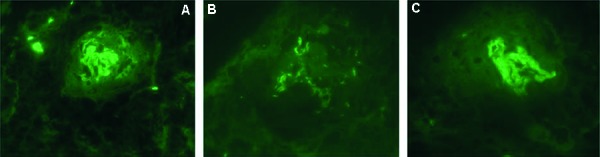
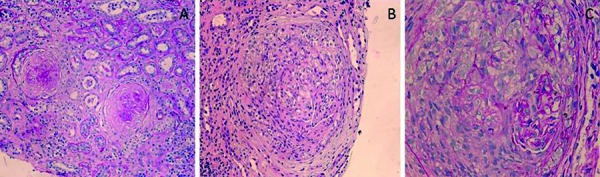
Case presentation: A 15-year-old Caucasian female with prior normal renal function presented with nephrotic proteinuria, pedal edema, oliguria, acute kidney injury, and was found to have positive serum anti-GBM antibody. She had been diagnosed with CVID at 3 years of age. Her renal biopsy showed crescentic glomerulonephritis (50%), and immunofluorescence showed linear staining for IgG along the glomerular capillary wall. There was no clinical or imaging evidence of pulmonary hemorrhage. She was treated with pulse IV steroids, cyclophosphamide, rituximab, and several sessions of plasmapheresis. Her serum anti-GBM antibody level decreased from 194 U/mL at presentation to 0 U/mL after therapy. However, she progressed to end-stage renal disease (ESRD) within weeks, despite aggressive therapy, and required chronic renal replacement therapy in the form of dialysis. Her clinical course was also complicated by hypertensive encephalopathy, CMV viremia and meningoencephalitis, status epilepticus, and she passed away a few months later from lower respiratory tract complications.
Conclusion: Anti-GBM disease is a rare autoimmune condition that has not been reported in association with a primary immunodeficiency syndrome. ESRD secondary to anti-GBM disease in a patient with CVID is an interesting association and supports the role of immune dysregulation in systemic autoimmune disease.



 京公网安备 11010802042870号
京ICP备2023020795号-1
京公网安备 11010802042870号
京ICP备2023020795号-1

 分享
分享

 求助内容:
求助内容: 应助结果提醒方式:
 扫码关注我们
