{"title":"Effects of icariside II on brain tissue oxidative stress and Nrf2/HO-1 expression in rats with cerebral ischemia-reperfusion injury1.","authors":"Yan Li, Fanjun Meng","doi":"10.1590/s0102-8650201900208","DOIUrl":null,"url":null,"abstract":"<p><strong>Purpose: </strong>To investigate the effects of icariside II on brain tissue oxidative stress and Nrf2/HO-1 expression in rats with cerebral ischemia-reperfusion injury (CIRI).</p><p><strong>Methods: </strong>One hundred SD rats were randomly divided into sham-operated, model, and 5, 10 and 20 mg/kg icariside II groups, 20 rats in each group. The middle cerebral artery occlusion model (ischemia for 2 h followed by reperfusion for 24 h) was established in the later 4 groups. In later 3 groups, at reperfusion beginning, the rats were intragastrically administrated with 5, 10 and 20 mg/kg icariside II, respectively. After 24 h of reperfusion, the neurological severity score, cerebral water content and cerebral infarction volume, brain tissue oxidative stress indexes and Nrf2 and HO-1 protein expressions were determined.</p><p><strong>Results: </strong>Compared with model group, in 20 mg/kg icariside II group the neurological severity score, cerebral water content and cerebral infarction volume, brain tissue ROS content and MDA level were significantly decreased (P<0.05), and the brain tissue SOD, GSH-Px and catalase levels and Nrf2 and HO-1 protein levels were significantly increased (P<0.05).</p><p><strong>Conclusion: </strong>Icariside II can alleviate the CIRI in rats through reducing brain tissue oxidative stress and improving Nrf2/HO-1 expression.</p>","PeriodicalId":6992,"journal":{"name":"Acta cirurgica brasileira","volume":"34 2","pages":"e201900208"},"PeriodicalIF":1.3000,"publicationDate":"2019-02-28","publicationTypes":"Journal Article","fieldsOfStudy":null,"isOpenAccess":false,"openAccessPdf":"https://sci-hub-pdf.com/10.1590/s0102-8650201900208","citationCount":"14","resultStr":null,"platform":"Semanticscholar","paperid":null,"PeriodicalName":"Acta cirurgica brasileira","FirstCategoryId":"3","ListUrlMain":"https://doi.org/10.1590/s0102-8650201900208","RegionNum":4,"RegionCategory":"医学","ArticlePicture":[],"TitleCN":null,"AbstractTextCN":null,"PMCID":null,"EPubDate":"","PubModel":"","JCR":"Q3","JCRName":"SURGERY","Score":null,"Total":0}
引用次数: 14
Abstract
Purpose: To investigate the effects of icariside II on brain tissue oxidative stress and Nrf2/HO-1 expression in rats with cerebral ischemia-reperfusion injury (CIRI).
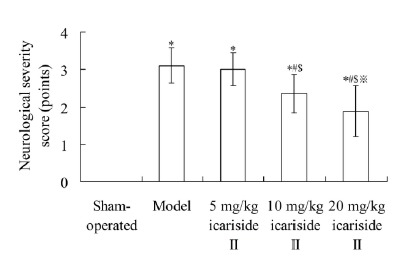
Methods: One hundred SD rats were randomly divided into sham-operated, model, and 5, 10 and 20 mg/kg icariside II groups, 20 rats in each group. The middle cerebral artery occlusion model (ischemia for 2 h followed by reperfusion for 24 h) was established in the later 4 groups. In later 3 groups, at reperfusion beginning, the rats were intragastrically administrated with 5, 10 and 20 mg/kg icariside II, respectively. After 24 h of reperfusion, the neurological severity score, cerebral water content and cerebral infarction volume, brain tissue oxidative stress indexes and Nrf2 and HO-1 protein expressions were determined.
Results: Compared with model group, in 20 mg/kg icariside II group the neurological severity score, cerebral water content and cerebral infarction volume, brain tissue ROS content and MDA level were significantly decreased (P<0.05), and the brain tissue SOD, GSH-Px and catalase levels and Nrf2 and HO-1 protein levels were significantly increased (P<0.05).
Conclusion: Icariside II can alleviate the CIRI in rats through reducing brain tissue oxidative stress and improving Nrf2/HO-1 expression.





 京公网安备 11010802042870号
京ICP备2023020795号-1
京公网安备 11010802042870号
京ICP备2023020795号-1

 分享
分享
 求助内容:
求助内容: 应助结果提醒方式:
 扫码关注我们
