Comparative study of Interleukin-18 (IL-18) serum levels in adult onset Still's disease (AOSD) and systemic onset juvenile idiopathic arthritis (sJIA) and its use as a biomarker for diagnosis and evaluation of disease activity.
Holger Kudela, Susanne Drynda, Anke Lux, Gerd Horneff, Joern Kekow
{"title":"Comparative study of Interleukin-18 (IL-18) serum levels in adult onset Still's disease (AOSD) and systemic onset juvenile idiopathic arthritis (sJIA) and its use as a biomarker for diagnosis and evaluation of disease activity.","authors":"Holger Kudela, Susanne Drynda, Anke Lux, Gerd Horneff, Joern Kekow","doi":"10.1186/s41927-019-0053-z","DOIUrl":null,"url":null,"abstract":"<p><strong>Background: </strong>Signs and symptoms establish the diagnosis of adult onset Still's disease (AOSD) as well as of systemic onset juvenile idiopathic arthritis (sJIA). The published data regarding the importance of IL-18 as a marker for diagnosis and disease activity so far are conflicting. The aim of this study was to clarify the role of IL-18 as a diagnostic and disease activity marker in AOSD and sJIA.</p><p><strong>Methods: </strong>Thirty adult patients diagnosed with AOSD and twenty children diagnosed with sJIA were included in the study. Clinical and laboratory data were obtained retrospectively for each patient visit whenever IL-18 serum levels were determined. IL-18 levels were determined by ELISA. Sixty-five adults and twenty-three children presenting with fever and/or arthritis who did not meet the criteria for a diagnosis of AOSD or sJIA served as comparison groups. Rau's criteria and CRP values were used to evaluate disease activity.</p><p><strong>Results: </strong>IL-18 levels were significantly elevated in patients with active AOSD compared to AOSD patients in remission and to the comparison group with a median of 16,327 pg/ml, 470 pg/ml, and 368 pg/ml, respectively (<i>p</i> < 0.001). Analogous to AOSD in active sJIA, the median IL-18 serum level was significantly higher with 21,512 pg/ml than in the comparison group with 2580 pg/ml (<i>p</i> < 0.001).At our cut-off point of 5000 pg/ml, the calculated specificity of IL-18 to establish the diagnosis of AOSD was 96.9%, and the sensitivity 63.3% (AUC = 0.870, p < 0.001). For the diagnosis of sJIA, a cut-off value of 10,000 pg/ml was chosen with a specificity of 100% and a sensitivity of 60% (AUC = 0.774, <i>p</i> = 0.003). At a cut-off value of 5000 pg/ml, the specificity was 62% and the sensitivity 65%.</p><p><strong>Conclusions: </strong>This study gives further evidence to earlier publications of elevated IL-18 serum levels in active AOSD and sJIA, with up to 1000-fold higher concentrations compared to other rheumatic diseases. A clear association of IL-18 serum levels with disease activity in AOSD was found. The results support the use of IL-18 as an important biomarker in AOSD and sJIA.</p>","PeriodicalId":9150,"journal":{"name":"BMC Rheumatology","volume":"3 ","pages":"4"},"PeriodicalIF":2.5000,"publicationDate":"2019-02-28","publicationTypes":"Journal Article","fieldsOfStudy":null,"isOpenAccess":false,"openAccessPdf":"https://sci-hub-pdf.com/10.1186/s41927-019-0053-z","citationCount":"42","resultStr":null,"platform":"Semanticscholar","paperid":null,"PeriodicalName":"BMC Rheumatology","FirstCategoryId":"1085","ListUrlMain":"https://doi.org/10.1186/s41927-019-0053-z","RegionNum":0,"RegionCategory":null,"ArticlePicture":[],"TitleCN":null,"AbstractTextCN":null,"PMCID":null,"EPubDate":"2019/1/1 0:00:00","PubModel":"eCollection","JCR":"Q3","JCRName":"RHEUMATOLOGY","Score":null,"Total":0}
引用次数: 42
Abstract
Background: Signs and symptoms establish the diagnosis of adult onset Still's disease (AOSD) as well as of systemic onset juvenile idiopathic arthritis (sJIA). The published data regarding the importance of IL-18 as a marker for diagnosis and disease activity so far are conflicting. The aim of this study was to clarify the role of IL-18 as a diagnostic and disease activity marker in AOSD and sJIA.
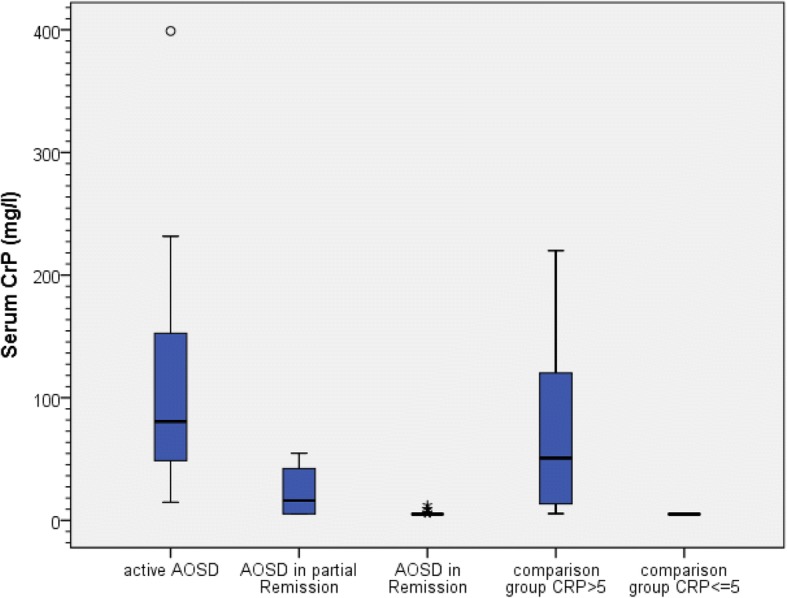
Methods: Thirty adult patients diagnosed with AOSD and twenty children diagnosed with sJIA were included in the study. Clinical and laboratory data were obtained retrospectively for each patient visit whenever IL-18 serum levels were determined. IL-18 levels were determined by ELISA. Sixty-five adults and twenty-three children presenting with fever and/or arthritis who did not meet the criteria for a diagnosis of AOSD or sJIA served as comparison groups. Rau's criteria and CRP values were used to evaluate disease activity.
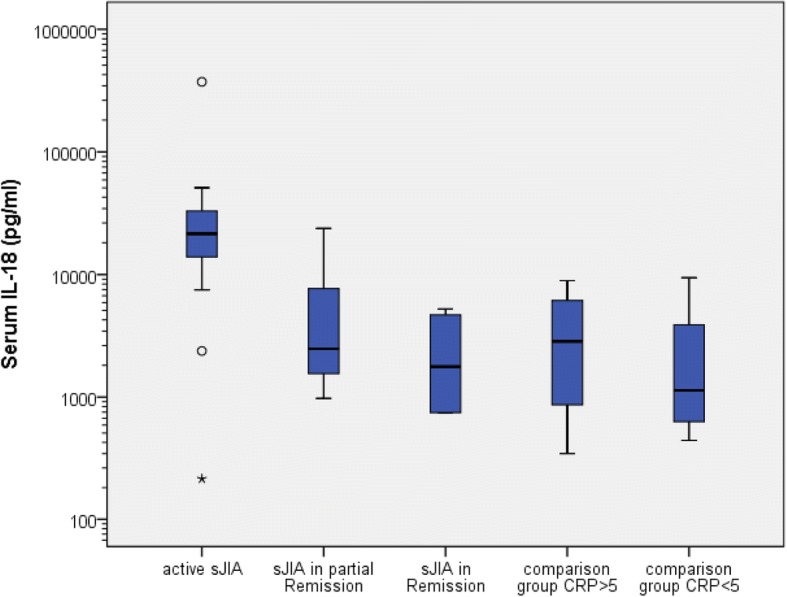
Results: IL-18 levels were significantly elevated in patients with active AOSD compared to AOSD patients in remission and to the comparison group with a median of 16,327 pg/ml, 470 pg/ml, and 368 pg/ml, respectively (p < 0.001). Analogous to AOSD in active sJIA, the median IL-18 serum level was significantly higher with 21,512 pg/ml than in the comparison group with 2580 pg/ml (p < 0.001).At our cut-off point of 5000 pg/ml, the calculated specificity of IL-18 to establish the diagnosis of AOSD was 96.9%, and the sensitivity 63.3% (AUC = 0.870, p < 0.001). For the diagnosis of sJIA, a cut-off value of 10,000 pg/ml was chosen with a specificity of 100% and a sensitivity of 60% (AUC = 0.774, p = 0.003). At a cut-off value of 5000 pg/ml, the specificity was 62% and the sensitivity 65%.
Conclusions: This study gives further evidence to earlier publications of elevated IL-18 serum levels in active AOSD and sJIA, with up to 1000-fold higher concentrations compared to other rheumatic diseases. A clear association of IL-18 serum levels with disease activity in AOSD was found. The results support the use of IL-18 as an important biomarker in AOSD and sJIA.




 京公网安备 11010802042870号
京ICP备2023020795号-1
京公网安备 11010802042870号
京ICP备2023020795号-1

 分享
分享
 求助内容:
求助内容: 应助结果提醒方式:
 扫码关注我们
