{"title":"Quantifying heterogeneous contact patterns in Japan: a social contact survey.","authors":"Lankeshwara Munasinghe, Yusuke Asai, Hiroshi Nishiura","doi":"10.1186/s12976-019-0102-8","DOIUrl":null,"url":null,"abstract":"<p><strong>Background: </strong>Social contact surveys can greatly help in quantifying the heterogeneous patterns of infectious disease transmission. The present study aimed to conduct a contact survey in Japan, offering estimates of contact by age and location and validating a social contact matrix using a seroepidemiological dataset of influenza.</p><p><strong>Methods: </strong>An internet-based questionnaire survey was conducted, covering all 47 prefectures in Japan and including a total of 1476 households. The social contact matrix was quantified assuming reciprocity and using the maximum likelihood method. By imposing several parametric assumptions for the next-generation matrix, the empirical seroepidemiological data of influenza A (H1N1) 2009 was analysed and we estimated the basic reproduction number, R<sub>0</sub>.</p><p><strong>Results: </strong>In total, the reported number of contacts on weekdays was 10,682 whereas that on weekend days was 8867. Strong age-dependent assortativity was identified. Forty percent of weekday contacts took place at schools or workplaces, but that declined to 14% on weekends. Accounting for the age-dependent heterogeneity with the known social contact matrix, the minimum value of the Akaike information criterion was obtained and R<sub>0</sub> was estimated at 1.45 (95% confidence interval: 1.42, 1.49).</p><p><strong>Conclusions: </strong>Survey datasets will be useful for parameterizing the heterogeneous transmission model of various directly transmitted infectious diseases in Japan. Age-dependent assortativity, especially among children, along with numerous contacts in school settings on weekdays implies the potential effectiveness of school closure.</p>","PeriodicalId":75215,"journal":{"name":"","volume":"16 1","pages":"6"},"PeriodicalIF":0.0,"publicationDate":"2019-03-20","publicationTypes":"Journal Article","fieldsOfStudy":null,"isOpenAccess":false,"openAccessPdf":"https://sci-hub-pdf.com/10.1186/s12976-019-0102-8","citationCount":"30","resultStr":null,"platform":"Semanticscholar","paperid":null,"PeriodicalName":"","FirstCategoryId":"1085","ListUrlMain":"https://doi.org/10.1186/s12976-019-0102-8","RegionNum":0,"RegionCategory":null,"ArticlePicture":[],"TitleCN":null,"AbstractTextCN":null,"PMCID":null,"EPubDate":"","PubModel":"","JCR":"","JCRName":"","Score":null,"Total":0}
引用次数: 30
Abstract
Background: Social contact surveys can greatly help in quantifying the heterogeneous patterns of infectious disease transmission. The present study aimed to conduct a contact survey in Japan, offering estimates of contact by age and location and validating a social contact matrix using a seroepidemiological dataset of influenza.
Methods: An internet-based questionnaire survey was conducted, covering all 47 prefectures in Japan and including a total of 1476 households. The social contact matrix was quantified assuming reciprocity and using the maximum likelihood method. By imposing several parametric assumptions for the next-generation matrix, the empirical seroepidemiological data of influenza A (H1N1) 2009 was analysed and we estimated the basic reproduction number, R0.
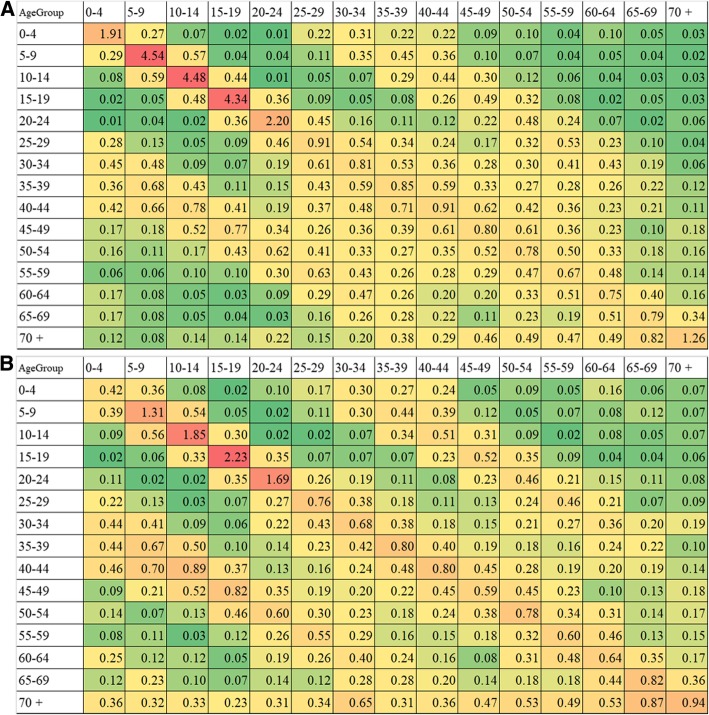
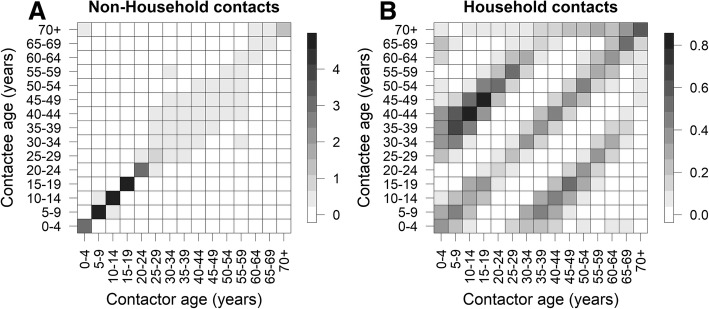
Results: In total, the reported number of contacts on weekdays was 10,682 whereas that on weekend days was 8867. Strong age-dependent assortativity was identified. Forty percent of weekday contacts took place at schools or workplaces, but that declined to 14% on weekends. Accounting for the age-dependent heterogeneity with the known social contact matrix, the minimum value of the Akaike information criterion was obtained and R0 was estimated at 1.45 (95% confidence interval: 1.42, 1.49).
Conclusions: Survey datasets will be useful for parameterizing the heterogeneous transmission model of various directly transmitted infectious diseases in Japan. Age-dependent assortativity, especially among children, along with numerous contacts in school settings on weekdays implies the potential effectiveness of school closure.



 京公网安备 11010802042870号
京ICP备2023020795号-1
京公网安备 11010802042870号
京ICP备2023020795号-1

 分享
分享
 求助内容:
求助内容: 应助结果提醒方式:
 扫码关注我们
