{"title":"Inferring Bacterial Infiltration in Primary Colorectal Tumors From Host Whole Genome Sequencing Data.","authors":"Man Guo, Er Xu, Dongmei Ai","doi":"10.3389/fgene.2019.00213","DOIUrl":null,"url":null,"abstract":"<p><p>Colorectal cancer is the third most common cancer worldwide with abysmal survival, thus requiring novel therapy strategies. Numerous studies have frequently observed infiltrating bacteria within the primary tumor tissues derived from patients. These studies have implicated the relative abundance of these bacteria as a contributing factor in tumor progression. Infiltrating bacteria are believed to be among the major drivers of tumorigenesis, progression, and metastasis and, hence, promising targets for new treatments. However, measuring their abundance directly remains challenging. One potential approach is to use the unmapped reads of host whole genome sequencing (hWGS) data, which previous studies have considered as contaminants and discarded. Here, we developed rigorous bioinformatics and statistical procedures to identify tumor-infiltrating bacteria associated with colorectal cancer from such whole genome sequencing data. Our approach used the reads of whole genome sequencing data of colon adenocarcinoma tissues not mapped to the human reference genome, including unmapped paired-end read pairs and single-end reads, the mates of which were mapped. We assembled the unmapped read pairs, remapped all those reads to the collection of human microbiome reference, and then computed their relative abundance of microbes by maximum likelihood (ML) estimation. We analyzed and compared the relative abundance and diversity of infiltrating bacteria between primary tumor tissues and associated normal blood samples. Our results showed that primary tumor tissues contained far more diverse total infiltrating bacteria than normal blood samples. The relative abundance of <i>Bacteroides fragilis</i>, <i>Bacteroides dorei</i>, and <i>Fusobacterium nucleatum</i> was significantly higher in primary colorectal tumors. These three bacteria were among the top ten microbes in the primary tumor tissues, yet were rarely found in normal blood samples. As a validation step, most of these bacteria were also closely associated with colorectal cancer in previous studies with alternative approaches. In summary, our approach provides a new analytic technique for investigating the infiltrating bacterial community within tumor tissues. Our novel cloud-based bioinformatics and statistical pipelines to analyze the infiltrating bacteria in colorectal tumors using the unmapped reads of whole genome sequences can be freely accessed from GitHub at https://github.com/gutmicrobes/UMIB.git.</p>","PeriodicalId":2,"journal":{"name":"ACS Applied Bio Materials","volume":" ","pages":"213"},"PeriodicalIF":4.7000,"publicationDate":"2019-03-15","publicationTypes":"Journal Article","fieldsOfStudy":null,"isOpenAccess":false,"openAccessPdf":"https://sci-hub-pdf.com/10.3389/fgene.2019.00213","citationCount":"9","resultStr":null,"platform":"Semanticscholar","paperid":null,"PeriodicalName":"ACS Applied Bio Materials","FirstCategoryId":"99","ListUrlMain":"https://doi.org/10.3389/fgene.2019.00213","RegionNum":0,"RegionCategory":null,"ArticlePicture":[],"TitleCN":null,"AbstractTextCN":null,"PMCID":null,"EPubDate":"2019/1/1 0:00:00","PubModel":"eCollection","JCR":"Q2","JCRName":"MATERIALS SCIENCE, BIOMATERIALS","Score":null,"Total":0}
引用次数: 9
Abstract
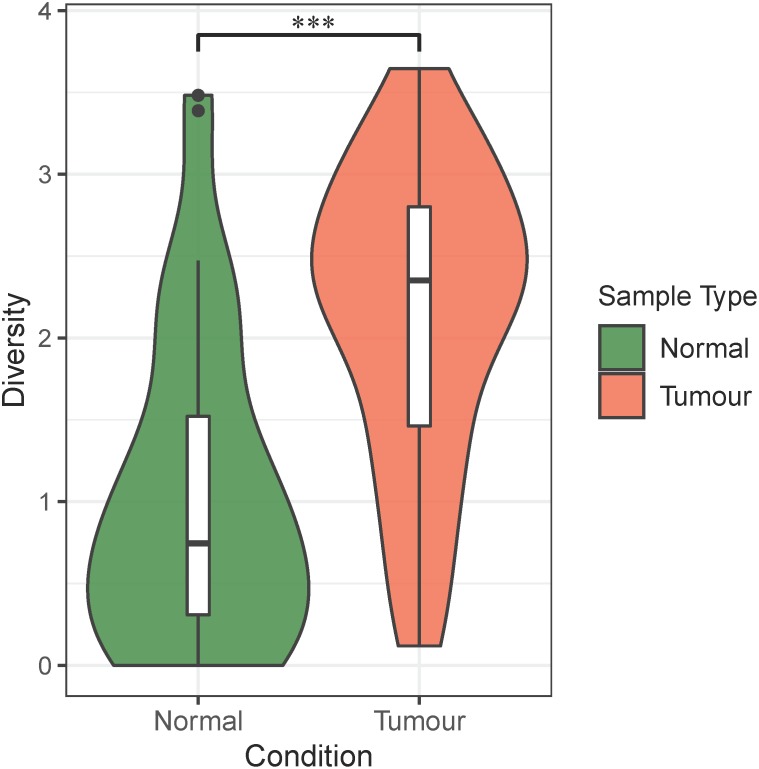
Colorectal cancer is the third most common cancer worldwide with abysmal survival, thus requiring novel therapy strategies. Numerous studies have frequently observed infiltrating bacteria within the primary tumor tissues derived from patients. These studies have implicated the relative abundance of these bacteria as a contributing factor in tumor progression. Infiltrating bacteria are believed to be among the major drivers of tumorigenesis, progression, and metastasis and, hence, promising targets for new treatments. However, measuring their abundance directly remains challenging. One potential approach is to use the unmapped reads of host whole genome sequencing (hWGS) data, which previous studies have considered as contaminants and discarded. Here, we developed rigorous bioinformatics and statistical procedures to identify tumor-infiltrating bacteria associated with colorectal cancer from such whole genome sequencing data. Our approach used the reads of whole genome sequencing data of colon adenocarcinoma tissues not mapped to the human reference genome, including unmapped paired-end read pairs and single-end reads, the mates of which were mapped. We assembled the unmapped read pairs, remapped all those reads to the collection of human microbiome reference, and then computed their relative abundance of microbes by maximum likelihood (ML) estimation. We analyzed and compared the relative abundance and diversity of infiltrating bacteria between primary tumor tissues and associated normal blood samples. Our results showed that primary tumor tissues contained far more diverse total infiltrating bacteria than normal blood samples. The relative abundance of Bacteroides fragilis, Bacteroides dorei, and Fusobacterium nucleatum was significantly higher in primary colorectal tumors. These three bacteria were among the top ten microbes in the primary tumor tissues, yet were rarely found in normal blood samples. As a validation step, most of these bacteria were also closely associated with colorectal cancer in previous studies with alternative approaches. In summary, our approach provides a new analytic technique for investigating the infiltrating bacterial community within tumor tissues. Our novel cloud-based bioinformatics and statistical pipelines to analyze the infiltrating bacteria in colorectal tumors using the unmapped reads of whole genome sequences can be freely accessed from GitHub at https://github.com/gutmicrobes/UMIB.git.
期刊介绍:
ACS Applied Bio Materials is an interdisciplinary journal publishing original research covering all aspects of biomaterials and biointerfaces including and beyond the traditional biosensing, biomedical and therapeutic applications.
The journal is devoted to reports of new and original experimental and theoretical research of an applied nature that integrates knowledge in the areas of materials, engineering, physics, bioscience, and chemistry into important bio applications. The journal is specifically interested in work that addresses the relationship between structure and function and assesses the stability and degradation of materials under relevant environmental and biological conditions.






 京公网安备 11010802042870号
京ICP备2023020795号-1
京公网安备 11010802042870号
京ICP备2023020795号-1

 分享
分享
 求助内容:
求助内容: 应助结果提醒方式:
 扫码关注我们
