Yi-Ying Wu, Feng-Lan Chiu, Chan-Shien Yeh, Hung-Chih Kuo
{"title":"Opportunities and challenges for the use of induced pluripotent stem cells in modelling neurodegenerative disease.","authors":"Yi-Ying Wu, Feng-Lan Chiu, Chan-Shien Yeh, Hung-Chih Kuo","doi":"10.1098/rsob.180177","DOIUrl":null,"url":null,"abstract":"<p><p>Adult-onset neurodegenerative diseases are among the most difficult human health conditions to model for drug development. Most genetic or toxin-induced cell and animal models cannot faithfully recapitulate pathology in disease-relevant cells, making it excessively challenging to explore the potential mechanisms underlying sporadic disease. Patient-derived induced pluripotent stem cells (iPSCs) can be differentiated into disease-relevant neurons, providing an unparalleled platform for in vitro modelling and development of therapeutic strategies. Here, we review recent progress in generating Alzheimer's, Parkinson's and Huntington's disease models from patient-derived iPSCs. We also describe novel discoveries of pathological mechanisms and drug evaluations that have used these patient iPSC-derived neuronal models. Additionally, current human iPSC technology allows researchers to model diseases with 3D brain organoids, which are more representative of tissue architecture than traditional neuronal cultures. We discuss remaining challenges and emerging opportunities for the use of three-dimensional brain organoids in modelling brain development and neurodegeneration.</p>","PeriodicalId":19629,"journal":{"name":"Open Biology","volume":" ","pages":"180177"},"PeriodicalIF":3.6000,"publicationDate":"2019-01-31","publicationTypes":"Journal Article","fieldsOfStudy":null,"isOpenAccess":false,"openAccessPdf":"https://sci-hub-pdf.com/10.1098/rsob.180177","citationCount":"53","resultStr":null,"platform":"Semanticscholar","paperid":null,"PeriodicalName":"Open Biology","FirstCategoryId":"99","ListUrlMain":"https://doi.org/10.1098/rsob.180177","RegionNum":3,"RegionCategory":"生物学","ArticlePicture":[],"TitleCN":null,"AbstractTextCN":null,"PMCID":null,"EPubDate":"","PubModel":"","JCR":"Q1","JCRName":"BIOCHEMISTRY & MOLECULAR BIOLOGY","Score":null,"Total":0}
引用次数: 53
Abstract
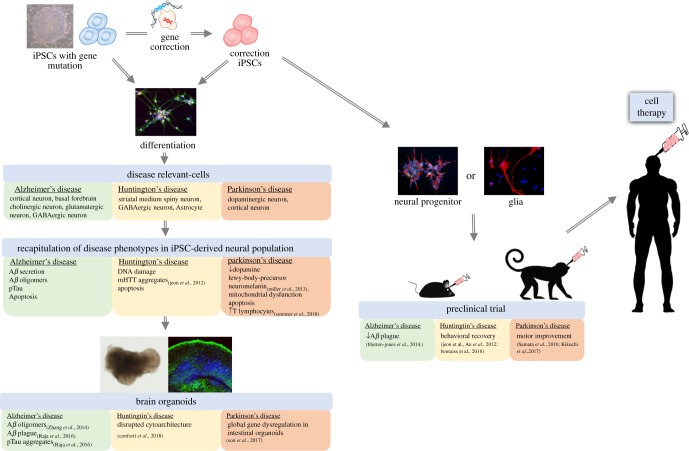
Adult-onset neurodegenerative diseases are among the most difficult human health conditions to model for drug development. Most genetic or toxin-induced cell and animal models cannot faithfully recapitulate pathology in disease-relevant cells, making it excessively challenging to explore the potential mechanisms underlying sporadic disease. Patient-derived induced pluripotent stem cells (iPSCs) can be differentiated into disease-relevant neurons, providing an unparalleled platform for in vitro modelling and development of therapeutic strategies. Here, we review recent progress in generating Alzheimer's, Parkinson's and Huntington's disease models from patient-derived iPSCs. We also describe novel discoveries of pathological mechanisms and drug evaluations that have used these patient iPSC-derived neuronal models. Additionally, current human iPSC technology allows researchers to model diseases with 3D brain organoids, which are more representative of tissue architecture than traditional neuronal cultures. We discuss remaining challenges and emerging opportunities for the use of three-dimensional brain organoids in modelling brain development and neurodegeneration.
期刊介绍:
Open Biology is an online journal that welcomes original, high impact research in cell and developmental biology, molecular and structural biology, biochemistry, neuroscience, immunology, microbiology and genetics.



 京公网安备 11010802042870号
京ICP备2023020795号-1
京公网安备 11010802042870号
京ICP备2023020795号-1

 分享
分享
 求助内容:
求助内容: 应助结果提醒方式:
 扫码关注我们
