Omar Ramos-Lopez, Jose I Riezu-Boj, Fermin I Milagro, M Angeles Zulet, Jose L Santos, J Alfredo Martinez
{"title":"Associations between olfactory pathway gene methylation marks, obesity features and dietary intakes.","authors":"Omar Ramos-Lopez, Jose I Riezu-Boj, Fermin I Milagro, M Angeles Zulet, Jose L Santos, J Alfredo Martinez","doi":"10.1186/s12263-019-0635-9","DOIUrl":null,"url":null,"abstract":"<p><strong>Background: </strong>Olfaction is an important sense influencing food preferences, appetite, and eating behaviors. This hypothesis-driven study aimed to assess associations between olfactory pathway gene methylation signatures, obesity features, and dietary intakes.</p><p><strong>Methods: </strong>A nutriepigenomic analysis was conducted in 474 adults from the Methyl Epigenome Network Association (MENA) project. Anthropometric measurements, clinical data, and serum metabolic profiles of the study population were obtained from structured databases of the MENA cohorts. Habitual dietary intake was assessed using a validated semiquantitative food frequency questionnaire. DNA methylation was measured in circulating white blood cells by microarray (Infinium Human Methylation 450 K BeadChips). FDR values (<i>p</i> < 0.0001) were used to select those CpGs that showed the best correlation with body mass index (BMI) and waist circumference (WC). Pathway analyses involving the characterization of genes involved in the olfactory transduction system were performed using KEGG and pathDIP reference databases.</p><p><strong>Results: </strong>Overall, 15 CpG sites at olfactory pathway genes were associated with BMI (<i>p</i> < 0.0001) and WC (<i>p</i> < 0.0001) after adjustments for potential confounding factors. Together, methylation levels at the15 CpG sites accounted for 22% and 20% of the variability in BMI and WC (<i>r</i> <sup>2</sup> = 0.219, <i>p</i> < 0.001, and <i>r</i> <sup>2</sup> = 0.204, <i>p</i> < 0.001, respectively). These genes encompassed olfactory receptors (<i>OR4D2</i>, <i>OR51A7</i>, <i>OR2T34</i>, and <i>OR2Y1</i>) and several downstream signaling molecules (<i>SLC8A1</i>, <i>ANO2</i>, <i>PDE2A</i>, <i>CALML3</i>, <i>GNG7</i>, <i>CALML6</i>, <i>PRKG1</i>, and <i>CAMK2D</i>), which significantly regulated odor detection and signal transduction processes within the complete olfactory cascade, as revealed by pathway enrichment analyses (<i>p</i> = 1.94 × 10<sup>-10</sup>). Moreover, <i>OR4D2</i> and <i>OR2Y1</i> gene methylation patterns strongly correlated with daily intakes of total energy (<i>p</i> < 0.0001), carbohydrates (<i>p</i> < 0.0001), protein (<i>p</i> < 0.0001), and fat (<i>p</i> < 0.0001).</p><p><strong>Conclusions: </strong>The results of this study suggest novel relationships between olfactory pathway gene methylation signatures, obesity indices, and dietary intakes.</p>","PeriodicalId":12554,"journal":{"name":"Genes & Nutrition","volume":"14 ","pages":"11"},"PeriodicalIF":0.0000,"publicationDate":"2019-04-25","publicationTypes":"Journal Article","fieldsOfStudy":null,"isOpenAccess":false,"openAccessPdf":"https://sci-hub-pdf.com/10.1186/s12263-019-0635-9","citationCount":"20","resultStr":null,"platform":"Semanticscholar","paperid":null,"PeriodicalName":"Genes & Nutrition","FirstCategoryId":"1085","ListUrlMain":"https://doi.org/10.1186/s12263-019-0635-9","RegionNum":0,"RegionCategory":null,"ArticlePicture":[],"TitleCN":null,"AbstractTextCN":null,"PMCID":null,"EPubDate":"2019/1/1 0:00:00","PubModel":"eCollection","JCR":"","JCRName":"","Score":null,"Total":0}
引用次数: 20
Abstract
Background: Olfaction is an important sense influencing food preferences, appetite, and eating behaviors. This hypothesis-driven study aimed to assess associations between olfactory pathway gene methylation signatures, obesity features, and dietary intakes.
Methods: A nutriepigenomic analysis was conducted in 474 adults from the Methyl Epigenome Network Association (MENA) project. Anthropometric measurements, clinical data, and serum metabolic profiles of the study population were obtained from structured databases of the MENA cohorts. Habitual dietary intake was assessed using a validated semiquantitative food frequency questionnaire. DNA methylation was measured in circulating white blood cells by microarray (Infinium Human Methylation 450 K BeadChips). FDR values (p < 0.0001) were used to select those CpGs that showed the best correlation with body mass index (BMI) and waist circumference (WC). Pathway analyses involving the characterization of genes involved in the olfactory transduction system were performed using KEGG and pathDIP reference databases.
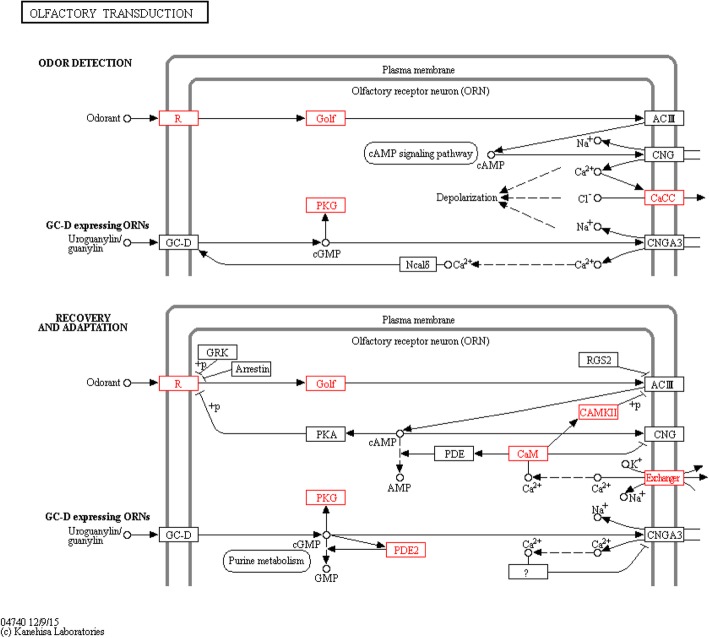
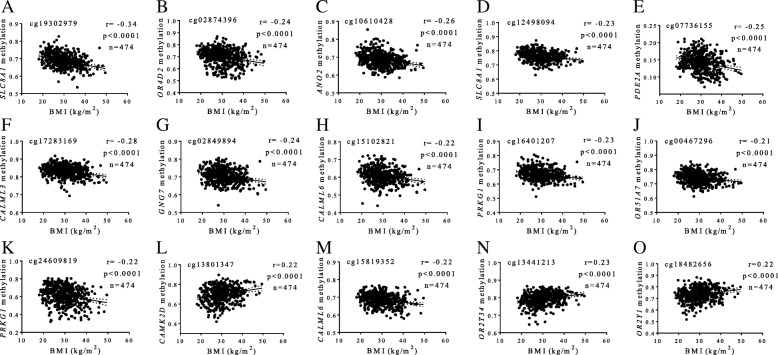
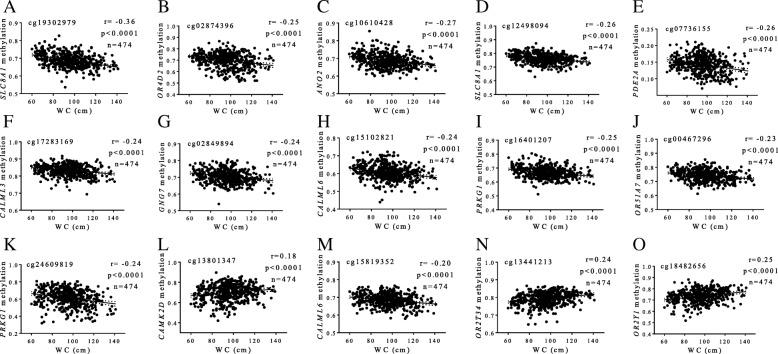
Results: Overall, 15 CpG sites at olfactory pathway genes were associated with BMI (p < 0.0001) and WC (p < 0.0001) after adjustments for potential confounding factors. Together, methylation levels at the15 CpG sites accounted for 22% and 20% of the variability in BMI and WC (r2 = 0.219, p < 0.001, and r2 = 0.204, p < 0.001, respectively). These genes encompassed olfactory receptors (OR4D2, OR51A7, OR2T34, and OR2Y1) and several downstream signaling molecules (SLC8A1, ANO2, PDE2A, CALML3, GNG7, CALML6, PRKG1, and CAMK2D), which significantly regulated odor detection and signal transduction processes within the complete olfactory cascade, as revealed by pathway enrichment analyses (p = 1.94 × 10⁻¹⁰). Moreover, OR4D2 and OR2Y1 gene methylation patterns strongly correlated with daily intakes of total energy (p < 0.0001), carbohydrates (p < 0.0001), protein (p < 0.0001), and fat (p < 0.0001).
Conclusions: The results of this study suggest novel relationships between olfactory pathway gene methylation signatures, obesity indices, and dietary intakes.



 京公网安备 11010802042870号
京ICP备2023020795号-1
京公网安备 11010802042870号
京ICP备2023020795号-1

 分享
分享

 求助内容:
求助内容: 应助结果提醒方式:
 扫码关注我们
