Darkeyah G. Reuven, H. B. Mihiri Shashikala, Sanjay Mandal, Myron N. V. Williams, Jaideep Chaudhary and Xiao-Qian Wang
{"title":"Supramolecular assembly of DNA on graphenenanoribbons","authors":"Darkeyah G. Reuven, H. B. Mihiri Shashikala, Sanjay Mandal, Myron N. V. Williams, Jaideep Chaudhary and Xiao-Qian Wang","doi":"10.1039/C3TB20397B","DOIUrl":null,"url":null,"abstract":"<p >Graphene's adhesive and charge delocalization properties offer the opportunity for the direct study of biological molecules in the nanoscale regime. The inherent charge on DNA base pairs and the associated <annref>phosphate</annref> backbone can be probed by non-covalent interactions with <annref>graphene</annref>, which is a useful platform for the creation of anisotropic nanopatterned biological assemblies. Here, we report the <annref>graphene</annref> <annref>nanoribbon</annref> (GNR) supported anisotropic supramolecular <annref>self-assembly</annref> of single stranded <compname>adenine</compname> (A), <compname>cytosine</compname> (C), <compname>guanine</compname> (G), <compname>thymine</compname> (T), AT, and <annref>GC</annref> 20mer <annref>oligonucleotides</annref>, as well as the unique ordering of double stranded plasmid (circular) and herring sperm (linear) DNA. The GNRs serve as a double sided adhesive platform for attachment to the SiO<small><sub>2</sub></small> substrate, as well as DNA oligomers and <annref>polymers</annref>. The <annref>self-assembly</annref> is attributed to donor–acceptor interactions between DNA and <annref>graphene</annref>. These findings demonstrate that the DNA–GNR assembly yields a prospective route to novel bio-relevant <annref>nanostructures</annref>.</p>","PeriodicalId":83,"journal":{"name":"Journal of Materials Chemistry B","volume":" 32","pages":" 3926-3931"},"PeriodicalIF":6.1000,"publicationDate":"2013-05-29","publicationTypes":"Journal Article","fieldsOfStudy":null,"isOpenAccess":false,"openAccessPdf":"https://sci-hub-pdf.com/10.1039/C3TB20397B","citationCount":"17","resultStr":null,"platform":"Semanticscholar","paperid":null,"PeriodicalName":"Journal of Materials Chemistry B","FirstCategoryId":"1","ListUrlMain":"https://pubs.rsc.org/en/content/articlelanding/2013/tb/c3tb20397b","RegionNum":3,"RegionCategory":"医学","ArticlePicture":[],"TitleCN":null,"AbstractTextCN":null,"PMCID":null,"EPubDate":"","PubModel":"","JCR":"Q1","JCRName":"MATERIALS SCIENCE, BIOMATERIALS","Score":null,"Total":0}
引用次数: 17
Abstract
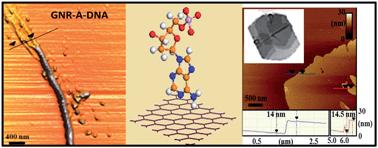
Graphene's adhesive and charge delocalization properties offer the opportunity for the direct study of biological molecules in the nanoscale regime. The inherent charge on DNA base pairs and the associated phosphate backbone can be probed by non-covalent interactions with graphene, which is a useful platform for the creation of anisotropic nanopatterned biological assemblies. Here, we report the graphenenanoribbon (GNR) supported anisotropic supramolecular self-assembly of single stranded adenine (A), cytosine (C), guanine (G), thymine (T), AT, and GC 20mer oligonucleotides, as well as the unique ordering of double stranded plasmid (circular) and herring sperm (linear) DNA. The GNRs serve as a double sided adhesive platform for attachment to the SiO2 substrate, as well as DNA oligomers and polymers. The self-assembly is attributed to donor–acceptor interactions between DNA and graphene. These findings demonstrate that the DNA–GNR assembly yields a prospective route to novel bio-relevant nanostructures.
期刊介绍:
Journal of Materials Chemistry A, B & C cover high quality studies across all fields of materials chemistry. The journals focus on those theoretical or experimental studies that report new understanding, applications, properties and synthesis of materials. Journal of Materials Chemistry A, B & C are separated by the intended application of the material studied. Broadly, applications in energy and sustainability are of interest to Journal of Materials Chemistry A, applications in biology and medicine are of interest to Journal of Materials Chemistry B, and applications in optical, magnetic and electronic devices are of interest to Journal of Materials Chemistry C.Journal of Materials Chemistry B is a Transformative Journal and Plan S compliant. Example topic areas within the scope of Journal of Materials Chemistry B are listed below. This list is neither exhaustive nor exclusive:
Antifouling coatings
Biocompatible materials
Bioelectronics
Bioimaging
Biomimetics
Biomineralisation
Bionics
Biosensors
Diagnostics
Drug delivery
Gene delivery
Immunobiology
Nanomedicine
Regenerative medicine & Tissue engineering
Scaffolds
Soft robotics
Stem cells
Therapeutic devices



 京公网安备 11010802042870号
京ICP备2023020795号-1
京公网安备 11010802042870号
京ICP备2023020795号-1

 分享
分享
 求助内容:
求助内容: 应助结果提醒方式:
 扫码关注我们
