Jeong Yeon Kim, Jun Ho Lim, Young Jin Jeong, Do-Young Kang, Kyung Won Park
{"title":"The Effect of Clinical Characteristics and Subtypes on Amyloid Positivity in Patients with Amnestic Mild Cognitive Impairment.","authors":"Jeong Yeon Kim, Jun Ho Lim, Young Jin Jeong, Do-Young Kang, Kyung Won Park","doi":"10.12779/dnd.2019.18.4.130","DOIUrl":null,"url":null,"abstract":"<p><strong>Background and purpose: </strong>Mild cognitive impairment (MCI) is a prodromal stage of dementia. Amyloid deposits in positron-emission tomography (PET) imaging of MCI patients imply a higher risk for advancing to dementia, with rates of 10%-15% yearly. The purpose of this study was to investigate the clinical characteristics of subgroups of amnestic MCI (aMCI) that may have a higher impact on amyloid positivity.</p><p><strong>Methods: </strong>We recruited 136 aMCI patients. All patients underwent a 20-minute F-18 florbetaben or flutemetamol PET scan. We classified amyloid PET images as positive or negative according to a semi-quantitative method. We evaluated the amyloid positivity of subgroups of aMCI (early vs. late type, single vs. multiple amnestic type, verbal vs. verbal, and visual amnestic type), and compared baseline clinical characteristics including key risk factors, apolipoprotein E4 (apoE4) genotype, and neuropsychological assessments with amyloid positivity in aMCI.</p><p><strong>Results: </strong>The amyloid positivity in total aMCI was 41%. The positivity rate according to subgroup of aMCI were as follow: Late aMCI (49%) vs. early aMCI (33%) (<i>p</i>=0.13), multiple aMCI (40%) vs. single aMCI (38%) (<i>p</i>=0.51), and verbal and visual aMCI (59%) vs. verbal aMCI (35%) (<i>p</i>=0.01), respectively. The mean age and the frequency of apoE4 allele of the amyloid-positive group was higher than that of the amyloid-negative group in aMCI (<i>p</i><0.01).</p><p><strong>Conclusions: </strong>We found that the amyloid positivity was related to patterns of clinical subtypes, characteristics, and risk factors in patients with aMCI.</p>","PeriodicalId":72779,"journal":{"name":"Dementia and neurocognitive disorders","volume":"18 4","pages":"130-137"},"PeriodicalIF":0.0000,"publicationDate":"2019-12-01","publicationTypes":"Journal Article","fieldsOfStudy":null,"isOpenAccess":false,"openAccessPdf":"https://ftp.ncbi.nlm.nih.gov/pub/pmc/oa_pdf/61/33/dnd-18-130.PMC6946617.pdf","citationCount":"6","resultStr":null,"platform":"Semanticscholar","paperid":null,"PeriodicalName":"Dementia and neurocognitive disorders","FirstCategoryId":"1085","ListUrlMain":"https://doi.org/10.12779/dnd.2019.18.4.130","RegionNum":0,"RegionCategory":null,"ArticlePicture":[],"TitleCN":null,"AbstractTextCN":null,"PMCID":null,"EPubDate":"2019/12/13 0:00:00","PubModel":"Epub","JCR":"","JCRName":"","Score":null,"Total":0}
引用次数: 6
Abstract
Background and purpose: Mild cognitive impairment (MCI) is a prodromal stage of dementia. Amyloid deposits in positron-emission tomography (PET) imaging of MCI patients imply a higher risk for advancing to dementia, with rates of 10%-15% yearly. The purpose of this study was to investigate the clinical characteristics of subgroups of amnestic MCI (aMCI) that may have a higher impact on amyloid positivity.
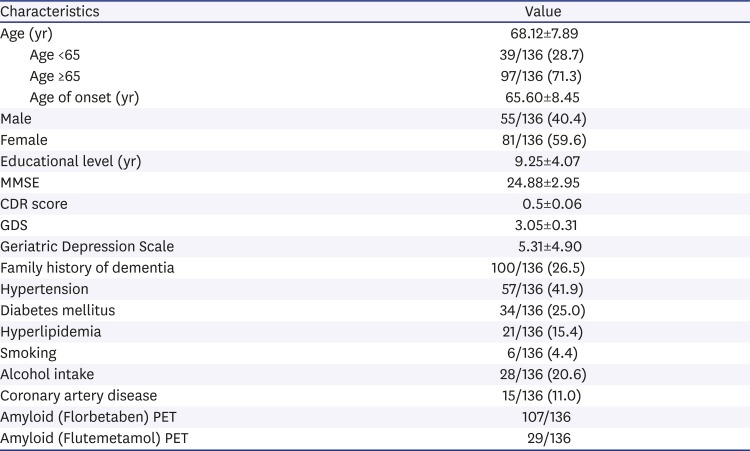
Methods: We recruited 136 aMCI patients. All patients underwent a 20-minute F-18 florbetaben or flutemetamol PET scan. We classified amyloid PET images as positive or negative according to a semi-quantitative method. We evaluated the amyloid positivity of subgroups of aMCI (early vs. late type, single vs. multiple amnestic type, verbal vs. verbal, and visual amnestic type), and compared baseline clinical characteristics including key risk factors, apolipoprotein E4 (apoE4) genotype, and neuropsychological assessments with amyloid positivity in aMCI.
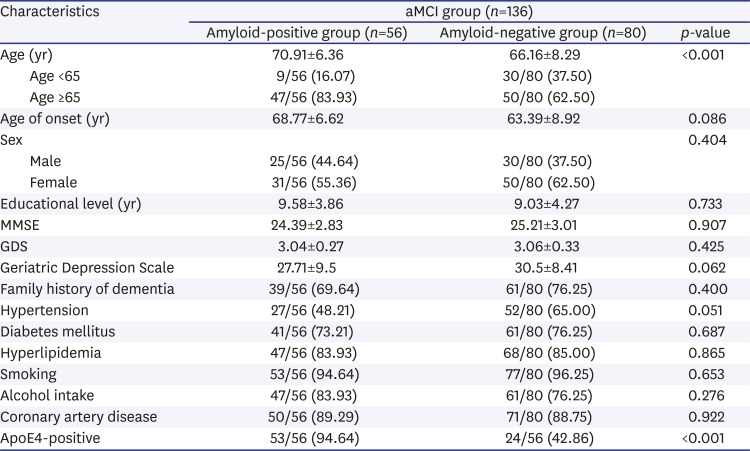
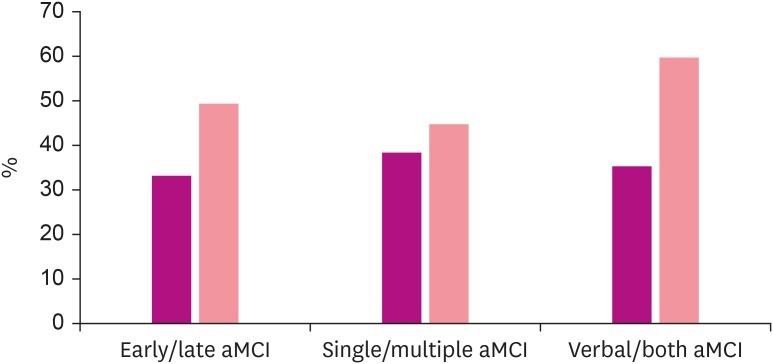
Results: The amyloid positivity in total aMCI was 41%. The positivity rate according to subgroup of aMCI were as follow: Late aMCI (49%) vs. early aMCI (33%) (p=0.13), multiple aMCI (40%) vs. single aMCI (38%) (p=0.51), and verbal and visual aMCI (59%) vs. verbal aMCI (35%) (p=0.01), respectively. The mean age and the frequency of apoE4 allele of the amyloid-positive group was higher than that of the amyloid-negative group in aMCI (p<0.01).
Conclusions: We found that the amyloid positivity was related to patterns of clinical subtypes, characteristics, and risk factors in patients with aMCI.



 京公网安备 11010802042870号
京ICP备2023020795号-1
京公网安备 11010802042870号
京ICP备2023020795号-1

 分享
分享

 求助内容:
求助内容: 应助结果提醒方式:
 扫码关注我们
