Zeyu Tian, Chun-Ko Wang, Feng-Ling Lin, Qian Liu, Ting Wang, Tzu-Cheng Sung, Abdullah A. Alarfaj, Abdurahman H. Hirad, Henry Hsin-Chung Lee, Gwo-Jang Wu and Akon Higuchi
{"title":"Effect of extracellular matrix proteins on the differentiation of human pluripotent stem cells into mesenchymal stem cells†","authors":"Zeyu Tian, Chun-Ko Wang, Feng-Ling Lin, Qian Liu, Ting Wang, Tzu-Cheng Sung, Abdullah A. Alarfaj, Abdurahman H. Hirad, Henry Hsin-Chung Lee, Gwo-Jang Wu and Akon Higuchi","doi":"10.1039/D2TB01026G","DOIUrl":null,"url":null,"abstract":"<p >The transplantation of human mesenchymal stem cells (hMSCs), such as bone marrow stem cells (BMSCs) and adipose-derived stem cells (ADSCs), has shown beneficial effects in protecting transplanted tissues and cells against graft-<em>versus</em>-host disease (GVHD). Human pluripotent stem cell (hPSC)-derived mesenchymal stem cells (MSCs) can also be used to generate hMSCs with stable characteristics without limitations. Therefore, we differentiated human induced pluripotent stem cells (hiPSCs, H-M5) and human embryonic stem cells (hESCs, H9) into hMSCs on dishes coated with different extracellular matrix (ECM) proteins to study the effect of cell culture biomaterials on hPSC differentiation into hMSCs. hPSC-derived MSCs cultured on Matrigel (MAT)-coated, collagen (COL)-coated and laminin-521 (LN-521)-coated tissue culture polystyrene (TCP) dishes showed excellent proliferation speed and reduced aging over 10 passages. High MSC surface marker (CD44, CD73, CD90 and CD105) expression was also observed on hPSC-derived MSCs cultured on MAT-coated, COL-coated and LN-521-coated TCP dishes as well as uncoated TCP dishes. Analysis of late osteogenic differentiation by evaluation of mineral deposition revealed that hPSC-derived MSCs cultured on fibronectin (FN)-coated and LN-521-coated TCP dishes showed high osteogenic differentiation. ECM proteins are effective as coating materials on cell culture biomaterials to regulate the proliferation and differentiation fate of hPSC-derived MSCs.</p>","PeriodicalId":83,"journal":{"name":"Journal of Materials Chemistry B","volume":" 30","pages":" 5723-5732"},"PeriodicalIF":6.1000,"publicationDate":"2022-06-06","publicationTypes":"Journal Article","fieldsOfStudy":null,"isOpenAccess":false,"openAccessPdf":"","citationCount":"2","resultStr":null,"platform":"Semanticscholar","paperid":null,"PeriodicalName":"Journal of Materials Chemistry B","FirstCategoryId":"1","ListUrlMain":"https://pubs.rsc.org/en/content/articlelanding/2022/tb/d2tb01026g","RegionNum":3,"RegionCategory":"医学","ArticlePicture":[],"TitleCN":null,"AbstractTextCN":null,"PMCID":null,"EPubDate":"","PubModel":"","JCR":"Q1","JCRName":"MATERIALS SCIENCE, BIOMATERIALS","Score":null,"Total":0}
引用次数: 2
Abstract
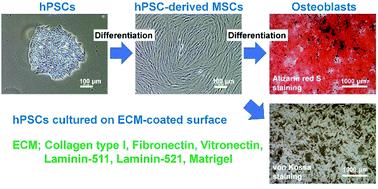
The transplantation of human mesenchymal stem cells (hMSCs), such as bone marrow stem cells (BMSCs) and adipose-derived stem cells (ADSCs), has shown beneficial effects in protecting transplanted tissues and cells against graft-versus-host disease (GVHD). Human pluripotent stem cell (hPSC)-derived mesenchymal stem cells (MSCs) can also be used to generate hMSCs with stable characteristics without limitations. Therefore, we differentiated human induced pluripotent stem cells (hiPSCs, H-M5) and human embryonic stem cells (hESCs, H9) into hMSCs on dishes coated with different extracellular matrix (ECM) proteins to study the effect of cell culture biomaterials on hPSC differentiation into hMSCs. hPSC-derived MSCs cultured on Matrigel (MAT)-coated, collagen (COL)-coated and laminin-521 (LN-521)-coated tissue culture polystyrene (TCP) dishes showed excellent proliferation speed and reduced aging over 10 passages. High MSC surface marker (CD44, CD73, CD90 and CD105) expression was also observed on hPSC-derived MSCs cultured on MAT-coated, COL-coated and LN-521-coated TCP dishes as well as uncoated TCP dishes. Analysis of late osteogenic differentiation by evaluation of mineral deposition revealed that hPSC-derived MSCs cultured on fibronectin (FN)-coated and LN-521-coated TCP dishes showed high osteogenic differentiation. ECM proteins are effective as coating materials on cell culture biomaterials to regulate the proliferation and differentiation fate of hPSC-derived MSCs.
期刊介绍:
Journal of Materials Chemistry A, B & C cover high quality studies across all fields of materials chemistry. The journals focus on those theoretical or experimental studies that report new understanding, applications, properties and synthesis of materials. Journal of Materials Chemistry A, B & C are separated by the intended application of the material studied. Broadly, applications in energy and sustainability are of interest to Journal of Materials Chemistry A, applications in biology and medicine are of interest to Journal of Materials Chemistry B, and applications in optical, magnetic and electronic devices are of interest to Journal of Materials Chemistry C.Journal of Materials Chemistry B is a Transformative Journal and Plan S compliant. Example topic areas within the scope of Journal of Materials Chemistry B are listed below. This list is neither exhaustive nor exclusive:
Antifouling coatings
Biocompatible materials
Bioelectronics
Bioimaging
Biomimetics
Biomineralisation
Bionics
Biosensors
Diagnostics
Drug delivery
Gene delivery
Immunobiology
Nanomedicine
Regenerative medicine & Tissue engineering
Scaffolds
Soft robotics
Stem cells
Therapeutic devices



 京公网安备 11010802042870号
京ICP备2023020795号-1
京公网安备 11010802042870号
京ICP备2023020795号-1

 分享
分享
 求助内容:
求助内容: 应助结果提醒方式:
 扫码关注我们
