{"title":"Incidence of and risk factors for postoperative delirium in older adult patients undergoing noncardiac surgery: a prospective study.","authors":"Arissara Iamaroon, Titima Wongviriyawong, Patumporn Sura-Arunsumrit, Nattikan Wiwatnodom, Nichakarn Rewuri, Onuma Chaiwat","doi":"10.1186/s12877-020-1449-8","DOIUrl":null,"url":null,"abstract":"<p><strong>Background: </strong>To identify the incidence of, risk factors for, and outcomes associated with postoperative delirium (POD) in older adult patients who underwent noncardiac surgery.</p><p><strong>Methods: </strong>This prospective study recruited patients aged ≥ 60 years who were scheduled to undergo noncardiac surgery at Siriraj Hospital (Bangkok, Thailand). Functional and cognitive statuses were assessed preoperatively using Barthel Index (BI) and the modified Informant Questionnaire on Cognitive Decline in the Elderly, respectively. POD was diagnosed based on the Diagnostic and Statistical Manual of Mental Disorders Fifth Edition criteria. Incidence of POD was reported. Univariate and multivariate analyses were used to identify risk factors for POD.</p><p><strong>Results: </strong>Of the 249 included patients, 29 (11.6%) developed POD. Most patients (61.3%) developed delirium on postoperative day 1. Univariate analysis showed age ≥ 75 years, BI score ≤ 70, pre-existing dementia, preoperative use of opioid or benzodiazepine, preoperative infection, and hematocrit < 30% to be significantly associated with POD. Multivariate logistic analysis revealed pre-existing dementia (adjusted risk ratio [RR]: 3.95, 95% confidence interval [CI]: 1.91-8.17; p < 0.001) and age ≥ 75 years (adjusted RR: 2.54, 95% CI: 1.11-5.80; p = 0.027) to be independent risk factors for POD. Median length of hospital stay was 10 (range: 3-36) days for patients with POD versus 6 (range: 2-76) days for those without delirium (p < 0.001).</p><p><strong>Conclusions: </strong>POD remains a common surgical complication, with an incidence of 11.6%. Patients with pre-existing dementia and age ≥ 75 years are the most vulnerable high-risk group. A multidisciplinary team consisting of anesthesiologists and geriatricians should implement perioperative care to prevent and manage POD.</p>","PeriodicalId":9056,"journal":{"name":"BMC Geriatrics","volume":" ","pages":"40"},"PeriodicalIF":3.8000,"publicationDate":"2020-02-03","publicationTypes":"Journal Article","fieldsOfStudy":null,"isOpenAccess":false,"openAccessPdf":"https://sci-hub-pdf.com/10.1186/s12877-020-1449-8","citationCount":"43","resultStr":null,"platform":"Semanticscholar","paperid":null,"PeriodicalName":"BMC Geriatrics","FirstCategoryId":"3","ListUrlMain":"https://doi.org/10.1186/s12877-020-1449-8","RegionNum":2,"RegionCategory":"医学","ArticlePicture":[],"TitleCN":null,"AbstractTextCN":null,"PMCID":null,"EPubDate":"","PubModel":"","JCR":"Q2","JCRName":"GERIATRICS & GERONTOLOGY","Score":null,"Total":0}
引用次数: 43
Abstract
Background: To identify the incidence of, risk factors for, and outcomes associated with postoperative delirium (POD) in older adult patients who underwent noncardiac surgery.
Methods: This prospective study recruited patients aged ≥ 60 years who were scheduled to undergo noncardiac surgery at Siriraj Hospital (Bangkok, Thailand). Functional and cognitive statuses were assessed preoperatively using Barthel Index (BI) and the modified Informant Questionnaire on Cognitive Decline in the Elderly, respectively. POD was diagnosed based on the Diagnostic and Statistical Manual of Mental Disorders Fifth Edition criteria. Incidence of POD was reported. Univariate and multivariate analyses were used to identify risk factors for POD.
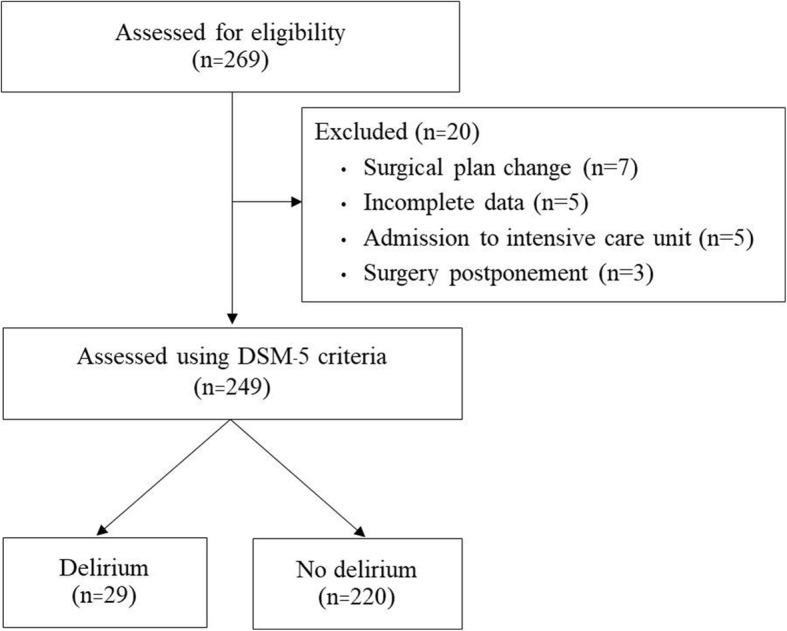
Results: Of the 249 included patients, 29 (11.6%) developed POD. Most patients (61.3%) developed delirium on postoperative day 1. Univariate analysis showed age ≥ 75 years, BI score ≤ 70, pre-existing dementia, preoperative use of opioid or benzodiazepine, preoperative infection, and hematocrit < 30% to be significantly associated with POD. Multivariate logistic analysis revealed pre-existing dementia (adjusted risk ratio [RR]: 3.95, 95% confidence interval [CI]: 1.91-8.17; p < 0.001) and age ≥ 75 years (adjusted RR: 2.54, 95% CI: 1.11-5.80; p = 0.027) to be independent risk factors for POD. Median length of hospital stay was 10 (range: 3-36) days for patients with POD versus 6 (range: 2-76) days for those without delirium (p < 0.001).
Conclusions: POD remains a common surgical complication, with an incidence of 11.6%. Patients with pre-existing dementia and age ≥ 75 years are the most vulnerable high-risk group. A multidisciplinary team consisting of anesthesiologists and geriatricians should implement perioperative care to prevent and manage POD.
背景:确定非心脏手术老年患者术后谵妄(POD)的发生率、危险因素和相关结局。方法:这项前瞻性研究招募年龄≥60岁的患者,这些患者计划在Siriraj医院(泰国曼谷)接受非心脏手术。术前分别采用Barthel指数(BI)和改进后的老年人认知能力下降问卷(inform Questionnaire on cognitive Decline in Elderly)评估功能和认知状态。根据精神障碍诊断与统计手册第五版标准诊断POD。报告了POD的发病率。采用单因素和多因素分析来确定POD的危险因素。结果:249例患者中,29例(11.6%)发生POD。大多数患者(61.3%)在术后第1天出现谵妄。单因素分析显示年龄≥75岁,BI评分≤70,既往存在痴呆,术前使用阿片类药物或苯二氮卓类药物,术前感染和红细胞压比。结论:POD仍然是一种常见的手术并发症,发生率为11.6%。已存在痴呆且年龄≥75岁的患者是最脆弱的高危人群。由麻醉医师和老年医师组成的多学科团队应实施围手术期护理,以预防和管理POD。
期刊介绍:
BMC Geriatrics is an open access journal publishing original peer-reviewed research articles in all aspects of the health and healthcare of older people, including the effects of healthcare systems and policies. The journal also welcomes research focused on the aging process, including cellular, genetic, and physiological processes and cognitive modifications.




 京公网安备 11010802042870号
京ICP备2023020795号-1
京公网安备 11010802042870号
京ICP备2023020795号-1

 分享
分享
 求助内容:
求助内容: 应助结果提醒方式:
 扫码关注我们
