Molecular mechanisms of cold pain

Q2 Medicine Neurobiology of Pain Pub Date : 2020-01-01 DOI:10.1016/j.ynpai.2020.100044
Donald Iain MacDonald , John N. Wood, Edward C. Emery
{"title":"Molecular mechanisms of cold pain","authors":"Donald Iain MacDonald ,&nbsp;John N. Wood,&nbsp;Edward C. Emery","doi":"10.1016/j.ynpai.2020.100044","DOIUrl":null,"url":null,"abstract":"<div><p>The sensation of cooling is essential for survival. Extreme cold is a noxious stimulus that drives protective behaviour and that we thus perceive as pain. However, chronic pain patients suffering from cold allodynia paradoxically experience innocuous cooling as excruciating pain. Peripheral sensory neurons that detect decreasing temperature express numerous cold-sensitive and voltage-gated ion channels that govern their response to cooling in health and disease. In this review, we discuss how these ion channels control the sense of cooling and cold pain under physiological conditions, before focusing on the molecular mechanisms by which ion channels can trigger pathological cold pain. With the ever-rising number of patients burdened by chronic pain, we end by highlighting the pressing need to define the cells and molecules involved in cold allodynia and so identify new, rational drug targets for the analgesic treatment of cold pain.</p></div>","PeriodicalId":52177,"journal":{"name":"Neurobiology of Pain","volume":"7 ","pages":"Article 100044"},"PeriodicalIF":0.0000,"publicationDate":"2020-01-01","publicationTypes":"Journal Article","fieldsOfStudy":null,"isOpenAccess":false,"openAccessPdf":"https://sci-hub-pdf.com/10.1016/j.ynpai.2020.100044","citationCount":"32","resultStr":null,"platform":"Semanticscholar","paperid":null,"PeriodicalName":"Neurobiology of Pain","FirstCategoryId":"1085","ListUrlMain":"https://www.sciencedirect.com/science/article/pii/S2452073X20300027","RegionNum":0,"RegionCategory":null,"ArticlePicture":[],"TitleCN":null,"AbstractTextCN":null,"PMCID":null,"EPubDate":"","PubModel":"","JCR":"Q2","JCRName":"Medicine","Score":null,"Total":0}
引用次数: 32

Abstract

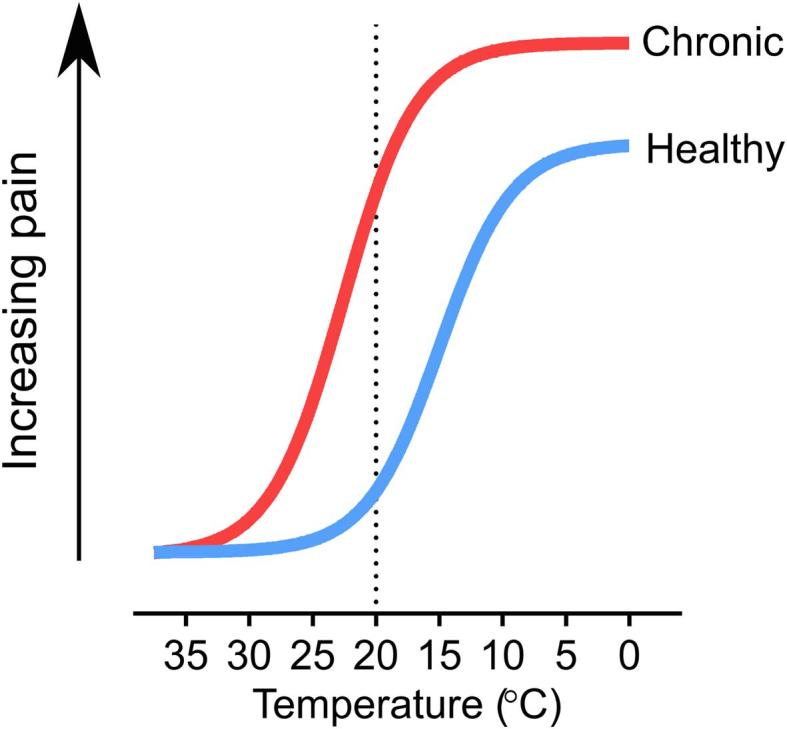
The sensation of cooling is essential for survival. Extreme cold is a noxious stimulus that drives protective behaviour and that we thus perceive as pain. However, chronic pain patients suffering from cold allodynia paradoxically experience innocuous cooling as excruciating pain. Peripheral sensory neurons that detect decreasing temperature express numerous cold-sensitive and voltage-gated ion channels that govern their response to cooling in health and disease. In this review, we discuss how these ion channels control the sense of cooling and cold pain under physiological conditions, before focusing on the molecular mechanisms by which ion channels can trigger pathological cold pain. With the ever-rising number of patients burdened by chronic pain, we end by highlighting the pressing need to define the cells and molecules involved in cold allodynia and so identify new, rational drug targets for the analgesic treatment of cold pain.
Abstract Image

Abstract Image

Abstract Image

查看原文
分享 分享
微信好友 朋友圈 QQ好友 复制链接
本刊更多论文
冷痛的分子机制
冷却的感觉是生存所必需的。极度寒冷是一种有害的刺激,它会驱动保护行为,因此我们将其视为疼痛。然而,慢性疼痛患者遭受冷异常性疼痛矛盾地经历无害的冷却作为痛苦的疼痛。感知温度下降的外周感觉神经元表达许多冷敏感和电压门控离子通道,这些通道控制着它们在健康和疾病中对冷却的反应。在这篇综述中,我们讨论了这些离子通道如何在生理条件下控制冷感和冷痛,然后重点讨论了离子通道触发病理性冷痛的分子机制。随着慢性疼痛患者数量的不断增加,我们最后强调了迫切需要确定参与冷异常性疼痛的细胞和分子,从而确定新的、合理的冷痛镇痛药物靶点。
本文章由计算机程序翻译,如有差异,请以英文原文为准。
求助全文
约1分钟内获得全文 去求助
来源期刊
Neurobiology of Pain
Neurobiology of Pain Medicine-Anesthesiology and Pain Medicine
CiteScore
4.40
自引率
0.00%
发文量
29
审稿时长
54 days
期刊最新文献
NGF stimulation alters the transcriptome and surface TrkB expression in axons of dorsal root ganglion neurons. ASIC1a-associated mechanical hypersensitivity in the GlaKO Fabry disease mouse model Neuronal physiology of amygdala neurons in the context of injury and pain Circulating microRNAs differentiate nociceptive and nociplastic pain: An exploratory study A non-toxic analgesic elicits cell-specific genomic and epigenomic modulation by targeting the PAG brain region
×
引用
GB/T 7714-2015
复制
MLA
复制
APA
复制
导出至
BibTeX EndNote RefMan NoteFirst NoteExpress
×
×
提示
您的信息不完整,为了账户安全,请先补充。
现在去补充
×
提示
您因"违规操作"
具体请查看互助需知
我知道了
×
提示
现在去查看 取消
×
提示
确定
0
微信
客服QQ
Book学术公众号 扫码关注我们
反馈
×
意见反馈
请填写您的意见或建议
请填写您的手机或邮箱
已复制链接
已复制链接
快去分享给好友吧!
我知道了
×
扫码分享
扫码分享
Book学术官方微信
Book学术文献互助
Book学术文献互助群
群 号:604180095
Book学术
文献互助 智能选刊 最新文献 互助须知 联系我们:info@booksci.cn
Book学术提供免费学术资源搜索服务,方便国内外学者检索中英文文献。致力于提供最便捷和优质的服务体验。
Copyright © 2023 Book学术 All rights reserved.
ghs 京公网安备 11010802042870号 京ICP备2023020795号-1