{"title":"Antidiabetic Drugs for the Risk of Alzheimer Disease in Patients With Type 2 DM Using FAERS.","authors":"Hayato Akimoto, Akio Negishi, Shinji Oshima, Haruna Wakiyama, Mitsuyoshi Okita, Norimitsu Horii, Naoko Inoue, Shigeru Ohshima, Daisuke Kobayashi","doi":"10.1177/1533317519899546","DOIUrl":null,"url":null,"abstract":"<p><p>Alzheimer disease (AD) may develop after the onset of type 2 diabetes mellitus (T2DM), and the risk of AD may depend on the antidiabetic drug administered. We compared the risk of AD among 66 085 patients (≥ 65 years) with T2DM (1250 having concomitant AD) who had been administered antidiabetic drug monotherapy for T2DM who had voluntarily reported themselves in the Food and Drug Administration Adverse Event Reporting System. The risk of AD from the use of different antidiabetic drug monotherapies compared to that of metformin monotherapy was assessed by logistic regression. Rosiglitazone (adjusted reporting odds ratio [aROR] = 0.11; 95% confidence interval [CI]: 0.07-0.17; <i>P</i> < .001), exenatide (aROR = 0.22; 95% CI: 0.11-0.37; <i>P</i> < .001), liraglutide (aROR = 0.36; 95% CI: 0.19-0.62; <i>P</i> < .001), dulaglutide (aROR = 0.39; 95% CI: 0.17-0.77; <i>P</i> = .014), and sitagliptin (aROR = 0.75; 95% CI: 0.60-0.93; <i>P</i> = .011) were found to have a significantly lower associated risk of AD than that of metformin. Therefore, the administration of glucagon-like peptide 1 receptor agonists and rosiglitazone may reduce the risk of AD in patients with T2DM.</p>","PeriodicalId":2,"journal":{"name":"ACS Applied Bio Materials","volume":" ","pages":"1533317519899546"},"PeriodicalIF":4.7000,"publicationDate":"2020-01-01","publicationTypes":"Journal Article","fieldsOfStudy":null,"isOpenAccess":false,"openAccessPdf":"https://www.ncbi.nlm.nih.gov/pmc/articles/PMC11005324/pdf/","citationCount":"0","resultStr":null,"platform":"Semanticscholar","paperid":null,"PeriodicalName":"ACS Applied Bio Materials","FirstCategoryId":"3","ListUrlMain":"https://doi.org/10.1177/1533317519899546","RegionNum":0,"RegionCategory":null,"ArticlePicture":[],"TitleCN":null,"AbstractTextCN":null,"PMCID":null,"EPubDate":"","PubModel":"","JCR":"Q2","JCRName":"MATERIALS SCIENCE, BIOMATERIALS","Score":null,"Total":0}
引用次数: 0
Abstract
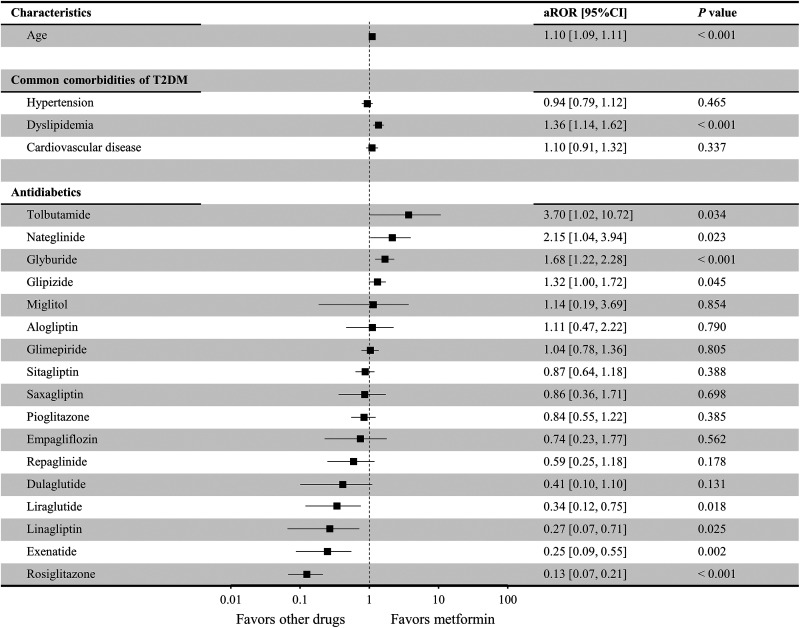
Alzheimer disease (AD) may develop after the onset of type 2 diabetes mellitus (T2DM), and the risk of AD may depend on the antidiabetic drug administered. We compared the risk of AD among 66 085 patients (≥ 65 years) with T2DM (1250 having concomitant AD) who had been administered antidiabetic drug monotherapy for T2DM who had voluntarily reported themselves in the Food and Drug Administration Adverse Event Reporting System. The risk of AD from the use of different antidiabetic drug monotherapies compared to that of metformin monotherapy was assessed by logistic regression. Rosiglitazone (adjusted reporting odds ratio [aROR] = 0.11; 95% confidence interval [CI]: 0.07-0.17; P < .001), exenatide (aROR = 0.22; 95% CI: 0.11-0.37; P < .001), liraglutide (aROR = 0.36; 95% CI: 0.19-0.62; P < .001), dulaglutide (aROR = 0.39; 95% CI: 0.17-0.77; P = .014), and sitagliptin (aROR = 0.75; 95% CI: 0.60-0.93; P = .011) were found to have a significantly lower associated risk of AD than that of metformin. Therefore, the administration of glucagon-like peptide 1 receptor agonists and rosiglitazone may reduce the risk of AD in patients with T2DM.
期刊介绍:
ACS Applied Bio Materials is an interdisciplinary journal publishing original research covering all aspects of biomaterials and biointerfaces including and beyond the traditional biosensing, biomedical and therapeutic applications.
The journal is devoted to reports of new and original experimental and theoretical research of an applied nature that integrates knowledge in the areas of materials, engineering, physics, bioscience, and chemistry into important bio applications. The journal is specifically interested in work that addresses the relationship between structure and function and assesses the stability and degradation of materials under relevant environmental and biological conditions.






 京公网安备 11010802042870号
京ICP备2023020795号-1
京公网安备 11010802042870号
京ICP备2023020795号-1

 分享
分享
 求助内容:
求助内容: 应助结果提醒方式:
 扫码关注我们
