Urolithin a attenuates IL-1β-induced inflammatory responses and cartilage degradation via inhibiting the MAPK/NF-κB signaling pathways in rat articular chondrocytes.
{"title":"Urolithin a attenuates IL-1β-induced inflammatory responses and cartilage degradation via inhibiting the MAPK/NF-κB signaling pathways in rat articular chondrocytes.","authors":"Sheng-Long Ding, Zhi-Ying Pang, Xue-Mei Chen, Zheng Li, Xin-Xin Liu, Qi-Lin Zhai, Jun-Ming Huang, Zhi-Yong Ruan","doi":"10.1186/s12950-020-00242-8","DOIUrl":null,"url":null,"abstract":"<p><strong>Background: </strong>Osteoarthritis (OA) is characterized by inflammation and extracellular matrix (ECM) degradation and is one of the most common chronic degenerative joint diseases that causes pain and disability in adults. Urolithin A (UA) has been widely reported for its anti-inflammatory properties in several chronic diseases. However, the effects of UA on OA remain unclear. The aim of the current study was to investigate the anti-inflammatory effects and mechanism of UA in interleukin-1β (IL-1β)-induced chondrocytes.</p><p><strong>Results: </strong>No marked UA cytotoxicity was noted, and UA protected cartilage from damage following IL-1β stimulation in micromasses. Moreover, UA promoted the expression of anabolic factors including Sox-9, Collagen II, and Aggrecan while inhibiting the expression of catabolic factors such as matrix metalloproteinases (MMPs) and a disintegrin and metalloproteinase with thrombospondin motifs 4 (ADAMTS-4) in rat chondrocytes. Protective effects of UA were also observed in ex vivo organ culture of articular cartilage. Mechanistically, IL-1β significantly activated and upregulated the expression of p-ERK 1/2, p-JNK, p-P38, and p-P65, while UA protected chondrocytes against IL-1β-induced injury by activating the mitogen-activated kinase (MAPK)/nuclear factor-κB (NF-κB) signaling pathways.</p><p><strong>Conclusion: </strong>Our results provide the evidence that UA could attenuate IL-1β-induced cell injury in chondrocytes via its anti-inflammatory action. UA may be a promising therapeutic agent in the treatment of OA.</p>","PeriodicalId":56120,"journal":{"name":"Journal of Inflammation-London","volume":"17 ","pages":"13"},"PeriodicalIF":4.1000,"publicationDate":"2020-03-24","publicationTypes":"Journal Article","fieldsOfStudy":null,"isOpenAccess":false,"openAccessPdf":"https://sci-hub-pdf.com/10.1186/s12950-020-00242-8","citationCount":"42","resultStr":null,"platform":"Semanticscholar","paperid":null,"PeriodicalName":"Journal of Inflammation-London","FirstCategoryId":"3","ListUrlMain":"https://doi.org/10.1186/s12950-020-00242-8","RegionNum":3,"RegionCategory":"医学","ArticlePicture":[],"TitleCN":null,"AbstractTextCN":null,"PMCID":null,"EPubDate":"2020/1/1 0:00:00","PubModel":"eCollection","JCR":"Q2","JCRName":"IMMUNOLOGY","Score":null,"Total":0}
引用次数: 42
Abstract
Background: Osteoarthritis (OA) is characterized by inflammation and extracellular matrix (ECM) degradation and is one of the most common chronic degenerative joint diseases that causes pain and disability in adults. Urolithin A (UA) has been widely reported for its anti-inflammatory properties in several chronic diseases. However, the effects of UA on OA remain unclear. The aim of the current study was to investigate the anti-inflammatory effects and mechanism of UA in interleukin-1β (IL-1β)-induced chondrocytes.
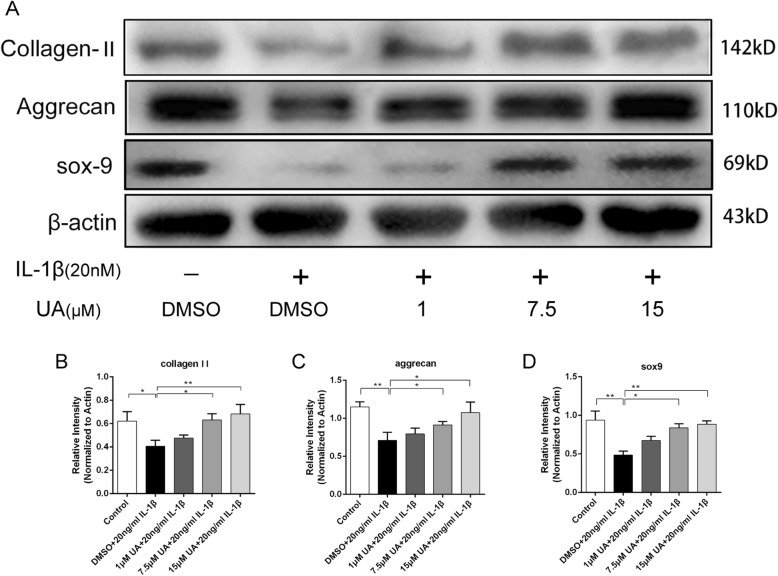
Results: No marked UA cytotoxicity was noted, and UA protected cartilage from damage following IL-1β stimulation in micromasses. Moreover, UA promoted the expression of anabolic factors including Sox-9, Collagen II, and Aggrecan while inhibiting the expression of catabolic factors such as matrix metalloproteinases (MMPs) and a disintegrin and metalloproteinase with thrombospondin motifs 4 (ADAMTS-4) in rat chondrocytes. Protective effects of UA were also observed in ex vivo organ culture of articular cartilage. Mechanistically, IL-1β significantly activated and upregulated the expression of p-ERK 1/2, p-JNK, p-P38, and p-P65, while UA protected chondrocytes against IL-1β-induced injury by activating the mitogen-activated kinase (MAPK)/nuclear factor-κB (NF-κB) signaling pathways.
Conclusion: Our results provide the evidence that UA could attenuate IL-1β-induced cell injury in chondrocytes via its anti-inflammatory action. UA may be a promising therapeutic agent in the treatment of OA.
期刊介绍:
Journal of Inflammation welcomes research submissions on all aspects of inflammation.
The five classical symptoms of inflammation, namely redness (rubor), swelling (tumour), heat (calor), pain (dolor) and loss of function (functio laesa), are only part of the story. The term inflammation is taken to include the full range of underlying cellular and molecular mechanisms involved, not only in the production of the inflammatory responses but, more importantly in clinical terms, in the healing process as well. Thus the journal covers molecular, cellular, animal and clinical studies, and related aspects of pharmacology, such as anti-inflammatory drug development, trials and therapeutic developments. It also considers publication of negative findings.
Journal of Inflammation aims to become the leading online journal on inflammation and, as online journals replace printed ones over the next decade, the main open access inflammation journal. Open access guarantees a larger audience, and thus impact, than any restricted access equivalent, and increasingly so, as the escalating costs of printed journals puts them outside University budgets. The unrestricted access to research findings in inflammation aids in promoting dynamic and productive dialogue between industrial and academic members of the inflammation research community, which plays such an important part in the development of future generations of anti-inflammatory therapies.





 京公网安备 11010802042870号
京ICP备2023020795号-1
京公网安备 11010802042870号
京ICP备2023020795号-1

 分享
分享
 求助内容:
求助内容: 应助结果提醒方式:
 扫码关注我们
