Oscar Campuzano, Georgia Sarquella-Brugada, Anna Fernandez-Falgueras, Mónica Coll, Anna Iglesias, Carles Ferrer-Costa, Sergi Cesar, Elena Arbelo, Ana García-Álvarez, Paloma Jordà, Rocío Toro, Coloma Tiron de Llano, Simone Grassi, Antonio Oliva, Josep Brugada, Ramon Brugada
{"title":"Reanalysis and reclassification of rare genetic variants associated with inherited arrhythmogenic syndromes.","authors":"Oscar Campuzano, Georgia Sarquella-Brugada, Anna Fernandez-Falgueras, Mónica Coll, Anna Iglesias, Carles Ferrer-Costa, Sergi Cesar, Elena Arbelo, Ana García-Álvarez, Paloma Jordà, Rocío Toro, Coloma Tiron de Llano, Simone Grassi, Antonio Oliva, Josep Brugada, Ramon Brugada","doi":"10.1016/j.ebiom.2020.102732","DOIUrl":null,"url":null,"abstract":"<p><strong>Background: </strong>Accurate interpretation of rare genetic variants is a challenge for clinical translation. Updates in recommendations for rare variant classification require the reanalysis and reclassification. We aim to perform an exhaustive re-analysis of rare variants associated with inherited arrhythmogenic syndromes, which were classified ten years ago, to determine whether their classification aligns with current standards and research findings.</p><p><strong>Methods: </strong>In 2010, the rare variants identified through genetic analysis were classified following recommendations available at that time. Nowadays, the same variants have been reclassified following current American College of Medical Genetics and Genomics recommendations.</p><p><strong>Findings: </strong>Our cohort included 104 cases diagnosed with inherited arrhythmogenic syndromes and 17 post-mortem cases in which inherited arrhythmogenic syndromes was cause of death. 71.87% of variants change their classification. While 65.62% of variants were classified as likely pathogenic in 2010, after reanalysis, only 17.96% remain as likely pathogenic. In 2010, 18.75% of variants were classified as uncertain role but nowadays 60.15% of variants are classified of unknown significance.</p><p><strong>Interpretation: </strong>Reclassification occurred in more than 70% of rare variants associated with inherited arrhythmogenic syndromes. Our results support the periodical reclassification and personalized clinical translation of rare variants to improve diagnosis and adjust treatment.</p><p><strong>Funding: </strong>Obra Social \"La Caixa Foundation\" (ID 100010434, LCF/PR/GN16/50290001 and LCF/PR/GN19/50320002), Fondo Investigacion Sanitaria (FIS PI16/01203 and FIS, PI17/01690), Sociedad Española de Cardiología, and \"Fundacio Privada Daniel Bravo Andreu\".</p>","PeriodicalId":11494,"journal":{"name":"EBioMedicine","volume":" ","pages":"102732"},"PeriodicalIF":10.8000,"publicationDate":"2020-04-01","publicationTypes":"Journal Article","fieldsOfStudy":null,"isOpenAccess":false,"openAccessPdf":"https://sci-hub-pdf.com/10.1016/j.ebiom.2020.102732","citationCount":"44","resultStr":null,"platform":"Semanticscholar","paperid":null,"PeriodicalName":"EBioMedicine","FirstCategoryId":"3","ListUrlMain":"https://doi.org/10.1016/j.ebiom.2020.102732","RegionNum":1,"RegionCategory":"医学","ArticlePicture":[],"TitleCN":null,"AbstractTextCN":null,"PMCID":null,"EPubDate":"2020/4/5 0:00:00","PubModel":"Epub","JCR":"Q1","JCRName":"MEDICINE, RESEARCH & EXPERIMENTAL","Score":null,"Total":0}
引用次数: 44
Abstract
Background: Accurate interpretation of rare genetic variants is a challenge for clinical translation. Updates in recommendations for rare variant classification require the reanalysis and reclassification. We aim to perform an exhaustive re-analysis of rare variants associated with inherited arrhythmogenic syndromes, which were classified ten years ago, to determine whether their classification aligns with current standards and research findings.
Methods: In 2010, the rare variants identified through genetic analysis were classified following recommendations available at that time. Nowadays, the same variants have been reclassified following current American College of Medical Genetics and Genomics recommendations.
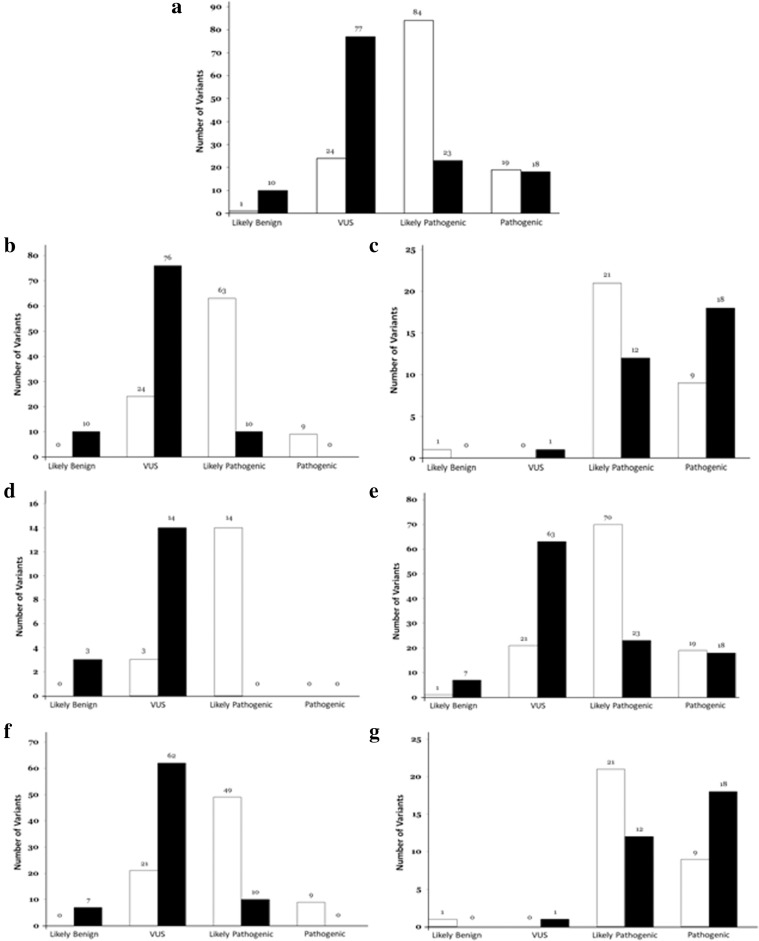
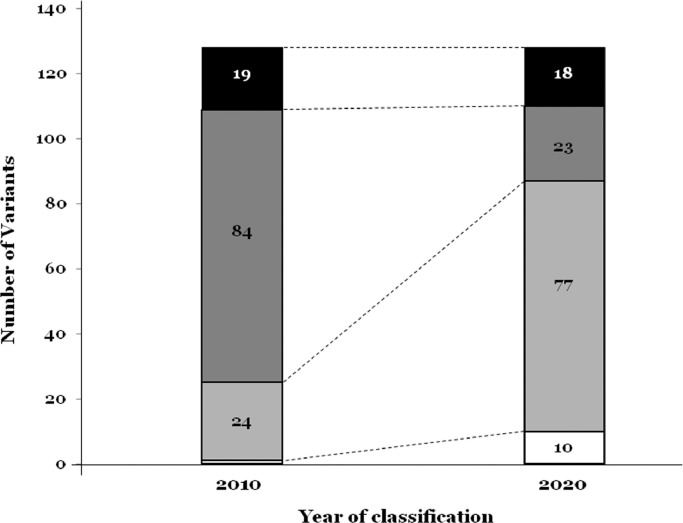
Findings: Our cohort included 104 cases diagnosed with inherited arrhythmogenic syndromes and 17 post-mortem cases in which inherited arrhythmogenic syndromes was cause of death. 71.87% of variants change their classification. While 65.62% of variants were classified as likely pathogenic in 2010, after reanalysis, only 17.96% remain as likely pathogenic. In 2010, 18.75% of variants were classified as uncertain role but nowadays 60.15% of variants are classified of unknown significance.
Interpretation: Reclassification occurred in more than 70% of rare variants associated with inherited arrhythmogenic syndromes. Our results support the periodical reclassification and personalized clinical translation of rare variants to improve diagnosis and adjust treatment.
Funding: Obra Social "La Caixa Foundation" (ID 100010434, LCF/PR/GN16/50290001 and LCF/PR/GN19/50320002), Fondo Investigacion Sanitaria (FIS PI16/01203 and FIS, PI17/01690), Sociedad Española de Cardiología, and "Fundacio Privada Daniel Bravo Andreu".
背景:罕见基因变异的准确解释是临床翻译的一个挑战。罕见变异分类建议的更新需要重新分析和重新分类。我们的目标是对10年前分类的与遗传性心律失常综合征相关的罕见变异进行详尽的重新分析,以确定它们的分类是否与当前的标准和研究结果一致。方法:2010年,通过遗传分析发现的罕见变异按照当时可用的建议进行分类。如今,相同的变异已按照目前美国医学遗传学和基因组学学院的建议重新分类。研究结果:我们的队列包括104例诊断为遗传性心律失常综合征的病例和17例死后因遗传性心律失常综合征死亡的病例。71.87%的变异改变了它们的分类。2010年,65.62%的变异被归类为可能致病,但经过重新分析,只有17.96%的变异仍然可能致病。2010年,18.75%的变异被归类为不确定作用,而现在60.15%的变异被归类为未知意义。解释:70%以上与遗传性心律失常综合征相关的罕见变异发生重分类。我们的研究结果支持罕见变异的定期重新分类和个性化的临床翻译,以提高诊断和调整治疗。资助:Obra Social“La Caixa基金会”(ID 100010434, LCF/PR/GN16/50290001和LCF/PR/GN19/50320002), Fondo investigation Sanitaria (FIS PI16/01203和FIS, PI17/01690), Sociedad Española de Cardiología和“Fundacio Privada Daniel Bravo Andreu”。
EBioMedicineBiochemistry, Genetics and Molecular Biology-General Biochemistry,Genetics and Molecular Biology
CiteScore
17.70
自引率
0.90%
发文量
579
审稿时长
5 weeks
期刊介绍:
eBioMedicine is a comprehensive biomedical research journal that covers a wide range of studies that are relevant to human health. Our focus is on original research that explores the fundamental factors influencing human health and disease, including the discovery of new therapeutic targets and treatments, the identification of biomarkers and diagnostic tools, and the investigation and modification of disease pathways and mechanisms. We welcome studies from any biomedical discipline that contribute to our understanding of disease and aim to improve human health.



 京公网安备 11010802042870号
京ICP备2023020795号-1
京公网安备 11010802042870号
京ICP备2023020795号-1

 分享
分享
 求助内容:
求助内容: 应助结果提醒方式:
 扫码关注我们
