Boyu Wang;Chi Man Wong;Zhao Kang;Feng Liu;Changjian Shui;Feng Wan;C. L. Philip Chen
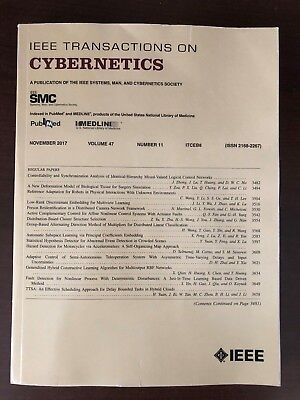
{"title":"Common Spatial Pattern Reformulated for Regularizations in Brain–Computer Interfaces","authors":"Boyu Wang;Chi Man Wong;Zhao Kang;Feng Liu;Changjian Shui;Feng Wan;C. L. Philip Chen","doi":"10.1109/TCYB.2020.2982901","DOIUrl":null,"url":null,"abstract":"Common spatial pattern (CSP) is one of the most successful feature extraction algorithms for brain–computer interfaces (BCIs). It aims to find spatial filters that maximize the projected variance ratio between the covariance matrices of the multichannel electroencephalography (EEG) signals corresponding to two mental tasks, which can be formulated as a generalized eigenvalue problem (GEP). However, it is challenging in principle to impose additional regularization onto the CSP to obtain structural solutions (e.g., sparse CSP) due to the intrinsic nonconvexity and invariance property of GEPs. This article reformulates the CSP as a constrained minimization problem and establishes the equivalence of the reformulated and the original CSPs. An efficient algorithm is proposed to solve this optimization problem by alternately performing singular value decomposition (SVD) and least squares. Under this new formulation, various regularization techniques for linear regression can then be easily implemented to regularize the CSPs for different learning paradigms, such as the sparse CSP, the transfer CSP, and the multisubject CSP. Evaluations on three BCI competition datasets show that the regularized CSP algorithms outperform other baselines, especially for the high-dimensional small training set. The extensive results validate the efficiency and effectiveness of the proposed CSP formulation in different learning contexts.","PeriodicalId":13112,"journal":{"name":"IEEE Transactions on Cybernetics","volume":"51 10","pages":"5008-5020"},"PeriodicalIF":10.5000,"publicationDate":"2020-04-22","publicationTypes":"Journal Article","fieldsOfStudy":null,"isOpenAccess":false,"openAccessPdf":"https://sci-hub-pdf.com/10.1109/TCYB.2020.2982901","citationCount":"30","resultStr":null,"platform":"Semanticscholar","paperid":null,"PeriodicalName":"IEEE Transactions on Cybernetics","FirstCategoryId":"94","ListUrlMain":"https://ieeexplore.ieee.org/document/9076261/","RegionNum":1,"RegionCategory":"计算机科学","ArticlePicture":[],"TitleCN":null,"AbstractTextCN":null,"PMCID":null,"EPubDate":"","PubModel":"","JCR":"Q1","JCRName":"AUTOMATION & CONTROL SYSTEMS","Score":null,"Total":0}
引用次数: 30
Abstract
Common spatial pattern (CSP) is one of the most successful feature extraction algorithms for brain–computer interfaces (BCIs). It aims to find spatial filters that maximize the projected variance ratio between the covariance matrices of the multichannel electroencephalography (EEG) signals corresponding to two mental tasks, which can be formulated as a generalized eigenvalue problem (GEP). However, it is challenging in principle to impose additional regularization onto the CSP to obtain structural solutions (e.g., sparse CSP) due to the intrinsic nonconvexity and invariance property of GEPs. This article reformulates the CSP as a constrained minimization problem and establishes the equivalence of the reformulated and the original CSPs. An efficient algorithm is proposed to solve this optimization problem by alternately performing singular value decomposition (SVD) and least squares. Under this new formulation, various regularization techniques for linear regression can then be easily implemented to regularize the CSPs for different learning paradigms, such as the sparse CSP, the transfer CSP, and the multisubject CSP. Evaluations on three BCI competition datasets show that the regularized CSP algorithms outperform other baselines, especially for the high-dimensional small training set. The extensive results validate the efficiency and effectiveness of the proposed CSP formulation in different learning contexts.
期刊介绍:
The scope of the IEEE Transactions on Cybernetics includes computational approaches to the field of cybernetics. Specifically, the transactions welcomes papers on communication and control across machines or machine, human, and organizations. The scope includes such areas as computational intelligence, computer vision, neural networks, genetic algorithms, machine learning, fuzzy systems, cognitive systems, decision making, and robotics, to the extent that they contribute to the theme of cybernetics or demonstrate an application of cybernetics principles.



 京公网安备 11010802042870号
京ICP备2023020795号-1
京公网安备 11010802042870号
京ICP备2023020795号-1

 分享
分享
 求助内容:
求助内容: 应助结果提醒方式:
 扫码关注我们
