Yujia Zhai , Danyang Zhang , Leiye Yu , Fang Sun , Fei Sun
{"title":"SmartBac, a new baculovirus system for large protein complex production","authors":"Yujia Zhai , Danyang Zhang , Leiye Yu , Fang Sun , Fei Sun","doi":"10.1016/j.yjsbx.2019.100003","DOIUrl":null,"url":null,"abstract":"<div><p>Recent revolution of cryo-electron microscopy has opened a new door to solve high-resolution structures of macromolecule complexes without crystallization while how to efficiently obtain homogenous macromolecule complex sample is therefore becoming a bottleneck. Here we report SmartBac, an easy and versatile system for constructing large-sized transfer plasmids used to generate recombinant baculoviruses that express large multiprotein complexes in insect cells. The SmartBac system integrates the univector plasmid-fusion system, Gibson assembly method and polyprotein strategy to construct the final transfer plasmid. The fluorescent proteins are designed co-expressed with the target to monitor transfection and expression efficiencies. A scheme of screening an optimal tagged subunit for efficient purification is provided. Six large multiprotein complexes including the human exocyst complex and dynactin complex were successfully expressed and purified, suggesting a great potential of SmartBac system for its wide application in the future.</p></div>","PeriodicalId":17238,"journal":{"name":"Journal of Structural Biology: X","volume":"1 ","pages":"Article 100003"},"PeriodicalIF":5.1000,"publicationDate":"2019-01-01","publicationTypes":"Journal Article","fieldsOfStudy":null,"isOpenAccess":false,"openAccessPdf":"https://sci-hub-pdf.com/10.1016/j.yjsbx.2019.100003","citationCount":"17","resultStr":null,"platform":"Semanticscholar","paperid":null,"PeriodicalName":"Journal of Structural Biology: X","FirstCategoryId":"1085","ListUrlMain":"https://www.sciencedirect.com/science/article/pii/S2590152419300017","RegionNum":0,"RegionCategory":null,"ArticlePicture":[],"TitleCN":null,"AbstractTextCN":null,"PMCID":null,"EPubDate":"","PubModel":"","JCR":"Q2","JCRName":"BIOCHEMISTRY & MOLECULAR BIOLOGY","Score":null,"Total":0}
引用次数: 17
Abstract
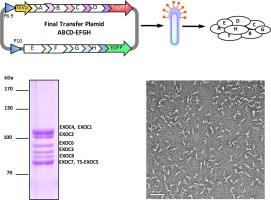
Recent revolution of cryo-electron microscopy has opened a new door to solve high-resolution structures of macromolecule complexes without crystallization while how to efficiently obtain homogenous macromolecule complex sample is therefore becoming a bottleneck. Here we report SmartBac, an easy and versatile system for constructing large-sized transfer plasmids used to generate recombinant baculoviruses that express large multiprotein complexes in insect cells. The SmartBac system integrates the univector plasmid-fusion system, Gibson assembly method and polyprotein strategy to construct the final transfer plasmid. The fluorescent proteins are designed co-expressed with the target to monitor transfection and expression efficiencies. A scheme of screening an optimal tagged subunit for efficient purification is provided. Six large multiprotein complexes including the human exocyst complex and dynactin complex were successfully expressed and purified, suggesting a great potential of SmartBac system for its wide application in the future.



 京公网安备 11010802042870号
京ICP备2023020795号-1
京公网安备 11010802042870号
京ICP备2023020795号-1

 分享
分享
 求助内容:
求助内容: 应助结果提醒方式:
 扫码关注我们
