Yumei Yan, Zhili Liu, Wenfeng Zhou, Haixiang Gao and Runhua Lu
{"title":"Construction of multiple modes using gold nanoparticles as probes for the rapid detection of fenpyroximate†","authors":"Yumei Yan, Zhili Liu, Wenfeng Zhou, Haixiang Gao and Runhua Lu","doi":"10.1039/D3AY00139C","DOIUrl":null,"url":null,"abstract":"<p >Herein, three patterns for the detection of fenpyroximate based on the response signal of gold nanoparticles are described. The strong interaction between the guanidine group of arginine-modified gold nanoparticles and the ester group of fenpyroximate led to the aggregation of the nanoparticles and to a variation of ultraviolet-visible light spectrum and color of the solution. Sensors were constructed based on the correlation of the concentration of fenpyroximate with the absorbance ratio (<em>A</em><small><sub>650</sub></small>/<em>A</em><small><sub>525</sub></small>) and the <em>R</em> value was obtained by extracting the color of the test solution by using a smartphone to take a photo of the solution, which was then analyzed by colorimeter software. The absorbance ratio increased linearly in the range of 0.225–0.375 mg L<small><sup>?1</sup></small> and the limit of detection was 0.215 mg L<small><sup>?1</sup></small>, while the <em>R</em> value declined linearly in the range of 0.20–0.40 mg L<small><sup>?1</sup></small> and the limit of detection was 0.21 mg L<small><sup>?1</sup></small>. Further, the gold nanoparticles could cause a fluorescence quenching of fluorescent dyes, such as rhodamine B, and it was found that the fluorescence could be quenched and then restored after aggregation; therefore, a fluorescence method based on fluorescence “off–on” was constructed, and the fluorescence quenching was found to increase linearly in the range of 0.0–1.0 mg L<small><sup>?1</sup></small> and the limit of detection was 0.013 mg L<small><sup>?1</sup></small>. These three patterns indicated highly selective and sensitive response signals for fenpyroximate, and all were applied to the detection of fenpyroximate in apple juice, pear juice, and environmental water samples, with the results showing that the three methods could be mutually verified, with the recoveries ranging from 94.15% to 110.65%.</p>","PeriodicalId":64,"journal":{"name":"Analytical Methods","volume":" 13","pages":" 1713-1721"},"PeriodicalIF":2.6000,"publicationDate":"2023-03-20","publicationTypes":"Journal Article","fieldsOfStudy":null,"isOpenAccess":false,"openAccessPdf":"","citationCount":"1","resultStr":null,"platform":"Semanticscholar","paperid":null,"PeriodicalName":"Analytical Methods","FirstCategoryId":"92","ListUrlMain":"https://pubs.rsc.org/en/content/articlelanding/2023/ay/d3ay00139c","RegionNum":3,"RegionCategory":"化学","ArticlePicture":[],"TitleCN":null,"AbstractTextCN":null,"PMCID":null,"EPubDate":"","PubModel":"","JCR":"Q2","JCRName":"CHEMISTRY, ANALYTICAL","Score":null,"Total":0}
引用次数: 1
Abstract
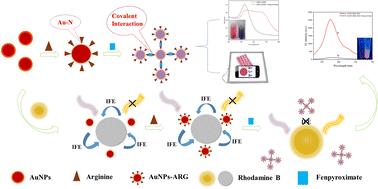
Herein, three patterns for the detection of fenpyroximate based on the response signal of gold nanoparticles are described. The strong interaction between the guanidine group of arginine-modified gold nanoparticles and the ester group of fenpyroximate led to the aggregation of the nanoparticles and to a variation of ultraviolet-visible light spectrum and color of the solution. Sensors were constructed based on the correlation of the concentration of fenpyroximate with the absorbance ratio (A650/A525) and the R value was obtained by extracting the color of the test solution by using a smartphone to take a photo of the solution, which was then analyzed by colorimeter software. The absorbance ratio increased linearly in the range of 0.225–0.375 mg L?1 and the limit of detection was 0.215 mg L?1, while the R value declined linearly in the range of 0.20–0.40 mg L?1 and the limit of detection was 0.21 mg L?1. Further, the gold nanoparticles could cause a fluorescence quenching of fluorescent dyes, such as rhodamine B, and it was found that the fluorescence could be quenched and then restored after aggregation; therefore, a fluorescence method based on fluorescence “off–on” was constructed, and the fluorescence quenching was found to increase linearly in the range of 0.0–1.0 mg L?1 and the limit of detection was 0.013 mg L?1. These three patterns indicated highly selective and sensitive response signals for fenpyroximate, and all were applied to the detection of fenpyroximate in apple juice, pear juice, and environmental water samples, with the results showing that the three methods could be mutually verified, with the recoveries ranging from 94.15% to 110.65%.



 京公网安备 11010802042870号
京ICP备2023020795号-1
京公网安备 11010802042870号
京ICP备2023020795号-1

 分享
分享
 求助内容:
求助内容: 应助结果提醒方式:
 扫码关注我们
