Associations between midlife chronic conditions and medication use with anxiety and depression: A cross-sectional analysis of the PREVENT Dementia study.
Lucy E Stirland, Sarah Gregory, Tom C Russ, Craig W Ritchie, Graciela Muniz-Terrera
{"title":"Associations between midlife chronic conditions and medication use with anxiety and depression: A cross-sectional analysis of the PREVENT Dementia study.","authors":"Lucy E Stirland, Sarah Gregory, Tom C Russ, Craig W Ritchie, Graciela Muniz-Terrera","doi":"10.1177/2235042X20920443","DOIUrl":null,"url":null,"abstract":"<p><strong>Background: </strong>Multimorbidity including physical and mental illness is increasing in prevalence. We aimed to investigate the associations between physical conditions and medication use with anxiety and depression in midlife.</p><p><strong>Methods: </strong>We conducted an observational cross-sectional study of volunteers in the PREVENT Dementia study. Using logistic and linear regression, we investigated the association between increasing numbers of self-reported chronic physical conditions and medications with self-reported depression and anxiety disorder, and scores on the Center for Epidemiologic Studies Depression (CES-D) scale and Spielberger State-Trait Anxiety Inventory (STAI) state subtest.</p><p><strong>Results: </strong>Of the 210 participants, 148 (71%) were women and 188 (90%) Caucasian. The mean age was 52 (standard deviation (SD) = 5.5) years. The mean number of physical conditions was 2.2 (SD = 1.9) and medications 1.7 (SD = 2.2). Each additional physical condition was associated with increased odds of self-reported depression (odds ratio (OR) 1.41, 95% confidence interval (CI) 1.11-1.80; <i>p</i> = 0.004, adjusted for age and gender) and anxiety disorder (OR 1.70, 95% CI 1.30-2.37; <i>p <</i> 0.001). Increasing medication use was associated with self-reported depression (adjusted OR per additional medication 1.35, 95% CI 1.08-1.71; <i>p</i> = 0.008) but not anxiety disorder. For each additional condition, CES-D scores increased by 0.72 (95% CI 0.11-1.33; <i>p</i> = 0.020) and for each extra medication, by 0.88 (95% CI 0.32-1.44; <i>p</i> = 0.002). There was no significant association between increasing conditions and medications with STAI scores. In models accounting for antidepressant use, all associations were attenuated.</p><p><strong>Conclusions: </strong>Having more physical conditions is associated with anxiety and depression in midlife, and taking more medications is associated with depression but not anxiety.</p>","PeriodicalId":92071,"journal":{"name":"Journal of comorbidity","volume":"10 ","pages":"2235042X20920443"},"PeriodicalIF":0.0000,"publicationDate":"2020-05-05","publicationTypes":"Journal Article","fieldsOfStudy":null,"isOpenAccess":false,"openAccessPdf":"https://www.ncbi.nlm.nih.gov/pmc/articles/PMC7218309/pdf/","citationCount":"0","resultStr":null,"platform":"Semanticscholar","paperid":null,"PeriodicalName":"Journal of comorbidity","FirstCategoryId":"1085","ListUrlMain":"https://doi.org/10.1177/2235042X20920443","RegionNum":0,"RegionCategory":null,"ArticlePicture":[],"TitleCN":null,"AbstractTextCN":null,"PMCID":null,"EPubDate":"2020/1/1 0:00:00","PubModel":"eCollection","JCR":"","JCRName":"","Score":null,"Total":0}
引用次数: 0
Abstract
Background: Multimorbidity including physical and mental illness is increasing in prevalence. We aimed to investigate the associations between physical conditions and medication use with anxiety and depression in midlife.
Methods: We conducted an observational cross-sectional study of volunteers in the PREVENT Dementia study. Using logistic and linear regression, we investigated the association between increasing numbers of self-reported chronic physical conditions and medications with self-reported depression and anxiety disorder, and scores on the Center for Epidemiologic Studies Depression (CES-D) scale and Spielberger State-Trait Anxiety Inventory (STAI) state subtest.
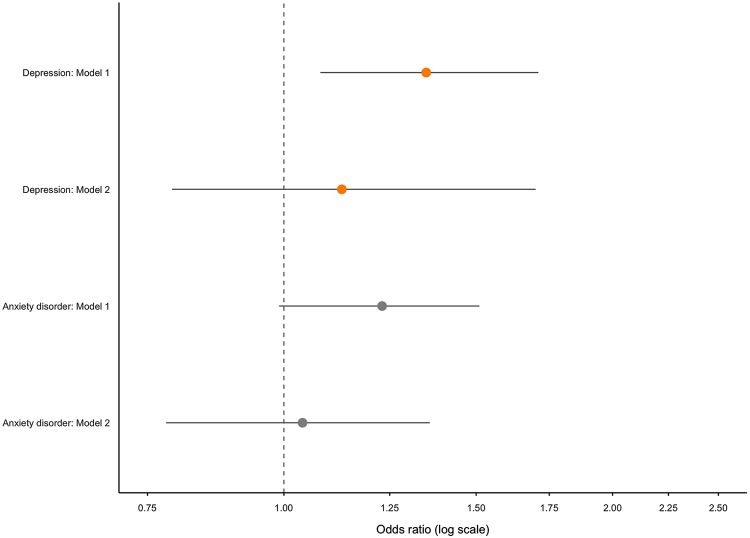
Results: Of the 210 participants, 148 (71%) were women and 188 (90%) Caucasian. The mean age was 52 (standard deviation (SD) = 5.5) years. The mean number of physical conditions was 2.2 (SD = 1.9) and medications 1.7 (SD = 2.2). Each additional physical condition was associated with increased odds of self-reported depression (odds ratio (OR) 1.41, 95% confidence interval (CI) 1.11-1.80; p = 0.004, adjusted for age and gender) and anxiety disorder (OR 1.70, 95% CI 1.30-2.37; p < 0.001). Increasing medication use was associated with self-reported depression (adjusted OR per additional medication 1.35, 95% CI 1.08-1.71; p = 0.008) but not anxiety disorder. For each additional condition, CES-D scores increased by 0.72 (95% CI 0.11-1.33; p = 0.020) and for each extra medication, by 0.88 (95% CI 0.32-1.44; p = 0.002). There was no significant association between increasing conditions and medications with STAI scores. In models accounting for antidepressant use, all associations were attenuated.
Conclusions: Having more physical conditions is associated with anxiety and depression in midlife, and taking more medications is associated with depression but not anxiety.




 京公网安备 11010802042870号
京ICP备2023020795号-1
京公网安备 11010802042870号
京ICP备2023020795号-1

 分享
分享

 求助内容:
求助内容: 应助结果提醒方式:
 扫码关注我们
