{"title":"Parkinson Disease and Orthostatic Hypotension in the Elderly: Recognition and Management of Risk Factors for Falls.","authors":"Peter A LeWitt, Steve Kymes, Robert A Hauser","doi":"10.14336/AD.2019.0805","DOIUrl":null,"url":null,"abstract":"<p><p>Parkinson disease (PD) is often associated with postural instability and gait dysfunction that can increase the risk for falls and associated consequences, including injuries, increased burden on healthcare resources, and reduced quality of life. Patients with PD have nearly twice the risk for falls and associated bone fractures compared with their general population counterparts of similar age. Although the cause of falls in patients with PD may be multifactorial, an often under-recognized factor is neurogenic orthostatic hypotension (nOH). nOH is a sustained decrease in blood pressure upon standing whose symptomology can include dizziness/lightheadedness, weakness, fatigue, and syncope. nOH is due to dysfunction of the autonomic nervous system compensatory response to standing and is a consequence of the neurodegenerative processes of PD. The symptoms associated with orthostatic hypotension (OH)/nOH can increase the risk of falls, and healthcare professionals may not be aware of the real-world clinical effect of nOH, the need for routine screening, or the value of early diagnosis of nOH when treating elderly patients with PD. nOH is easily missed and, importantly, healthcare providers may not realize that there are effective treatments for nOH symptoms that could help lessen the fall risk resulting from the condition. This review discusses the burden of, and key risk factors for, falls among patients with PD, with a focus on practical approaches for the recognition, assessment, and successful management of OH/nOH. In addition, insights are provided as to how fall patterns can suggest fall etiology, thereby influencing the choice of intervention.</p>","PeriodicalId":7434,"journal":{"name":"Aging and Disease","volume":"11 3","pages":"679-691"},"PeriodicalIF":6.9000,"publicationDate":"2020-05-09","publicationTypes":"Journal Article","fieldsOfStudy":null,"isOpenAccess":false,"openAccessPdf":"https://sci-hub-pdf.com/10.14336/AD.2019.0805","citationCount":"31","resultStr":null,"platform":"Semanticscholar","paperid":null,"PeriodicalName":"Aging and Disease","FirstCategoryId":"3","ListUrlMain":"https://doi.org/10.14336/AD.2019.0805","RegionNum":2,"RegionCategory":"医学","ArticlePicture":[],"TitleCN":null,"AbstractTextCN":null,"PMCID":null,"EPubDate":"2020/5/1 0:00:00","PubModel":"eCollection","JCR":"Q1","JCRName":"GERIATRICS & GERONTOLOGY","Score":null,"Total":0}
引用次数: 31
Abstract
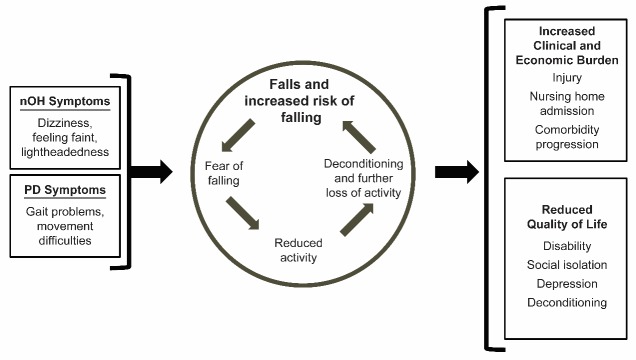
Parkinson disease (PD) is often associated with postural instability and gait dysfunction that can increase the risk for falls and associated consequences, including injuries, increased burden on healthcare resources, and reduced quality of life. Patients with PD have nearly twice the risk for falls and associated bone fractures compared with their general population counterparts of similar age. Although the cause of falls in patients with PD may be multifactorial, an often under-recognized factor is neurogenic orthostatic hypotension (nOH). nOH is a sustained decrease in blood pressure upon standing whose symptomology can include dizziness/lightheadedness, weakness, fatigue, and syncope. nOH is due to dysfunction of the autonomic nervous system compensatory response to standing and is a consequence of the neurodegenerative processes of PD. The symptoms associated with orthostatic hypotension (OH)/nOH can increase the risk of falls, and healthcare professionals may not be aware of the real-world clinical effect of nOH, the need for routine screening, or the value of early diagnosis of nOH when treating elderly patients with PD. nOH is easily missed and, importantly, healthcare providers may not realize that there are effective treatments for nOH symptoms that could help lessen the fall risk resulting from the condition. This review discusses the burden of, and key risk factors for, falls among patients with PD, with a focus on practical approaches for the recognition, assessment, and successful management of OH/nOH. In addition, insights are provided as to how fall patterns can suggest fall etiology, thereby influencing the choice of intervention.
期刊介绍:
Aging & Disease (A&D) is an open-access online journal dedicated to publishing groundbreaking research on the biology of aging, the pathophysiology of age-related diseases, and innovative therapies for conditions affecting the elderly. The scope encompasses various diseases such as Stroke, Alzheimer's disease, Parkinson’s disease, Epilepsy, Dementia, Depression, Cardiovascular Disease, Cancer, Arthritis, Cataract, Osteoporosis, Diabetes, and Hypertension. The journal welcomes studies involving animal models as well as human tissues or cells.



 京公网安备 11010802042870号
京ICP备2023020795号-1
京公网安备 11010802042870号
京ICP备2023020795号-1

 分享
分享
 求助内容:
求助内容: 应助结果提醒方式:
 扫码关注我们
