Molecular Cloning and Characterization of Five Glutathione S-Transferase Genes and Promoters from Micromelalopha troglodyta (Graeser) (Lepidoptera: Notodontidae) and Their Response to Tannic Acid Stress.
{"title":"Molecular Cloning and Characterization of Five Glutathione S-Transferase Genes and Promoters from <i>Micromelalopha troglodyta</i> (Graeser) (Lepidoptera: Notodontidae) and Their Response to Tannic Acid Stress.","authors":"Fang Tang, Huizhen Tu, Qingli Shang, Xiwu Gao, Pei Liang","doi":"10.3390/insects11060339","DOIUrl":null,"url":null,"abstract":"<p><p>Plants accumulate phenolic compounds such as tannic acid to resist insect herbivores. The survival of insects exposed to toxic secondary metabolites depends on the detoxification metabolism mediated by limited groups of glutathione S-transferases (GSTs). <i>Micromelalopha troglodyta</i> (Graeser) (Lepidoptera: Notodontidae) is an important foliar pest of poplar trees. GSTs play an important role in xenobiotic detoxification in <i>M. troglodyta</i>. Five GST genes were identified in <i>M. troglodyta</i> and were classified into five different cytosolic GST classes, delta, omega, sigma, theta, and zeta. Real-time fluorescent quantitative polymerase chain reaction (qPCR) was used to determine the mRNA expression of the five cloned GSTs in the midguts and fat bodies of <i>M. troglodyta</i>. The mRNA expression of the five GSTs was significantly induced when <i>M. troglodyta</i> was exposed to tannic acid. To further understand the tannic acid regulatory cascade, the 5'-flanking promoter sequences of the five <i>MtGST</i>s were isolated by genome walking methods, and the promoters were very active and induced by tannic acid. In summary, the induction of GST mRNA expression was due to the response of five <i>MtGST</i> promoters to tannic acid. Therefore, <i>MtGST</i> promoters play an important role in the regulation of GST transcription.</p>","PeriodicalId":13642,"journal":{"name":"Insects","volume":"11 6","pages":""},"PeriodicalIF":2.9000,"publicationDate":"2020-06-01","publicationTypes":"Journal Article","fieldsOfStudy":null,"isOpenAccess":false,"openAccessPdf":"https://sci-hub-pdf.com/10.3390/insects11060339","citationCount":"5","resultStr":null,"platform":"Semanticscholar","paperid":null,"PeriodicalName":"Insects","FirstCategoryId":"97","ListUrlMain":"https://doi.org/10.3390/insects11060339","RegionNum":2,"RegionCategory":"农林科学","ArticlePicture":[],"TitleCN":null,"AbstractTextCN":null,"PMCID":null,"EPubDate":"","PubModel":"","JCR":"Q1","JCRName":"ENTOMOLOGY","Score":null,"Total":0}
引用次数: 5
Abstract
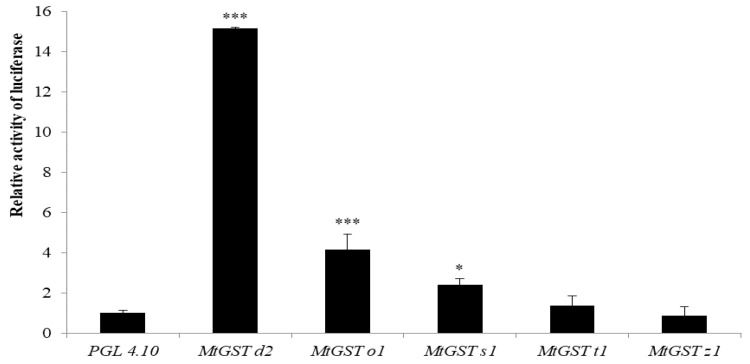
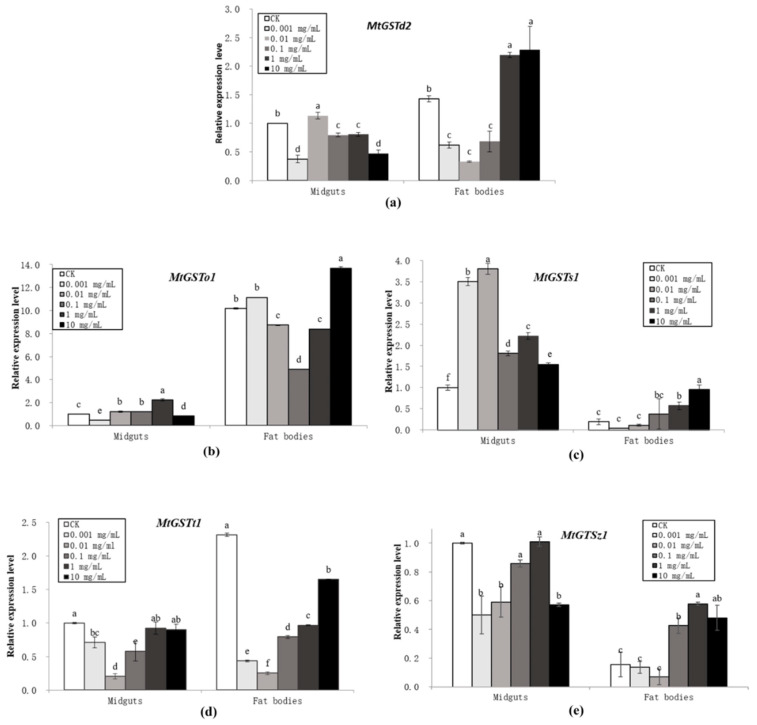
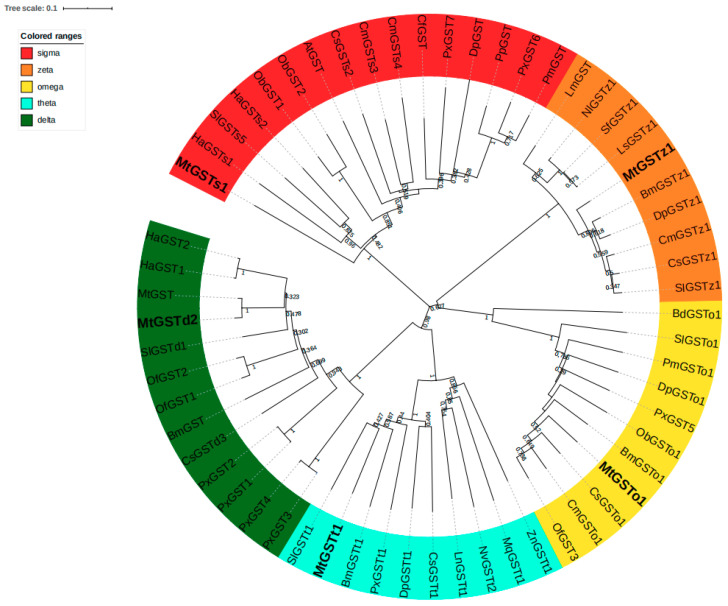
Plants accumulate phenolic compounds such as tannic acid to resist insect herbivores. The survival of insects exposed to toxic secondary metabolites depends on the detoxification metabolism mediated by limited groups of glutathione S-transferases (GSTs). Micromelalopha troglodyta (Graeser) (Lepidoptera: Notodontidae) is an important foliar pest of poplar trees. GSTs play an important role in xenobiotic detoxification in M. troglodyta. Five GST genes were identified in M. troglodyta and were classified into five different cytosolic GST classes, delta, omega, sigma, theta, and zeta. Real-time fluorescent quantitative polymerase chain reaction (qPCR) was used to determine the mRNA expression of the five cloned GSTs in the midguts and fat bodies of M. troglodyta. The mRNA expression of the five GSTs was significantly induced when M. troglodyta was exposed to tannic acid. To further understand the tannic acid regulatory cascade, the 5'-flanking promoter sequences of the five MtGSTs were isolated by genome walking methods, and the promoters were very active and induced by tannic acid. In summary, the induction of GST mRNA expression was due to the response of five MtGST promoters to tannic acid. Therefore, MtGST promoters play an important role in the regulation of GST transcription.
InsectsAgricultural and Biological Sciences-Insect Science
CiteScore
5.10
自引率
10.00%
发文量
1013
审稿时长
21.77 days
期刊介绍:
Insects (ISSN 2075-4450) is an international, peer-reviewed open access journal of entomology published by MDPI online quarterly. It publishes reviews, research papers and communications related to the biology, physiology and the behavior of insects and arthropods. Our aim is to encourage scientists to publish their experimental and theoretical results in as much detail as possible. There is no restriction on the length of the papers. The full experimental details must be provided so that the results can be reproduced. Electronic files regarding the full details of the experimental procedure, if unable to be published in a normal way, can be deposited as supplementary material.



 京公网安备 11010802042870号
京ICP备2023020795号-1
京公网安备 11010802042870号
京ICP备2023020795号-1

 分享
分享
 求助内容:
求助内容: 应助结果提醒方式:
 扫码关注我们
