{"title":"Depressive symptoms affect short- and long-term speech recognition outcome in cochlear implant users.","authors":"Katharina Heinze-Köhler, Effi Katharina Lehmann, Ulrich Hoppe","doi":"10.1007/s00405-020-06096-3","DOIUrl":null,"url":null,"abstract":"<p><strong>Purpose: </strong>To investigate the impact of the amount of depressive symptoms in cochlear implant (CI) recipients on the development of speech recognition after CI-activation up to 2 years.</p><p><strong>Design: </strong>Retrospective data analysis of a German short form of the Beck Depression Inventory given at initial activation of the implant in relation to monosyllabic word recognition score at conversational level at initial activation and at 3 months, 1 and 2-year follow-up measurements.</p><p><strong>Study sample: </strong>Thirty-one CI-patients (11 female, 20 male) aged between 41 and 83 (M = 64.77, SD = 10.43) who were German native speakers, postlingually deafened, with severe hearing loss in both sides but unilaterally implanted (19 right-sided, 12 left-sided).</p><p><strong>Results: </strong>The amount of depressive symptoms at initial activation was negatively correlated with the monosyllabic recognition score after 3 months and after 1 year of implant use.</p><p><strong>Conclusion: </strong>The psychological status in terms of depressive symptoms is an important parameter regarding the rehabilitative outcome of CI-patients. Care staff and CI-users should be sensitized to the link between depressive symptoms and the development of speech recognition with CI.</p>","PeriodicalId":520614,"journal":{"name":"European archives of oto-rhino-laryngology : official journal of the European Federation of Oto-Rhino-Laryngological Societies (EUFOS) : affiliated with the German Society for Oto-Rhino-Laryngology - Head and Neck Surgery","volume":" ","pages":"345-351"},"PeriodicalIF":2.2000,"publicationDate":"2021-02-01","publicationTypes":"Journal Article","fieldsOfStudy":null,"isOpenAccess":false,"openAccessPdf":"https://sci-hub-pdf.com/10.1007/s00405-020-06096-3","citationCount":"7","resultStr":null,"platform":"Semanticscholar","paperid":null,"PeriodicalName":"European archives of oto-rhino-laryngology : official journal of the European Federation of Oto-Rhino-Laryngological Societies (EUFOS) : affiliated with the German Society for Oto-Rhino-Laryngology - Head and Neck Surgery","FirstCategoryId":"3","ListUrlMain":"https://doi.org/10.1007/s00405-020-06096-3","RegionNum":0,"RegionCategory":null,"ArticlePicture":[],"TitleCN":null,"AbstractTextCN":null,"PMCID":null,"EPubDate":"2020/6/5 0:00:00","PubModel":"Epub","JCR":"","JCRName":"","Score":null,"Total":0}
引用次数: 7
Abstract
Purpose: To investigate the impact of the amount of depressive symptoms in cochlear implant (CI) recipients on the development of speech recognition after CI-activation up to 2 years.
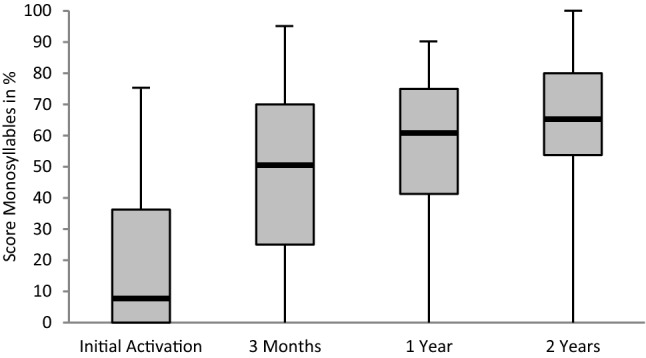
Design: Retrospective data analysis of a German short form of the Beck Depression Inventory given at initial activation of the implant in relation to monosyllabic word recognition score at conversational level at initial activation and at 3 months, 1 and 2-year follow-up measurements.
Study sample: Thirty-one CI-patients (11 female, 20 male) aged between 41 and 83 (M = 64.77, SD = 10.43) who were German native speakers, postlingually deafened, with severe hearing loss in both sides but unilaterally implanted (19 right-sided, 12 left-sided).
Results: The amount of depressive symptoms at initial activation was negatively correlated with the monosyllabic recognition score after 3 months and after 1 year of implant use.
Conclusion: The psychological status in terms of depressive symptoms is an important parameter regarding the rehabilitative outcome of CI-patients. Care staff and CI-users should be sensitized to the link between depressive symptoms and the development of speech recognition with CI.



 京公网安备 11010802042870号
京ICP备2023020795号-1
京公网安备 11010802042870号
京ICP备2023020795号-1

 分享
分享

 求助内容:
求助内容: 应助结果提醒方式:
 扫码关注我们
