Risk prediction models versus simplified selection criteria to determine eligibility for lung cancer screening: an analysis of German federal-wide survey and incidence data.
{"title":"Risk prediction models versus simplified selection criteria to determine eligibility for lung cancer screening: an analysis of German federal-wide survey and incidence data.","authors":"Anika Hüsing, Rudolf Kaaks","doi":"10.1007/s10654-020-00657-w","DOIUrl":null,"url":null,"abstract":"<p><p>As randomized trials in the USA and Europe have convincingly demonstrated efficacy of lung cancer screening by computed tomography (CT), European countries are discussing the introduction of screening programs. To maintain acceptable cost-benefit and clinical benefit-to-harm ratios, screening should be offered to individuals at sufficiently elevated risk of having lung cancer. Using federal-wide survey and lung cancer incidence data (2008-2013), we examined the performance of four well-established risk models from the USA (PLCO<sub>M2012</sub>, LCRAT, Bach) and the UK (LLP<sub>2008</sub>) in the German population, comparing with standard eligibility criteria based on age limits, minimal pack years of smoking (or combination of total duration with average intensity) and maximum years since smoking cessation. The eligibility criterion recommended by the United States Preventive Services Taskforce (USPSTF) would select about 3.2 million individuals, a group equal in size to the upper fifth of ever smokers age 50-79 at highest risk, and to 11% of all adults aged 50-79. According to PLCO<sub>M2012</sub>, the model showing best concordance between numbers of lung cancer cases predicted and reported in registries, persons with 5-year risk ≥ 1.7% included about half of all lung cancer incidence in the full German population. Compared to eligibility criteria (e.g. USPSTF), risk models elected individuals in higher age groups, including ex-smokers with longer average quitting times. Further studies should address how in Germany these shifts may affect expected benefits of CT screening in terms of life-years gained versus the potential harm of age-specific increasing risk of over-diagnosis.</p>","PeriodicalId":11907,"journal":{"name":"European Journal of Epidemiology","volume":"35 10","pages":"899-912"},"PeriodicalIF":5.9000,"publicationDate":"2020-10-01","publicationTypes":"Journal Article","fieldsOfStudy":null,"isOpenAccess":false,"openAccessPdf":"https://sci-hub-pdf.com/10.1007/s10654-020-00657-w","citationCount":"24","resultStr":null,"platform":"Semanticscholar","paperid":null,"PeriodicalName":"European Journal of Epidemiology","FirstCategoryId":"3","ListUrlMain":"https://doi.org/10.1007/s10654-020-00657-w","RegionNum":1,"RegionCategory":"医学","ArticlePicture":[],"TitleCN":null,"AbstractTextCN":null,"PMCID":null,"EPubDate":"2020/6/27 0:00:00","PubModel":"Epub","JCR":"Q1","JCRName":"PUBLIC, ENVIRONMENTAL & OCCUPATIONAL HEALTH","Score":null,"Total":0}
引用次数: 24
Abstract
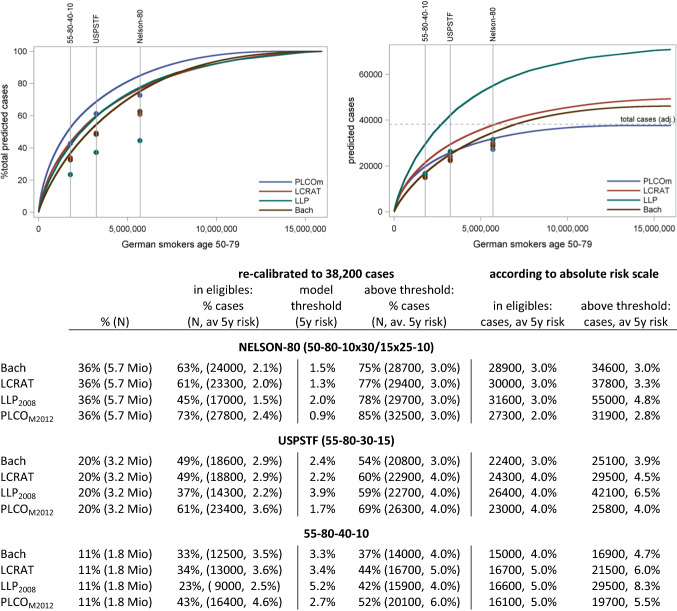
As randomized trials in the USA and Europe have convincingly demonstrated efficacy of lung cancer screening by computed tomography (CT), European countries are discussing the introduction of screening programs. To maintain acceptable cost-benefit and clinical benefit-to-harm ratios, screening should be offered to individuals at sufficiently elevated risk of having lung cancer. Using federal-wide survey and lung cancer incidence data (2008-2013), we examined the performance of four well-established risk models from the USA (PLCOM2012, LCRAT, Bach) and the UK (LLP2008) in the German population, comparing with standard eligibility criteria based on age limits, minimal pack years of smoking (or combination of total duration with average intensity) and maximum years since smoking cessation. The eligibility criterion recommended by the United States Preventive Services Taskforce (USPSTF) would select about 3.2 million individuals, a group equal in size to the upper fifth of ever smokers age 50-79 at highest risk, and to 11% of all adults aged 50-79. According to PLCOM2012, the model showing best concordance between numbers of lung cancer cases predicted and reported in registries, persons with 5-year risk ≥ 1.7% included about half of all lung cancer incidence in the full German population. Compared to eligibility criteria (e.g. USPSTF), risk models elected individuals in higher age groups, including ex-smokers with longer average quitting times. Further studies should address how in Germany these shifts may affect expected benefits of CT screening in terms of life-years gained versus the potential harm of age-specific increasing risk of over-diagnosis.
期刊介绍:
The European Journal of Epidemiology, established in 1985, is a peer-reviewed publication that provides a platform for discussions on epidemiology in its broadest sense. It covers various aspects of epidemiologic research and statistical methods. The journal facilitates communication between researchers, educators, and practitioners in epidemiology, including those in clinical and community medicine. Contributions from diverse fields such as public health, preventive medicine, clinical medicine, health economics, and computational biology and data science, in relation to health and disease, are encouraged. While accepting submissions from all over the world, the journal particularly emphasizes European topics relevant to epidemiology. The published articles consist of empirical research findings, developments in methodology, and opinion pieces.




 京公网安备 11010802042870号
京ICP备2023020795号-1
京公网安备 11010802042870号
京ICP备2023020795号-1

 分享
分享
 求助内容:
求助内容: 应助结果提醒方式:
 扫码关注我们
