Rocco A Montone, Giulia Iannaccone, Maria Chiara Meucci, Filippo Gurgoglione, Giampaolo Niccoli
{"title":"Myocardial and Microvascular Injury Due to Coronavirus Disease 2019.","authors":"Rocco A Montone, Giulia Iannaccone, Maria Chiara Meucci, Filippo Gurgoglione, Giampaolo Niccoli","doi":"10.15420/ecr.2020.22","DOIUrl":null,"url":null,"abstract":"<p><p>Over the past few months, health systems worldwide have been put to the test with the coronavirus disease 2019 (COVID-19) pandemic caused by severe acute respiratory syndrome coronavirus 2 (SARS-CoV-2). Even though the leading clinical manifestations of the SARS-CoV-2 infection involve the respiratory tract, there is a non-negligible risk of systemic involvement leading to the onset of multi-organ failure with fatal consequences. Since the onset of COVID-19, patients with underlying cardiovascular disease have been at increased risk of poor clinical outcomes with higher death rates. Moreover, the occurrence of new-onset cardiac complications is not uncommon among patients hospitalised for COVID-19. Of importance, a significant portion of COVID-19 patients present with myocardial injury. Herein, the authors discuss the mechanisms leading to myocardial and microvascular injury in SARS-CoV-2 infection and their clinical implications.</p>","PeriodicalId":45957,"journal":{"name":"European Cardiology Review","volume":"15 ","pages":"e52"},"PeriodicalIF":3.6000,"publicationDate":"2020-06-23","publicationTypes":"Journal Article","fieldsOfStudy":null,"isOpenAccess":false,"openAccessPdf":"https://ftp.ncbi.nlm.nih.gov/pub/pmc/oa_pdf/d8/43/ecr-15-e52.PMC7325215.pdf","citationCount":"33","resultStr":null,"platform":"Semanticscholar","paperid":null,"PeriodicalName":"European Cardiology Review","FirstCategoryId":"1085","ListUrlMain":"https://doi.org/10.15420/ecr.2020.22","RegionNum":0,"RegionCategory":null,"ArticlePicture":[],"TitleCN":null,"AbstractTextCN":null,"PMCID":null,"EPubDate":"2020/2/1 0:00:00","PubModel":"eCollection","JCR":"Q2","JCRName":"CARDIAC & CARDIOVASCULAR SYSTEMS","Score":null,"Total":0}
引用次数: 33
Abstract
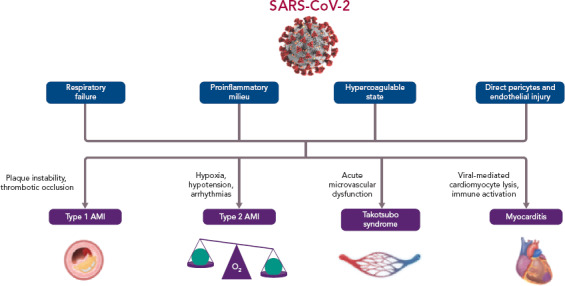
Over the past few months, health systems worldwide have been put to the test with the coronavirus disease 2019 (COVID-19) pandemic caused by severe acute respiratory syndrome coronavirus 2 (SARS-CoV-2). Even though the leading clinical manifestations of the SARS-CoV-2 infection involve the respiratory tract, there is a non-negligible risk of systemic involvement leading to the onset of multi-organ failure with fatal consequences. Since the onset of COVID-19, patients with underlying cardiovascular disease have been at increased risk of poor clinical outcomes with higher death rates. Moreover, the occurrence of new-onset cardiac complications is not uncommon among patients hospitalised for COVID-19. Of importance, a significant portion of COVID-19 patients present with myocardial injury. Herein, the authors discuss the mechanisms leading to myocardial and microvascular injury in SARS-CoV-2 infection and their clinical implications.




 京公网安备 11010802042870号
京ICP备2023020795号-1
京公网安备 11010802042870号
京ICP备2023020795号-1

 分享
分享
 求助内容:
求助内容: 应助结果提醒方式:
 扫码关注我们
