Zoltán Papp, Piergiuseppe Agostoni, Julian Alvarez, Dominique Bettex, Stefan Bouchez, Dulce Brito, Vladimir Černý, Josep Comin-Colet, Marisa G Crespo-Leiro, Juan F Delgado, István Édes, Alexander A Eremenko, Dimitrios Farmakis, Francesco Fedele, Cândida Fonseca, Sonja Fruhwald, Massimo Girardis, Fabio Guarracino, Veli-Pekka Harjola, Matthias Heringlake, Antoine Herpain, Leo M A Heunks, Tryggve Husebye, Višnja Ivancan, Kristjan Karason, Sundeep Kaul, Matti Kivikko, Janek Kubica, Josep Masip, Simon Matskeplishvili, Alexandre Mebazaa, Markku S Nieminen, Fabrizio Oliva, Julius G Papp, John Parissis, Alexander Parkhomenko, Pentti Põder, Gerhard Pölzl, Alexander Reinecke, Sven-Erik Ricksten, Hynek Riha, Alain Rudiger, Toni Sarapohja, Robert H G Schwinger, Wolfgang Toller, Luigi Tritapepe, Carsten Tschöpe, Gerhard Wikström, Dirk von Lewinski, Bojan Vrtovec, Piero Pollesello
{"title":"Levosimendan Efficacy and Safety: 20 Years of SIMDAX in Clinical Use.","authors":"Zoltán Papp, Piergiuseppe Agostoni, Julian Alvarez, Dominique Bettex, Stefan Bouchez, Dulce Brito, Vladimir Černý, Josep Comin-Colet, Marisa G Crespo-Leiro, Juan F Delgado, István Édes, Alexander A Eremenko, Dimitrios Farmakis, Francesco Fedele, Cândida Fonseca, Sonja Fruhwald, Massimo Girardis, Fabio Guarracino, Veli-Pekka Harjola, Matthias Heringlake, Antoine Herpain, Leo M A Heunks, Tryggve Husebye, Višnja Ivancan, Kristjan Karason, Sundeep Kaul, Matti Kivikko, Janek Kubica, Josep Masip, Simon Matskeplishvili, Alexandre Mebazaa, Markku S Nieminen, Fabrizio Oliva, Julius G Papp, John Parissis, Alexander Parkhomenko, Pentti Põder, Gerhard Pölzl, Alexander Reinecke, Sven-Erik Ricksten, Hynek Riha, Alain Rudiger, Toni Sarapohja, Robert H G Schwinger, Wolfgang Toller, Luigi Tritapepe, Carsten Tschöpe, Gerhard Wikström, Dirk von Lewinski, Bojan Vrtovec, Piero Pollesello","doi":"10.1097/FJC.0000000000000859","DOIUrl":null,"url":null,"abstract":"<p><p>Levosimendan was first approved for clinical use in 2000, when authorization was granted by Swedish regulatory authorities for the hemodynamic stabilization of patients with acutely decompensated chronic heart failure (HF). In the ensuing 20 years, this distinctive inodilator, which enhances cardiac contractility through calcium sensitization and promotes vasodilatation through the opening of adenosine triphosphate-dependent potassium channels on vascular smooth muscle cells, has been approved in more than 60 jurisdictions, including most of the countries of the European Union and Latin America. Areas of clinical application have expanded considerably and now include cardiogenic shock, takotsubo cardiomyopathy, advanced HF, right ventricular failure, pulmonary hypertension, cardiac surgery, critical care, and emergency medicine. Levosimendan is currently in active clinical evaluation in the United States. Levosimendan in IV formulation is being used as a research tool in the exploration of a wide range of cardiac and noncardiac disease states. A levosimendan oral form is at present under evaluation in the management of amyotrophic lateral sclerosis. To mark the 20 years since the advent of levosimendan in clinical use, 51 experts from 23 European countries (Austria, Belgium, Croatia, Cyprus, Czech Republic, Estonia, Finland, France, Germany, Greece, Hungary, Italy, the Netherlands, Norway, Poland, Portugal, Russia, Slovenia, Spain, Sweden, Switzerland, the United Kingdom, and Ukraine) contributed to this essay, which evaluates one of the relatively few drugs to have been successfully introduced into the acute HF arena in recent times and charts a possible development trajectory for the next 20 years.</p>","PeriodicalId":2,"journal":{"name":"ACS Applied Bio Materials","volume":" ","pages":"4-22"},"PeriodicalIF":4.7000,"publicationDate":"2020-07-01","publicationTypes":"Journal Article","fieldsOfStudy":null,"isOpenAccess":false,"openAccessPdf":"https://www.ncbi.nlm.nih.gov/pmc/articles/PMC7340234/pdf/","citationCount":"0","resultStr":null,"platform":"Semanticscholar","paperid":null,"PeriodicalName":"ACS Applied Bio Materials","FirstCategoryId":"3","ListUrlMain":"https://doi.org/10.1097/FJC.0000000000000859","RegionNum":0,"RegionCategory":null,"ArticlePicture":[],"TitleCN":null,"AbstractTextCN":null,"PMCID":null,"EPubDate":"","PubModel":"","JCR":"Q2","JCRName":"MATERIALS SCIENCE, BIOMATERIALS","Score":null,"Total":0}
引用次数: 0
Abstract
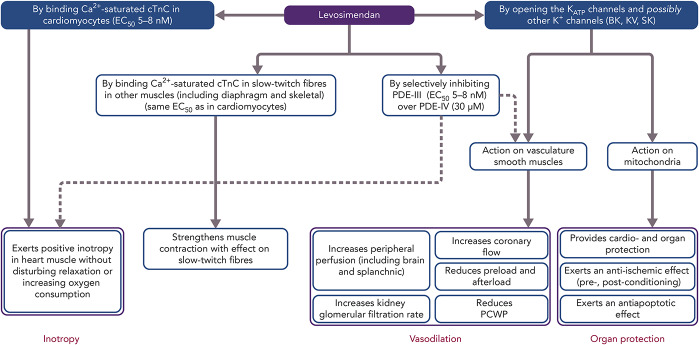
Levosimendan was first approved for clinical use in 2000, when authorization was granted by Swedish regulatory authorities for the hemodynamic stabilization of patients with acutely decompensated chronic heart failure (HF). In the ensuing 20 years, this distinctive inodilator, which enhances cardiac contractility through calcium sensitization and promotes vasodilatation through the opening of adenosine triphosphate-dependent potassium channels on vascular smooth muscle cells, has been approved in more than 60 jurisdictions, including most of the countries of the European Union and Latin America. Areas of clinical application have expanded considerably and now include cardiogenic shock, takotsubo cardiomyopathy, advanced HF, right ventricular failure, pulmonary hypertension, cardiac surgery, critical care, and emergency medicine. Levosimendan is currently in active clinical evaluation in the United States. Levosimendan in IV formulation is being used as a research tool in the exploration of a wide range of cardiac and noncardiac disease states. A levosimendan oral form is at present under evaluation in the management of amyotrophic lateral sclerosis. To mark the 20 years since the advent of levosimendan in clinical use, 51 experts from 23 European countries (Austria, Belgium, Croatia, Cyprus, Czech Republic, Estonia, Finland, France, Germany, Greece, Hungary, Italy, the Netherlands, Norway, Poland, Portugal, Russia, Slovenia, Spain, Sweden, Switzerland, the United Kingdom, and Ukraine) contributed to this essay, which evaluates one of the relatively few drugs to have been successfully introduced into the acute HF arena in recent times and charts a possible development trajectory for the next 20 years.
期刊介绍:
ACS Applied Bio Materials is an interdisciplinary journal publishing original research covering all aspects of biomaterials and biointerfaces including and beyond the traditional biosensing, biomedical and therapeutic applications.
The journal is devoted to reports of new and original experimental and theoretical research of an applied nature that integrates knowledge in the areas of materials, engineering, physics, bioscience, and chemistry into important bio applications. The journal is specifically interested in work that addresses the relationship between structure and function and assesses the stability and degradation of materials under relevant environmental and biological conditions.





 京公网安备 11010802042870号
京ICP备2023020795号-1
京公网安备 11010802042870号
京ICP备2023020795号-1

 分享
分享
 求助内容:
求助内容: 应助结果提醒方式:
 扫码关注我们
