Henrik Fox, Thomas Bitter, Odile Sauzet, Volker Rudolph, Olaf Oldenburg
{"title":"Automatic positive airway pressure for obstructive sleep apnea in heart failure with reduced ejection fraction.","authors":"Henrik Fox, Thomas Bitter, Odile Sauzet, Volker Rudolph, Olaf Oldenburg","doi":"10.1007/s00392-020-01701-1","DOIUrl":null,"url":null,"abstract":"<p><strong>Background: </strong>Moderate-to-severe obstructive sleep apnea (OSA) is highly prevalent in heart failure patients with reduced left ventricular ejection fraction (HFrEF), and is associated with worsening cardiac function and increased mortality.</p><p><strong>Objectives: </strong>The automatic positive airway pressure (APAP) trial tested the impact of APAP treatment on changes for the pre-specified endpoints: changes in peak oxygen uptake (peak VO<sub>2</sub>), percent-predicted peak VO<sub>2</sub> and oxygen uptake at anaerobic threshold (VO<sub>2</sub>-AT).</p><p><strong>Methods: </strong>This randomized, controlled pilot study included patients with chronic, stable HFrEF who had moderate-to-severe OSA. Patients were randomized 1:1 to either APAP (AutoSet™, ResMed) or nasal strips (control) for 6 months.</p><p><strong>Results: </strong>76 patients have been randomized and 58 had complete data for final analysis. There was a statistically significant change in the APAP intervention arm for the primary endpoint percent-predicted peak VO<sub>2</sub> in comparison to control (67 ± 17 to 73 ± 19%; p = 0.01). Additional primary endpoints peak VO<sub>2</sub> and VO<sub>2</sub>-AT showed a trend in increase in the APAP group. Moreover, there were significant improvements within the APAP group for hypoxemia, left ventricular function and quality of life from baseline to 6 months, but not within the control group (p = 0.001 and p = 0.037, respectively).</p><p><strong>Conclusion: </strong>APAP intervention was shown to significantly improve outcome compared to control group, represented in percent-predicted peak VO<sub>2</sub>, an established surrogate marker for cardiovascular prognosis in HFrEF. APAP has additional beneficial effects on hypoxemia, cardiac function and quality of life.</p>","PeriodicalId":10474,"journal":{"name":"Clinical Research in Cardiology","volume":"110 7","pages":"983-992"},"PeriodicalIF":3.7000,"publicationDate":"2021-07-01","publicationTypes":"Journal Article","fieldsOfStudy":null,"isOpenAccess":false,"openAccessPdf":"https://sci-hub-pdf.com/10.1007/s00392-020-01701-1","citationCount":"20","resultStr":null,"platform":"Semanticscholar","paperid":null,"PeriodicalName":"Clinical Research in Cardiology","FirstCategoryId":"3","ListUrlMain":"https://doi.org/10.1007/s00392-020-01701-1","RegionNum":2,"RegionCategory":"医学","ArticlePicture":[],"TitleCN":null,"AbstractTextCN":null,"PMCID":null,"EPubDate":"2020/7/10 0:00:00","PubModel":"Epub","JCR":"Q1","JCRName":"CARDIAC & CARDIOVASCULAR SYSTEMS","Score":null,"Total":0}
引用次数: 20
Abstract
Background: Moderate-to-severe obstructive sleep apnea (OSA) is highly prevalent in heart failure patients with reduced left ventricular ejection fraction (HFrEF), and is associated with worsening cardiac function and increased mortality.
Objectives: The automatic positive airway pressure (APAP) trial tested the impact of APAP treatment on changes for the pre-specified endpoints: changes in peak oxygen uptake (peak VO2), percent-predicted peak VO2 and oxygen uptake at anaerobic threshold (VO2-AT).
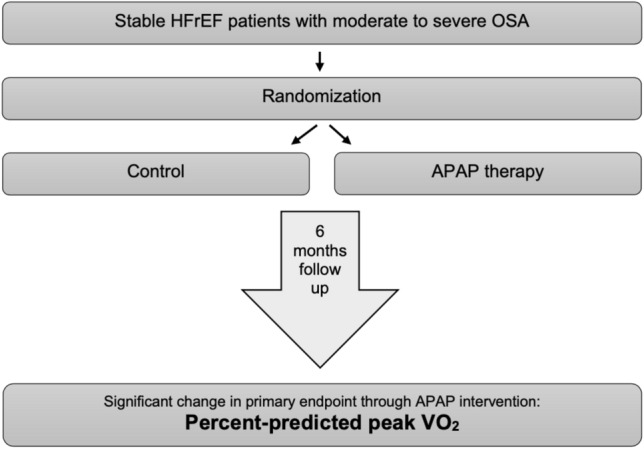
Methods: This randomized, controlled pilot study included patients with chronic, stable HFrEF who had moderate-to-severe OSA. Patients were randomized 1:1 to either APAP (AutoSet™, ResMed) or nasal strips (control) for 6 months.
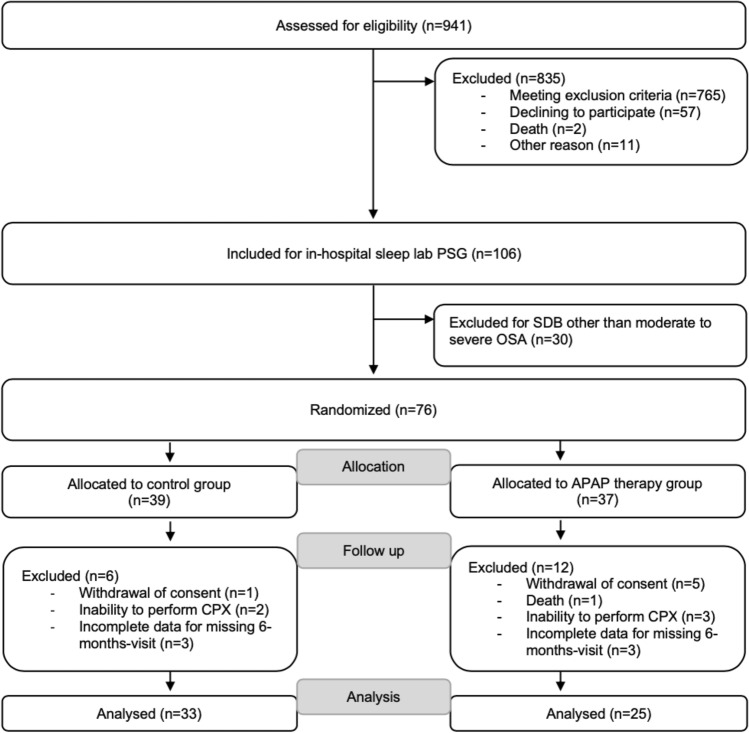
Results: 76 patients have been randomized and 58 had complete data for final analysis. There was a statistically significant change in the APAP intervention arm for the primary endpoint percent-predicted peak VO2 in comparison to control (67 ± 17 to 73 ± 19%; p = 0.01). Additional primary endpoints peak VO2 and VO2-AT showed a trend in increase in the APAP group. Moreover, there were significant improvements within the APAP group for hypoxemia, left ventricular function and quality of life from baseline to 6 months, but not within the control group (p = 0.001 and p = 0.037, respectively).
Conclusion: APAP intervention was shown to significantly improve outcome compared to control group, represented in percent-predicted peak VO2, an established surrogate marker for cardiovascular prognosis in HFrEF. APAP has additional beneficial effects on hypoxemia, cardiac function and quality of life.
期刊介绍:
Clinical Research in Cardiology is an international journal for clinical cardiovascular research. It provides a forum for original and review articles as well as critical perspective articles. Articles are only accepted if they meet stringent scientific standards and have undergone peer review. The journal regularly receives articles from the field of clinical cardiology, angiology, as well as heart and vascular surgery.
As the official journal of the German Cardiac Society, it gives a current and competent survey on the diagnosis and therapy of heart and vascular diseases.



 京公网安备 11010802042870号
京ICP备2023020795号-1
京公网安备 11010802042870号
京ICP备2023020795号-1

 分享
分享
 求助内容:
求助内容: 应助结果提醒方式:
 扫码关注我们
