Two-dimensional semiconductor materials with high stability and electron mobility in group-11 chalcogenide compounds: MNX (M = Cu, Ag, Au; N = Cu, Ag, Au; X = S, Se, Te; M ≠ N)†
Wei Shangguan, Cuixia Yan, Wenqing Li, Chen Long, Liming Liu, Chenchen Qi, Qiuyang Li, Yan Zhou, Yurou Guan, Lei Gao and Jinming Cai
{"title":"Two-dimensional semiconductor materials with high stability and electron mobility in group-11 chalcogenide compounds: MNX (M = Cu, Ag, Au; N = Cu, Ag, Au; X = S, Se, Te; M ≠ N)†","authors":"Wei Shangguan, Cuixia Yan, Wenqing Li, Chen Long, Liming Liu, Chenchen Qi, Qiuyang Li, Yan Zhou, Yurou Guan, Lei Gao and Jinming Cai","doi":"10.1039/D1NR06971C","DOIUrl":null,"url":null,"abstract":"<p >It is still an urgent task to find new two-dimensional (2D) semiconductor materials with a suitable band gap, high stability and high mobility for the applications of next generation electronic devices. Based on first-principles calculations, we report a new class of 2D group-11-chalcogenide trielement monolayers (MNX, where M = Cu, Ag, Au; N = Cu, Ag, Au; X = S, Se, Te; M ≠ N) with a wide band gap, excellent stability (dynamic stability, thermodynamic stability and environmental stability) and high mobility. At the mixed density functional level, the energy band gap extends from 0.61 eV to 2.65 eV, covering the ultraviolet-A and visible light regions, which is critical for a broadband optical response. For δ-MNX monolayers, the carrier mobility is as high as 10<small><sup>4</sup></small> cm<small><sup>2</sup></small> V<small><sup>?1</sup></small> s<small><sup>?1</sup></small> at room temperature. In particular, the mobility of δ-AgAuS is as high as 6.94 × 10<small><sup>4</sup></small> cm<small><sup>2</sup></small> V<small><sup>?1</sup></small> s<small><sup>?1</sup></small>, which is of great research significance for the application of electronic devices in the future. Based on the above advantages, group-11 chalcogenide MNX monomolecular films have broad prospects in the field of nanoelectronics and optoelectronics in the future.</p>","PeriodicalId":92,"journal":{"name":"Nanoscale","volume":" 11","pages":" 4271-4280"},"PeriodicalIF":5.1000,"publicationDate":"2022-02-09","publicationTypes":"Journal Article","fieldsOfStudy":null,"isOpenAccess":false,"openAccessPdf":"","citationCount":"2","resultStr":null,"platform":"Semanticscholar","paperid":null,"PeriodicalName":"Nanoscale","FirstCategoryId":"88","ListUrlMain":"https://pubs.rsc.org/en/content/articlelanding/2022/nr/d1nr06971c","RegionNum":3,"RegionCategory":"材料科学","ArticlePicture":[],"TitleCN":null,"AbstractTextCN":null,"PMCID":null,"EPubDate":"","PubModel":"","JCR":"Q1","JCRName":"CHEMISTRY, MULTIDISCIPLINARY","Score":null,"Total":0}
引用次数: 2
Abstract
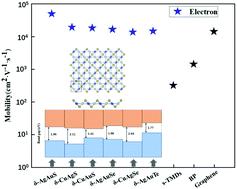
It is still an urgent task to find new two-dimensional (2D) semiconductor materials with a suitable band gap, high stability and high mobility for the applications of next generation electronic devices. Based on first-principles calculations, we report a new class of 2D group-11-chalcogenide trielement monolayers (MNX, where M = Cu, Ag, Au; N = Cu, Ag, Au; X = S, Se, Te; M ≠ N) with a wide band gap, excellent stability (dynamic stability, thermodynamic stability and environmental stability) and high mobility. At the mixed density functional level, the energy band gap extends from 0.61 eV to 2.65 eV, covering the ultraviolet-A and visible light regions, which is critical for a broadband optical response. For δ-MNX monolayers, the carrier mobility is as high as 104 cm2 V?1 s?1 at room temperature. In particular, the mobility of δ-AgAuS is as high as 6.94 × 104 cm2 V?1 s?1, which is of great research significance for the application of electronic devices in the future. Based on the above advantages, group-11 chalcogenide MNX monomolecular films have broad prospects in the field of nanoelectronics and optoelectronics in the future.
期刊介绍:
Nanoscale is a high-impact international journal, publishing high-quality research across nanoscience and nanotechnology. Nanoscale publishes a full mix of research articles on experimental and theoretical work, including reviews, communications, and full papers.Highly interdisciplinary, this journal appeals to scientists, researchers and professionals interested in nanoscience and nanotechnology, quantum materials and quantum technology, including the areas of physics, chemistry, biology, medicine, materials, energy/environment, information technology, detection science, healthcare and drug discovery, and electronics.



 京公网安备 11010802042870号
京ICP备2023020795号-1
京公网安备 11010802042870号
京ICP备2023020795号-1

 分享
分享
 求助内容:
求助内容: 应助结果提醒方式:
 扫码关注我们
