What Media Helps, What Media Hurts: A Mixed Methods Survey Study of Coping with COVID-19 Using the Media Repertoire Framework and the Appraisal Theory of Stress.
{"title":"What Media Helps, What Media Hurts: A Mixed Methods Survey Study of Coping with COVID-19 Using the Media Repertoire Framework and the Appraisal Theory of Stress.","authors":"Amber Pahayahay, Najmeh Khalili-Mahani","doi":"10.2196/20186","DOIUrl":null,"url":null,"abstract":"<p><strong>Background: </strong>Social and physical distancing in response to the coronavirus disease (COVID-19) pandemic has made screen-mediated information and communication technologies (media) indispensable. Whether an increase in screen use is a source of or a relief for stress remains to be seen.</p><p><strong>Objective: </strong>In the immediate aftermath of the COVID-19 lockdowns, we investigated the relation between subjective stress and changes in the pattern of media use. Based on Lazarus's transactional model of appraisal and coping, and building on an earlier similar survey, we hypothesize that individual differences in the appraisal of media predict variations in approach or avoidance of media for coping with COVID-19 stress.</p><p><strong>Methods: </strong>Between March 20 and April 20, 2020, a brief snowball survey entitled: \"What media helps, what media hurts: coping with COVID19 through screens\" was distributed via Concordia University's mailing lists and social media (PERFORM Centre, EngAGE Centre, and Media Health Lab). Using a media repertoire method, we asked questions about preferences, changes in use, and personal appraisal of media experiences (approach, avoid, and ignore) as a result of the COVID-19 pandemic and investigated interindividual differences in media use by factors such as subjective stress, age, gender, and self-reported mental health.</p><p><strong>Results: </strong>More than 90% of the survey respondents were in Canada and the east coast of the United States. From 685 completed responses, 169 respondents were \"very stressed\" and 452 were \"slightly worried\" about the pandemic. COVID-19 stress led to increased use of Facebook (χ<sup>2</sup><sub>3</sub>=11.76, P=.008), television (χ<sup>2</sup><sub>3</sub>=12.40, P=.006), YouTube (χ<sup>2</sup><sub>3</sub>=8.577, P=.04), and streaming services such as Netflix (χ<sup>2</sup><sub>3</sub>=10.71, P=.01). Respondents who considered their mental health \"not good\" were twice as likely to prefer streaming services as a coping tool for self-isolation. Women and nonbinary respondents were twice as likely than men to pick social media for coping. Individuals younger than 35 years were 3 times more likely to pick computer games, and individuals older than 55 years were more likely to pick network television or print media. Gender affected the appraisal of media (less in men than others) in terms of avoid (F<sub>1,637</sub>=5.84, P=.02) and approach scores (F<sub>1,637</sub>=14.31, P<.001). Subjective mental health affected the ignore score (less in those who said \"good\" than others; F<sub>1,637</sub>=13.88, P<.001). The appraisal score and use increase explained variations in worrying about physical and mental health stress due to increased screen time. A qualitative analysis of open-ended questions revealed that media (especially social networks) were important for coping if they provided support and connection through the dissemination of factual and positive information while avoiding the overflow of sensational and false news.</p><p><strong>Conclusions: </strong>The relationship between appraisal of media's positive and negative facets vary with demographic differences in mental health resiliency. The media repertoire approach is an important tool in studies that focus on assessing the benefits and harms of screen overuse in different populations, especially in the context of the COVID-19 pandemic.</p>","PeriodicalId":16337,"journal":{"name":"Journal of Medical Internet Research","volume":"22 8","pages":"e20186"},"PeriodicalIF":6.0000,"publicationDate":"2020-08-06","publicationTypes":"Journal Article","fieldsOfStudy":null,"isOpenAccess":false,"openAccessPdf":"https://www.ncbi.nlm.nih.gov/pmc/articles/PMC7419155/pdf/","citationCount":"84","resultStr":null,"platform":"Semanticscholar","paperid":null,"PeriodicalName":"Journal of Medical Internet Research","FirstCategoryId":"3","ListUrlMain":"https://doi.org/10.2196/20186","RegionNum":2,"RegionCategory":"医学","ArticlePicture":[],"TitleCN":null,"AbstractTextCN":null,"PMCID":null,"EPubDate":"","PubModel":"","JCR":"Q1","JCRName":"HEALTH CARE SCIENCES & SERVICES","Score":null,"Total":0}
引用次数: 84
Abstract
Background: Social and physical distancing in response to the coronavirus disease (COVID-19) pandemic has made screen-mediated information and communication technologies (media) indispensable. Whether an increase in screen use is a source of or a relief for stress remains to be seen.
Objective: In the immediate aftermath of the COVID-19 lockdowns, we investigated the relation between subjective stress and changes in the pattern of media use. Based on Lazarus's transactional model of appraisal and coping, and building on an earlier similar survey, we hypothesize that individual differences in the appraisal of media predict variations in approach or avoidance of media for coping with COVID-19 stress.
Methods: Between March 20 and April 20, 2020, a brief snowball survey entitled: "What media helps, what media hurts: coping with COVID19 through screens" was distributed via Concordia University's mailing lists and social media (PERFORM Centre, EngAGE Centre, and Media Health Lab). Using a media repertoire method, we asked questions about preferences, changes in use, and personal appraisal of media experiences (approach, avoid, and ignore) as a result of the COVID-19 pandemic and investigated interindividual differences in media use by factors such as subjective stress, age, gender, and self-reported mental health.
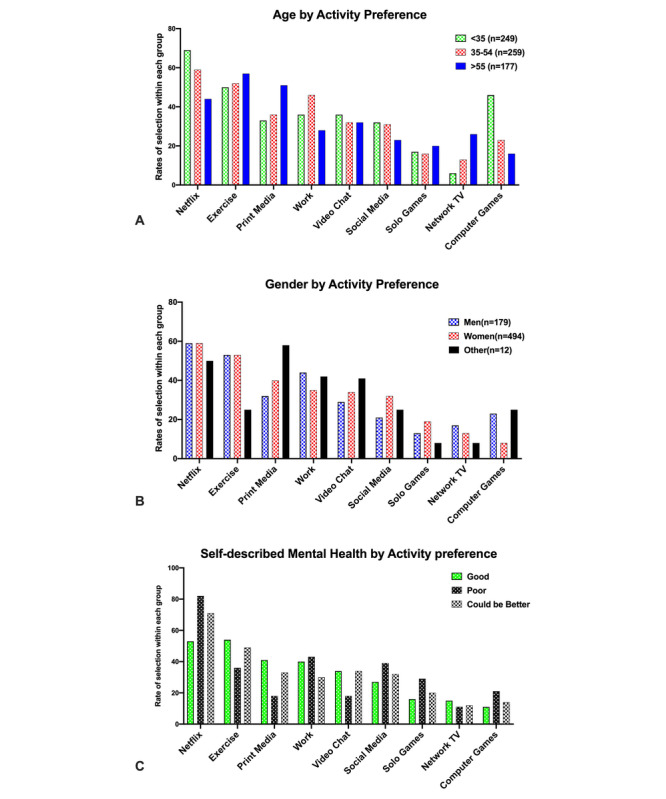
Results: More than 90% of the survey respondents were in Canada and the east coast of the United States. From 685 completed responses, 169 respondents were "very stressed" and 452 were "slightly worried" about the pandemic. COVID-19 stress led to increased use of Facebook (χ23=11.76, P=.008), television (χ23=12.40, P=.006), YouTube (χ23=8.577, P=.04), and streaming services such as Netflix (χ23=10.71, P=.01). Respondents who considered their mental health "not good" were twice as likely to prefer streaming services as a coping tool for self-isolation. Women and nonbinary respondents were twice as likely than men to pick social media for coping. Individuals younger than 35 years were 3 times more likely to pick computer games, and individuals older than 55 years were more likely to pick network television or print media. Gender affected the appraisal of media (less in men than others) in terms of avoid (F1,637=5.84, P=.02) and approach scores (F1,637=14.31, P<.001). Subjective mental health affected the ignore score (less in those who said "good" than others; F1,637=13.88, P<.001). The appraisal score and use increase explained variations in worrying about physical and mental health stress due to increased screen time. A qualitative analysis of open-ended questions revealed that media (especially social networks) were important for coping if they provided support and connection through the dissemination of factual and positive information while avoiding the overflow of sensational and false news.
Conclusions: The relationship between appraisal of media's positive and negative facets vary with demographic differences in mental health resiliency. The media repertoire approach is an important tool in studies that focus on assessing the benefits and harms of screen overuse in different populations, especially in the context of the COVID-19 pandemic.
期刊介绍:
The Journal of Medical Internet Research (JMIR) is a highly respected publication in the field of health informatics and health services. With a founding date in 1999, JMIR has been a pioneer in the field for over two decades.
As a leader in the industry, the journal focuses on digital health, data science, health informatics, and emerging technologies for health, medicine, and biomedical research. It is recognized as a top publication in these disciplines, ranking in the first quartile (Q1) by Impact Factor.
Notably, JMIR holds the prestigious position of being ranked #1 on Google Scholar within the "Medical Informatics" discipline.





 京公网安备 11010802042870号
京ICP备2023020795号-1
京公网安备 11010802042870号
京ICP备2023020795号-1

 分享
分享
 求助内容:
求助内容: 应助结果提醒方式:
 扫码关注我们
