{"title":"Breast artery calcification as a predictor of coronary artery calcification: a cross-sectional study.","authors":"Batool Seifi, Reza Javadrashid, Fatemeh Seifi, Jhila Khamanian, Armin Zarrintan, Mohammad Mirza-Aghazadeh-Attari","doi":"10.5114/pjr.2020.97932","DOIUrl":null,"url":null,"abstract":"<p><strong>Introduction: </strong>Coronary artery disease is the main cause of burden of disease in the world. Coronary calcification is seen as an aetiopathological event in the pathogenesis of cardiovascular diseases. Studies have shown that breast artery calcification, which is routinely found in mammography of elderly women, could be predictive of coronary artery calcification.</p><p><strong>Material and methods: </strong>In this cross-sectional study, 60 women over 40 years of age were included. All of these patients had undergone mammography after having an indication to undergo a computed tomography-angiography. Breast arterial calcification and calcium scores were determined for each patient, and the paired-<i>t</i> test was used to analyse the data.</p><p><strong>Results: </strong>The mean age of patients was 49.52 ± 8.83 years. Of these 60 women, 50% were postmenopausal and 50% were not. In 37 (61.7%) cases, mild to severe coronary calcification was observed, and 50 (83.3%) had mild to severe breast arterial calcification. There was a significant correlation between coronary calcification and breast artery calcification (<i>p</i> = 0.001), and there was also a significant relationship between coronary calcification and postmenopausal calcification (<i>p</i> < 0.001).</p><p><strong>Conclusions: </strong>Breast artery calcification can be a suitable predictor for coronary artery calcification and is a valid method for predicting cardiovascular disease probability in the future.</p>","PeriodicalId":47128,"journal":{"name":"Polish Journal of Radiology","volume":"85 ","pages":"e369-e374"},"PeriodicalIF":1.6000,"publicationDate":"2020-07-20","publicationTypes":"Journal Article","fieldsOfStudy":null,"isOpenAccess":false,"openAccessPdf":"https://ftp.ncbi.nlm.nih.gov/pub/pmc/oa_pdf/22/50/PJR-85-41522.PMC7425222.pdf","citationCount":"4","resultStr":null,"platform":"Semanticscholar","paperid":null,"PeriodicalName":"Polish Journal of Radiology","FirstCategoryId":"1085","ListUrlMain":"https://doi.org/10.5114/pjr.2020.97932","RegionNum":0,"RegionCategory":null,"ArticlePicture":[],"TitleCN":null,"AbstractTextCN":null,"PMCID":null,"EPubDate":"2020/1/1 0:00:00","PubModel":"eCollection","JCR":"Q4","JCRName":"RADIOLOGY, NUCLEAR MEDICINE & MEDICAL IMAGING","Score":null,"Total":0}
引用次数: 4
Abstract
Introduction: Coronary artery disease is the main cause of burden of disease in the world. Coronary calcification is seen as an aetiopathological event in the pathogenesis of cardiovascular diseases. Studies have shown that breast artery calcification, which is routinely found in mammography of elderly women, could be predictive of coronary artery calcification.
Material and methods: In this cross-sectional study, 60 women over 40 years of age were included. All of these patients had undergone mammography after having an indication to undergo a computed tomography-angiography. Breast arterial calcification and calcium scores were determined for each patient, and the paired-t test was used to analyse the data.
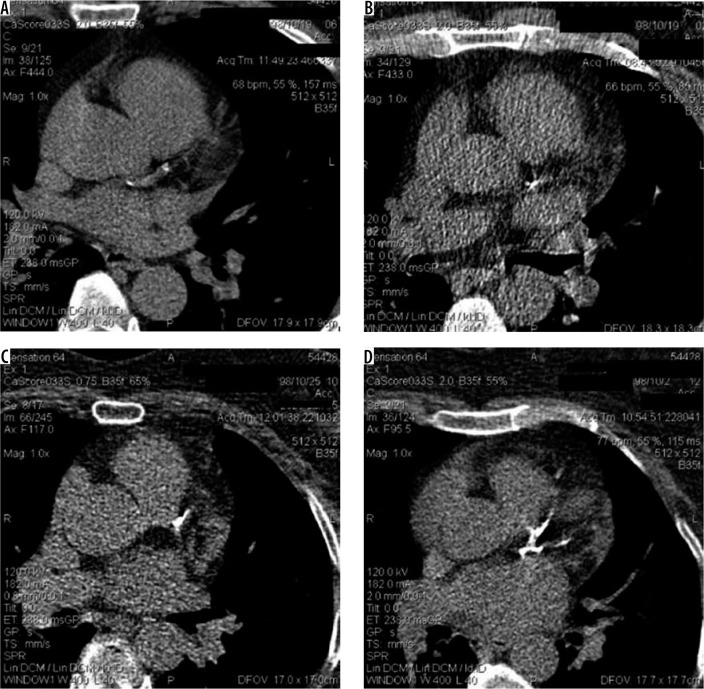
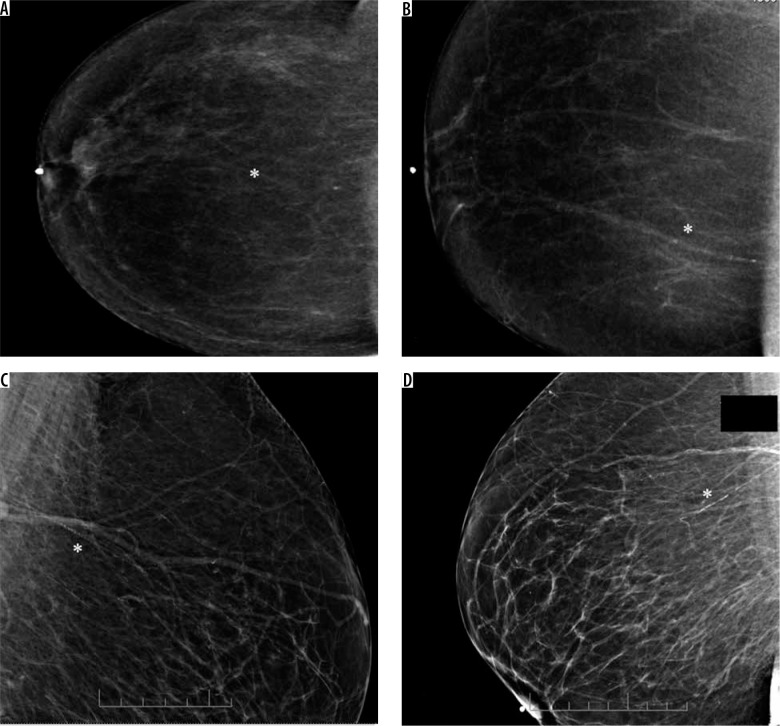
Results: The mean age of patients was 49.52 ± 8.83 years. Of these 60 women, 50% were postmenopausal and 50% were not. In 37 (61.7%) cases, mild to severe coronary calcification was observed, and 50 (83.3%) had mild to severe breast arterial calcification. There was a significant correlation between coronary calcification and breast artery calcification (p = 0.001), and there was also a significant relationship between coronary calcification and postmenopausal calcification (p < 0.001).
Conclusions: Breast artery calcification can be a suitable predictor for coronary artery calcification and is a valid method for predicting cardiovascular disease probability in the future.





 京公网安备 11010802042870号
京ICP备2023020795号-1
京公网安备 11010802042870号
京ICP备2023020795号-1

 分享
分享
 求助内容:
求助内容: 应助结果提醒方式:
 扫码关注我们
