Clinical effectiveness of zinc supplementation on the biomarkers of oxidative stress: A systematic review and meta-analysis of randomized controlled trials
Seyed Mohammad Mousavi , Maryam Hajishafiee , Cain C.T. Clark , Israel Júnior Borges do Nascimento , Alireza Milajerdi , Mohammad Reza Amini , Ahmad Esmaillzadeh
{"title":"Clinical effectiveness of zinc supplementation on the biomarkers of oxidative stress: A systematic review and meta-analysis of randomized controlled trials","authors":"Seyed Mohammad Mousavi , Maryam Hajishafiee , Cain C.T. Clark , Israel Júnior Borges do Nascimento , Alireza Milajerdi , Mohammad Reza Amini , Ahmad Esmaillzadeh","doi":"10.1016/j.phrs.2020.105166","DOIUrl":null,"url":null,"abstract":"<div><h3>Background</h3><p>Oxidative stress plays an important role in the occurrence of chronic diseases. Zinc supplementation is also known to be an antioxidant agent. While, there is no review on the effects of zinc supplementation on oxidative stress, this study aimed to systematically summarize randomized clinical trials (RCTs) which have evaluated the impacts of zinc supplementation on oxidative stress biomarkers.</p></div><div><h3>Methods</h3><p><span><span>Systematic searches were performed using the PubMed/Medline, Scopus, and Google Scholar databases, up to April 2020. All RCTs assessed the effect of oral zinc supplementation on serum malondialdehyde<span> (MDA), total antioxidant capacity (TAC), </span></span>glutathione (GSH), and </span>nitric oxide (NO) levels, were included. For each variable, mean differences (MD) and standard deviations (SDs) were combined using the random-effects model, and the fractional polynomial model was used to implement the dose-response analysis.</p></div><div><h3>Results</h3><p>Ten RCTs were included. The pooled analysis of data showed that zinc supplementation significantly reduced MDA levels (MD: -0.42 μmol/L; 95 % CI: -0.71 to -0.13), increased serum TAC (MD: 225.96 mmol/L; 95 % CI: 68.42–383.5) and GSH levels (MD: 49.99 μmol/L; 95 % CI: 2.25 t 97.73), compared with the placebo group. In contrast, no significant changes were seen in NO levels following zinc supplementation (MD: -1.66 μmol/L; 95 % CI: -5.89 to 2.57). Dose-response analysis showed a significant non-linear relationship between zinc supplementation dosage and serum levels of MDA (p < 0.01), but not other biomarkers.</p></div><div><h3>Conclusions</h3><p>The current study showed that zinc supplementation would significantly decrease MDA and increase TAC and GSH, but not NO levels. Thus, it encourages the use of zinc supplementation in oxidative stress-related diseases.</p></div>","PeriodicalId":19918,"journal":{"name":"Pharmacological research","volume":"161 ","pages":"Article 105166"},"PeriodicalIF":10.5000,"publicationDate":"2020-11-01","publicationTypes":"Journal Article","fieldsOfStudy":null,"isOpenAccess":false,"openAccessPdf":"https://sci-hub-pdf.com/10.1016/j.phrs.2020.105166","citationCount":"11","resultStr":null,"platform":"Semanticscholar","paperid":null,"PeriodicalName":"Pharmacological research","FirstCategoryId":"3","ListUrlMain":"https://www.sciencedirect.com/science/article/pii/S1043661820314742","RegionNum":2,"RegionCategory":"医学","ArticlePicture":[],"TitleCN":null,"AbstractTextCN":null,"PMCID":null,"EPubDate":"","PubModel":"","JCR":"Q1","JCRName":"PHARMACOLOGY & PHARMACY","Score":null,"Total":0}
引用次数: 11
Abstract
Background
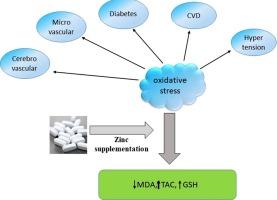
Oxidative stress plays an important role in the occurrence of chronic diseases. Zinc supplementation is also known to be an antioxidant agent. While, there is no review on the effects of zinc supplementation on oxidative stress, this study aimed to systematically summarize randomized clinical trials (RCTs) which have evaluated the impacts of zinc supplementation on oxidative stress biomarkers.
Methods
Systematic searches were performed using the PubMed/Medline, Scopus, and Google Scholar databases, up to April 2020. All RCTs assessed the effect of oral zinc supplementation on serum malondialdehyde (MDA), total antioxidant capacity (TAC), glutathione (GSH), and nitric oxide (NO) levels, were included. For each variable, mean differences (MD) and standard deviations (SDs) were combined using the random-effects model, and the fractional polynomial model was used to implement the dose-response analysis.
Results
Ten RCTs were included. The pooled analysis of data showed that zinc supplementation significantly reduced MDA levels (MD: -0.42 μmol/L; 95 % CI: -0.71 to -0.13), increased serum TAC (MD: 225.96 mmol/L; 95 % CI: 68.42–383.5) and GSH levels (MD: 49.99 μmol/L; 95 % CI: 2.25 t 97.73), compared with the placebo group. In contrast, no significant changes were seen in NO levels following zinc supplementation (MD: -1.66 μmol/L; 95 % CI: -5.89 to 2.57). Dose-response analysis showed a significant non-linear relationship between zinc supplementation dosage and serum levels of MDA (p < 0.01), but not other biomarkers.
Conclusions
The current study showed that zinc supplementation would significantly decrease MDA and increase TAC and GSH, but not NO levels. Thus, it encourages the use of zinc supplementation in oxidative stress-related diseases.
期刊介绍:
Pharmacological Research publishes cutting-edge articles in biomedical sciences to cover a broad range of topics that move the pharmacological field forward. Pharmacological research publishes articles on molecular, biochemical, translational, and clinical research (including clinical trials); it is proud of its rapid publication of accepted papers that comprises a dedicated, fast acceptance and publication track for high profile articles.



 京公网安备 11010802042870号
京ICP备2023020795号-1
京公网安备 11010802042870号
京ICP备2023020795号-1

 分享
分享
 求助内容:
求助内容: 应助结果提醒方式:
 扫码关注我们
