{"title":"Beyond just \"flattening the curve\": Optimal control of epidemics with purely non-pharmaceutical interventions.","authors":"Markus Kantner, Thomas Koprucki","doi":"10.1186/s13362-020-00091-3","DOIUrl":null,"url":null,"abstract":"<p><p>When effective medical treatment and vaccination are not available, non-pharmaceutical interventions such as social distancing, home quarantine and far-reaching shutdown of public life are the only available strategies to prevent the spread of epidemics. Based on an extended SEIR (susceptible-exposed-infectious-recovered) model and continuous-time optimal control theory, we compute the optimal non-pharmaceutical intervention strategy for the case that a vaccine is never found and complete containment (eradication of the epidemic) is impossible. In this case, the optimal control must meet competing requirements: First, the minimization of disease-related deaths, and, second, the establishment of a sufficient degree of natural immunity at the end of the measures, in order to exclude a second wave. Moreover, the socio-economic costs of the intervention shall be kept at a minimum. The numerically computed optimal control strategy is a single-intervention scenario that goes beyond heuristically motivated interventions and simple \"flattening of the curve\". Careful analysis of the computed control strategy reveals, however, that the obtained solution is in fact a tightrope walk close to the stability boundary of the system, where socio-economic costs and the risk of a new outbreak must be constantly balanced against one another. The model system is calibrated to reproduce the initial exponential growth phase of the COVID-19 pandemic in Germany.</p>","PeriodicalId":44012,"journal":{"name":"Journal of Mathematics in Industry","volume":"10 1","pages":"23"},"PeriodicalIF":1.7000,"publicationDate":"2020-01-01","publicationTypes":"Journal Article","fieldsOfStudy":null,"isOpenAccess":false,"openAccessPdf":"https://www.ncbi.nlm.nih.gov/pmc/articles/PMC7432561/pdf/","citationCount":"0","resultStr":null,"platform":"Semanticscholar","paperid":null,"PeriodicalName":"Journal of Mathematics in Industry","FirstCategoryId":"1085","ListUrlMain":"https://doi.org/10.1186/s13362-020-00091-3","RegionNum":0,"RegionCategory":null,"ArticlePicture":[],"TitleCN":null,"AbstractTextCN":null,"PMCID":null,"EPubDate":"2020/8/18 0:00:00","PubModel":"Epub","JCR":"Q3","JCRName":"MATHEMATICS, INTERDISCIPLINARY APPLICATIONS","Score":null,"Total":0}
引用次数: 0
Abstract
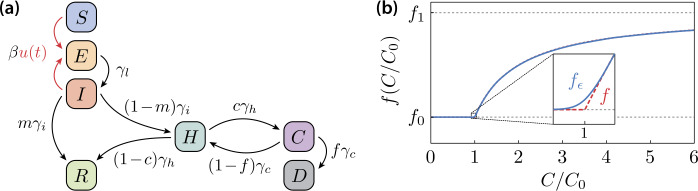
When effective medical treatment and vaccination are not available, non-pharmaceutical interventions such as social distancing, home quarantine and far-reaching shutdown of public life are the only available strategies to prevent the spread of epidemics. Based on an extended SEIR (susceptible-exposed-infectious-recovered) model and continuous-time optimal control theory, we compute the optimal non-pharmaceutical intervention strategy for the case that a vaccine is never found and complete containment (eradication of the epidemic) is impossible. In this case, the optimal control must meet competing requirements: First, the minimization of disease-related deaths, and, second, the establishment of a sufficient degree of natural immunity at the end of the measures, in order to exclude a second wave. Moreover, the socio-economic costs of the intervention shall be kept at a minimum. The numerically computed optimal control strategy is a single-intervention scenario that goes beyond heuristically motivated interventions and simple "flattening of the curve". Careful analysis of the computed control strategy reveals, however, that the obtained solution is in fact a tightrope walk close to the stability boundary of the system, where socio-economic costs and the risk of a new outbreak must be constantly balanced against one another. The model system is calibrated to reproduce the initial exponential growth phase of the COVID-19 pandemic in Germany.





 京公网安备 11010802042870号
京ICP备2023020795号-1
京公网安备 11010802042870号
京ICP备2023020795号-1

 分享
分享
 求助内容:
求助内容: 应助结果提醒方式:
 扫码关注我们
