Jingjing Jin, Dan Liu, Yongzhi Qi, Jun Ma, Wenchao Zhen
{"title":"Major QTL for Seven Yield-Related Traits in Common Wheat (Triticum aestivum L.).","authors":"Jingjing Jin, Dan Liu, Yongzhi Qi, Jun Ma, Wenchao Zhen","doi":"10.3389/fgene.2020.01012","DOIUrl":null,"url":null,"abstract":"<p><p>Flag leaves, plant height (PH), and spike-related traits are key determinants contributing to yield potential in wheat. In this study, we developed a recombinant inbred line (RIL) population with 94 lines derived from the cross between 'AS985472' and 'Sumai 3.' A genetic map spanned 3553.69 cM in length were constructed using 1978 DArT markers. Severn traits including flag leaf width (FLW), flag leaf length (FLL), PH, anthesis date (AD), spike length (SL), spikelet number spike (SNS), and spike density (SD) were evaluated against this RIL population under three different environments. Combined phenotypic data and genetic map, we identified quantitative trait loci (QTL) for each trait. A total of four major and stably expressed QTLs for FLW, PH, and SD were detected on chromosomes 2D and 4B. Of them, the major QTLs individually explained 10.10 - 30.68% of the phenotypic variation. QTLs with pleiotropic effects were identified on chromosomes 4A and 6D as well. Furthermore, the genetic relationships between seven yield-related traits were detected and discussed. A few genes related to leaf growth and development at the interval of a major locus for FLW on chromosome 2D were predicated. Overall, the present study provided useful information for understanding the genetic basis of yield-related traits and will be useful for marker-assisted selection in wheat breeding.</p>","PeriodicalId":12750,"journal":{"name":"Frontiers in Genetics","volume":" ","pages":"1012"},"PeriodicalIF":2.8000,"publicationDate":"2020-08-28","publicationTypes":"Journal Article","fieldsOfStudy":null,"isOpenAccess":false,"openAccessPdf":"https://sci-hub-pdf.com/10.3389/fgene.2020.01012","citationCount":"18","resultStr":null,"platform":"Semanticscholar","paperid":null,"PeriodicalName":"Frontiers in Genetics","FirstCategoryId":"99","ListUrlMain":"https://doi.org/10.3389/fgene.2020.01012","RegionNum":3,"RegionCategory":"生物学","ArticlePicture":[],"TitleCN":null,"AbstractTextCN":null,"PMCID":null,"EPubDate":"2020/1/1 0:00:00","PubModel":"eCollection","JCR":"Q2","JCRName":"GENETICS & HEREDITY","Score":null,"Total":0}
引用次数: 18
Abstract
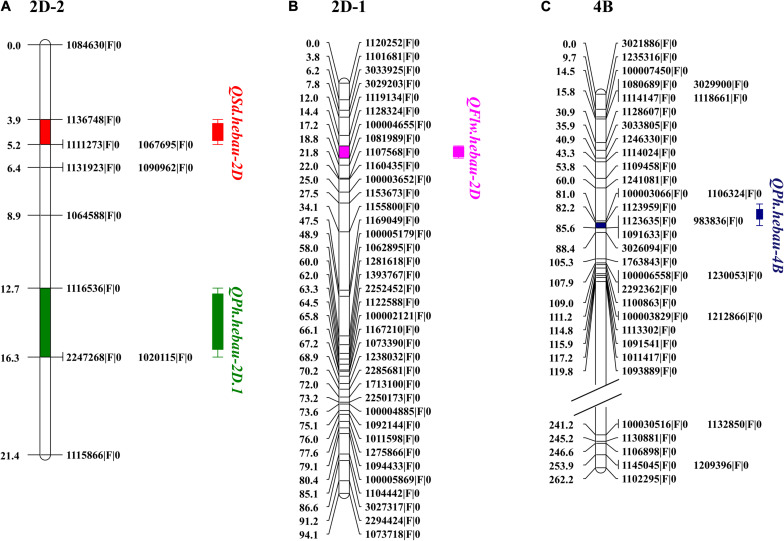
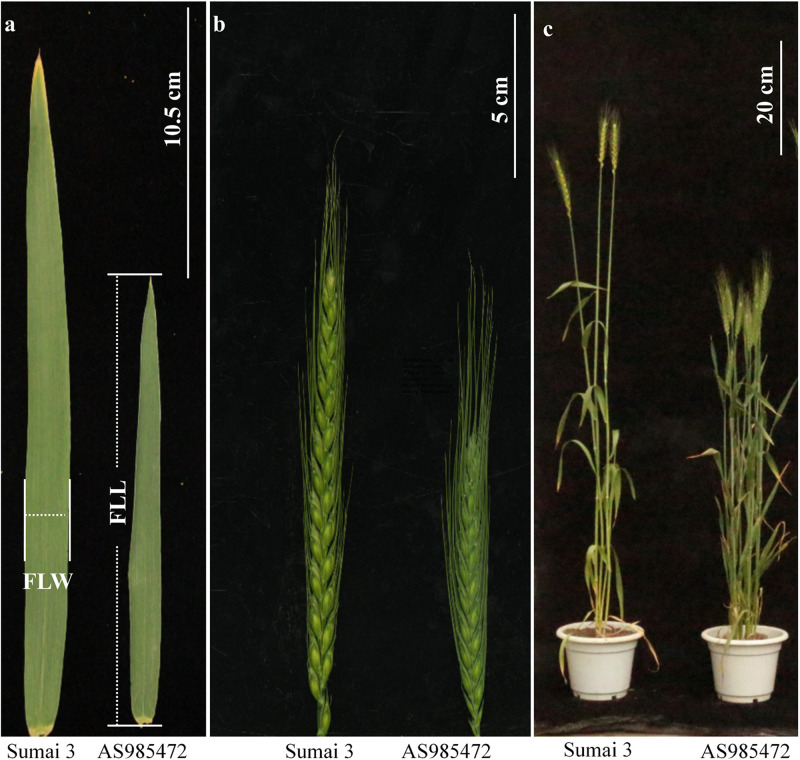
Flag leaves, plant height (PH), and spike-related traits are key determinants contributing to yield potential in wheat. In this study, we developed a recombinant inbred line (RIL) population with 94 lines derived from the cross between 'AS985472' and 'Sumai 3.' A genetic map spanned 3553.69 cM in length were constructed using 1978 DArT markers. Severn traits including flag leaf width (FLW), flag leaf length (FLL), PH, anthesis date (AD), spike length (SL), spikelet number spike (SNS), and spike density (SD) were evaluated against this RIL population under three different environments. Combined phenotypic data and genetic map, we identified quantitative trait loci (QTL) for each trait. A total of four major and stably expressed QTLs for FLW, PH, and SD were detected on chromosomes 2D and 4B. Of them, the major QTLs individually explained 10.10 - 30.68% of the phenotypic variation. QTLs with pleiotropic effects were identified on chromosomes 4A and 6D as well. Furthermore, the genetic relationships between seven yield-related traits were detected and discussed. A few genes related to leaf growth and development at the interval of a major locus for FLW on chromosome 2D were predicated. Overall, the present study provided useful information for understanding the genetic basis of yield-related traits and will be useful for marker-assisted selection in wheat breeding.
Frontiers in GeneticsBiochemistry, Genetics and Molecular Biology-Molecular Medicine
CiteScore
5.50
自引率
8.10%
发文量
3491
审稿时长
14 weeks
期刊介绍:
Frontiers in Genetics publishes rigorously peer-reviewed research on genes and genomes relating to all the domains of life, from humans to plants to livestock and other model organisms. Led by an outstanding Editorial Board of the world’s leading experts, this multidisciplinary, open-access journal is at the forefront of communicating cutting-edge research to researchers, academics, clinicians, policy makers and the public.
The study of inheritance and the impact of the genome on various biological processes is well documented. However, the majority of discoveries are still to come. A new era is seeing major developments in the function and variability of the genome, the use of genetic and genomic tools and the analysis of the genetic basis of various biological phenomena.




 京公网安备 11010802042870号
京ICP备2023020795号-1
京公网安备 11010802042870号
京ICP备2023020795号-1

 分享
分享
 求助内容:
求助内容: 应助结果提醒方式:
 扫码关注我们
