Karlijn E. P. E. Hermans, Piet A. van den Brandt, Caroline Loef, Rob L. H. Jansen, Leo J. Schouten
{"title":"Alcohol consumption, cigarette smoking and cancer of unknown primary risk: Results from the Netherlands Cohort Study","authors":"Karlijn E. P. E. Hermans, Piet A. van den Brandt, Caroline Loef, Rob L. H. Jansen, Leo J. Schouten","doi":"10.1002/ijc.33328","DOIUrl":null,"url":null,"abstract":"<p>Cancer of unknown primary (CUP) is a metastasised malignancy with no identifiable primary tumour origin. Despite the frequent occurrence and bleak prognosis of CUP, research into its aetiology is scarce. Our study investigates alcohol consumption, tobacco smoking and CUP risk. We used data from the Netherlands Cohort Study, a cohort that includes 120 852 participants aged 55 to 69 years, who completed a self-administered questionnaire on cancer risk factors at baseline. Cancer follow-up was established through record linkage to the Netherlands Cancer Registry and Dutch Pathology Registry. After 20.3 years of follow-up, 963 CUP cases and 4288 subcohort members were available for case-cohort analyses. Multivariable-adjusted hazard ratios (HRs) were calculated using proportional hazard models. In general, CUP risk increased with higher levels of alcohol intake (<i>P</i><sub>trend</sub> = .02). The association was more pronounced in participants who drank ≥30 g of ethanol per day (HR: 1.57, 95% confidence interval [CI]: 1.20-2.05) compared to abstainers. Current smokers were at an increased CUP risk (HR: 1.59, 95% CI: 1.29-1.97) compared to never smokers. We observed that the more the cigarettes or the longer a participant smoked, the higher the CUP risk was (<i>P</i><sub>trend</sub> = .003 and <i>P</i><sub>trend</sub> = .02, respectively). Interaction on additive scale was found for participants with the highest exposure categories of alcohol consumption and cigarette smoking frequency and CUP risk. Our findings demonstrate that alcohol consumption and cigarette smoking are associated with increased CUP risk. Lifestyle recommendations for cancer prevention regarding not drinking alcohol and avoiding exposure to smoking are therefore also valid for CUP.</p>","PeriodicalId":180,"journal":{"name":"International Journal of Cancer","volume":"148 7","pages":"1586-1597"},"PeriodicalIF":4.7000,"publicationDate":"2020-10-06","publicationTypes":"Journal Article","fieldsOfStudy":null,"isOpenAccess":false,"openAccessPdf":"https://sci-hub-pdf.com/10.1002/ijc.33328","citationCount":"13","resultStr":null,"platform":"Semanticscholar","paperid":null,"PeriodicalName":"International Journal of Cancer","FirstCategoryId":"3","ListUrlMain":"https://onlinelibrary.wiley.com/doi/10.1002/ijc.33328","RegionNum":2,"RegionCategory":"医学","ArticlePicture":[],"TitleCN":null,"AbstractTextCN":null,"PMCID":null,"EPubDate":"","PubModel":"","JCR":"Q1","JCRName":"ONCOLOGY","Score":null,"Total":0}
引用次数: 13
Abstract
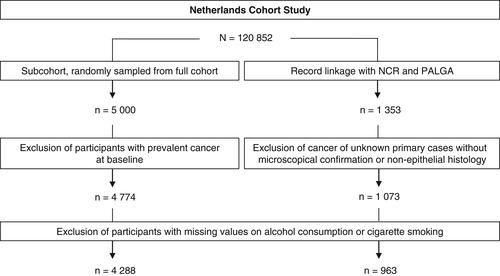
Cancer of unknown primary (CUP) is a metastasised malignancy with no identifiable primary tumour origin. Despite the frequent occurrence and bleak prognosis of CUP, research into its aetiology is scarce. Our study investigates alcohol consumption, tobacco smoking and CUP risk. We used data from the Netherlands Cohort Study, a cohort that includes 120 852 participants aged 55 to 69 years, who completed a self-administered questionnaire on cancer risk factors at baseline. Cancer follow-up was established through record linkage to the Netherlands Cancer Registry and Dutch Pathology Registry. After 20.3 years of follow-up, 963 CUP cases and 4288 subcohort members were available for case-cohort analyses. Multivariable-adjusted hazard ratios (HRs) were calculated using proportional hazard models. In general, CUP risk increased with higher levels of alcohol intake (Ptrend = .02). The association was more pronounced in participants who drank ≥30 g of ethanol per day (HR: 1.57, 95% confidence interval [CI]: 1.20-2.05) compared to abstainers. Current smokers were at an increased CUP risk (HR: 1.59, 95% CI: 1.29-1.97) compared to never smokers. We observed that the more the cigarettes or the longer a participant smoked, the higher the CUP risk was (Ptrend = .003 and Ptrend = .02, respectively). Interaction on additive scale was found for participants with the highest exposure categories of alcohol consumption and cigarette smoking frequency and CUP risk. Our findings demonstrate that alcohol consumption and cigarette smoking are associated with increased CUP risk. Lifestyle recommendations for cancer prevention regarding not drinking alcohol and avoiding exposure to smoking are therefore also valid for CUP.
期刊介绍:
The International Journal of Cancer (IJC) is the official journal of the Union for International Cancer Control—UICC; it appears twice a month. IJC invites submission of manuscripts under a broad scope of topics relevant to experimental and clinical cancer research and publishes original Research Articles and Short Reports under the following categories:
-Cancer Epidemiology-
Cancer Genetics and Epigenetics-
Infectious Causes of Cancer-
Innovative Tools and Methods-
Molecular Cancer Biology-
Tumor Immunology and Microenvironment-
Tumor Markers and Signatures-
Cancer Therapy and Prevention



 京公网安备 11010802042870号
京ICP备2023020795号-1
京公网安备 11010802042870号
京ICP备2023020795号-1

 分享
分享
 求助内容:
求助内容: 应助结果提醒方式:
 扫码关注我们
