Unicompartmental knee arthroplasty and revision total knee arthroplasty have a lower risk of venous thromboembolism disease at 30 days than primary total knee arthroplasty.
Andrew M Schneider, Daniel R Schmitt, Nicholas M Brown
{"title":"Unicompartmental knee arthroplasty and revision total knee arthroplasty have a lower risk of venous thromboembolism disease at 30 days than primary total knee arthroplasty.","authors":"Andrew M Schneider, Daniel R Schmitt, Nicholas M Brown","doi":"10.1186/s43019-020-00078-9","DOIUrl":null,"url":null,"abstract":"<p><strong>Background: </strong>While multiple studies have demonstrated a lower venous thromboembolism disease (VTED) risk for unicompartmental knee arthroplasty (UKA) compared to primary total knee arthroplasty (TKA), recent reports have shown that revision TKA also had a lower VTED risk compared to primary TKA, an unexpected finding because of its theoretical increased risk. Given the paucity of up-to-date comparative studies, our goal was to perform a high-powered VTED risk comparison study of UKA and revision TKA to primary TKA using recent data.</p><p><strong>Methods: </strong>The National Surgical Quality Improvement Program (NSQIP) database was queried between 2011 and 2018, and we identified 213,234 patients for inclusion: 191,810 primary TKA, 9294 UKA, and 12,130 revision TKA. Demographics, medical comorbidities, and possible VTE risk factors were collected. Thirty-day outcomes, including deep vein thrombosis (DVT), pulmonary embolism (PE), and all-cause VTED were compared between knee arthroplasty types.</p><p><strong>Results: </strong>On multivariate analysis, UKA was significantly associated with lower rates of DVT [OR 0.44 (0.31-0.61); P < 0.001], PE [OR 0.42 (0.28-0.65); P < 0.001], and all-cause VTED [OR 0.42 (0.32-0.55); P < 0.001] when compared to primary TKA. Revision TKA was significantly associated with lower rates of PE [OR 0.62 (0.47-0.83); P = 0.002], and all-cause VTED [OR 0.82 (0.70-0.98); P = 0.029] when compared to primary TKA.</p><p><strong>Conclusions: </strong>Utilizing recent data from a nationwide patient cohort and controlling for confounding variables, our results showed that both revision TKA and UKA had a lower risk of VTED compared to primary TKA, corroborating the results of recent investigations. Additional prospective investigations are needed to explain this unexpected result.</p>","PeriodicalId":17886,"journal":{"name":"Knee Surgery & Related Research","volume":"32 1","pages":"59"},"PeriodicalIF":4.4000,"publicationDate":"2020-11-04","publicationTypes":"Journal Article","fieldsOfStudy":null,"isOpenAccess":false,"openAccessPdf":"https://sci-hub-pdf.com/10.1186/s43019-020-00078-9","citationCount":"2","resultStr":null,"platform":"Semanticscholar","paperid":null,"PeriodicalName":"Knee Surgery & Related Research","FirstCategoryId":"1085","ListUrlMain":"https://doi.org/10.1186/s43019-020-00078-9","RegionNum":0,"RegionCategory":null,"ArticlePicture":[],"TitleCN":null,"AbstractTextCN":null,"PMCID":null,"EPubDate":"","PubModel":"","JCR":"Q1","JCRName":"ORTHOPEDICS","Score":null,"Total":0}
引用次数: 2
Abstract
Background: While multiple studies have demonstrated a lower venous thromboembolism disease (VTED) risk for unicompartmental knee arthroplasty (UKA) compared to primary total knee arthroplasty (TKA), recent reports have shown that revision TKA also had a lower VTED risk compared to primary TKA, an unexpected finding because of its theoretical increased risk. Given the paucity of up-to-date comparative studies, our goal was to perform a high-powered VTED risk comparison study of UKA and revision TKA to primary TKA using recent data.
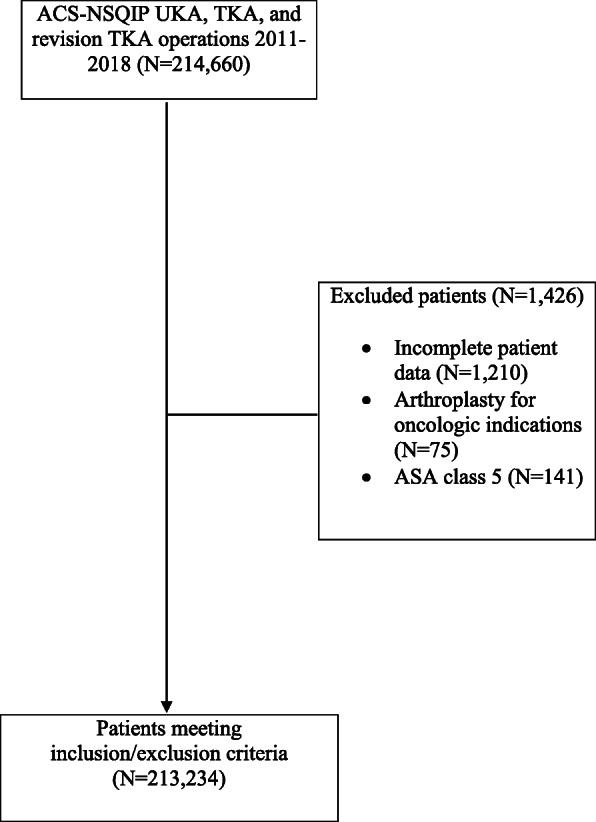
Methods: The National Surgical Quality Improvement Program (NSQIP) database was queried between 2011 and 2018, and we identified 213,234 patients for inclusion: 191,810 primary TKA, 9294 UKA, and 12,130 revision TKA. Demographics, medical comorbidities, and possible VTE risk factors were collected. Thirty-day outcomes, including deep vein thrombosis (DVT), pulmonary embolism (PE), and all-cause VTED were compared between knee arthroplasty types.
Results: On multivariate analysis, UKA was significantly associated with lower rates of DVT [OR 0.44 (0.31-0.61); P < 0.001], PE [OR 0.42 (0.28-0.65); P < 0.001], and all-cause VTED [OR 0.42 (0.32-0.55); P < 0.001] when compared to primary TKA. Revision TKA was significantly associated with lower rates of PE [OR 0.62 (0.47-0.83); P = 0.002], and all-cause VTED [OR 0.82 (0.70-0.98); P = 0.029] when compared to primary TKA.
Conclusions: Utilizing recent data from a nationwide patient cohort and controlling for confounding variables, our results showed that both revision TKA and UKA had a lower risk of VTED compared to primary TKA, corroborating the results of recent investigations. Additional prospective investigations are needed to explain this unexpected result.




 京公网安备 11010802042870号
京ICP备2023020795号-1
京公网安备 11010802042870号
京ICP备2023020795号-1

 分享
分享
 求助内容:
求助内容: 应助结果提醒方式:
 扫码关注我们
