Keno K Bressem, Lisa C Adams, Jakob Albrecht, Antonie Petersen, Hans-Martin Thieß, Alexandra Niehues, Stefan M Niehues, Janis L Vahldiek
{"title":"Is lung density associated with severity of COVID-19?","authors":"Keno K Bressem, Lisa C Adams, Jakob Albrecht, Antonie Petersen, Hans-Martin Thieß, Alexandra Niehues, Stefan M Niehues, Janis L Vahldiek","doi":"10.5114/pjr.2020.100788","DOIUrl":null,"url":null,"abstract":"<p><strong>Purpose: </strong>Emphysema and chronic obstructive lung disease were previously identified as major risk factors for severe disease progression in COVID-19. Computed tomography (CT)-based lung-density analysis offers a fast, reliable, and quantitative assessment of lung density. Therefore, we aimed to assess the benefit of CT-based lung density measurements to predict possible severe disease progression in COVID-19.</p><p><strong>Material and methods: </strong>Thirty COVID-19-positive patients were included in this retrospective study. Lung density was quantified based on routinely acquired chest CTs. Presence of COVID-19 was confirmed by reverse transcription polymerase chain reaction (RT-PCR). Wilcoxon test was used to compare two groups of patients. A multivariate regression analysis, adjusted for age and sex, was employed to model the relative increase of risk for severe disease, depending on the measured densities.</p><p><strong>Results: </strong>Intensive care unit (ICU) patients or patients requiring mechanical ventilation showed a lower proportion of medium- and low-density lung volume compared to patients on the normal ward, but a significantly larger volume of high-density lung volume (12.26 dl IQR 4.65 dl vs. 7.51 dl vs. IQR 5.39 dl, <i>p</i> = 0.039). In multivariate regression analysis, high-density lung volume was identified as a significant predictor of severe disease.</p><p><strong>Conclusions: </strong>The amount of high-density lung tissue showed a significant association with severe COVID-19, with odds ratios of 1.42 (95% CI: 1.09-2.00) and 1.37 (95% CI: 1.03-2.11) for requiring intensive care and mechanical ventilation, respectively. Acknowledging our small sample size as an important limitation; our study might thus suggest that high-density lung tissue could serve as a possible predictor of severe COVID-19.</p>","PeriodicalId":47128,"journal":{"name":"Polish Journal of Radiology","volume":"85 ","pages":"e600-e606"},"PeriodicalIF":1.6000,"publicationDate":"2020-10-30","publicationTypes":"Journal Article","fieldsOfStudy":null,"isOpenAccess":false,"openAccessPdf":"https://ftp.ncbi.nlm.nih.gov/pub/pmc/oa_pdf/61/f0/PJR-85-42392.PMC7654311.pdf","citationCount":"6","resultStr":null,"platform":"Semanticscholar","paperid":null,"PeriodicalName":"Polish Journal of Radiology","FirstCategoryId":"1085","ListUrlMain":"https://doi.org/10.5114/pjr.2020.100788","RegionNum":0,"RegionCategory":null,"ArticlePicture":[],"TitleCN":null,"AbstractTextCN":null,"PMCID":null,"EPubDate":"2020/1/1 0:00:00","PubModel":"eCollection","JCR":"Q4","JCRName":"RADIOLOGY, NUCLEAR MEDICINE & MEDICAL IMAGING","Score":null,"Total":0}
引用次数: 6
Abstract
Purpose: Emphysema and chronic obstructive lung disease were previously identified as major risk factors for severe disease progression in COVID-19. Computed tomography (CT)-based lung-density analysis offers a fast, reliable, and quantitative assessment of lung density. Therefore, we aimed to assess the benefit of CT-based lung density measurements to predict possible severe disease progression in COVID-19.
Material and methods: Thirty COVID-19-positive patients were included in this retrospective study. Lung density was quantified based on routinely acquired chest CTs. Presence of COVID-19 was confirmed by reverse transcription polymerase chain reaction (RT-PCR). Wilcoxon test was used to compare two groups of patients. A multivariate regression analysis, adjusted for age and sex, was employed to model the relative increase of risk for severe disease, depending on the measured densities.
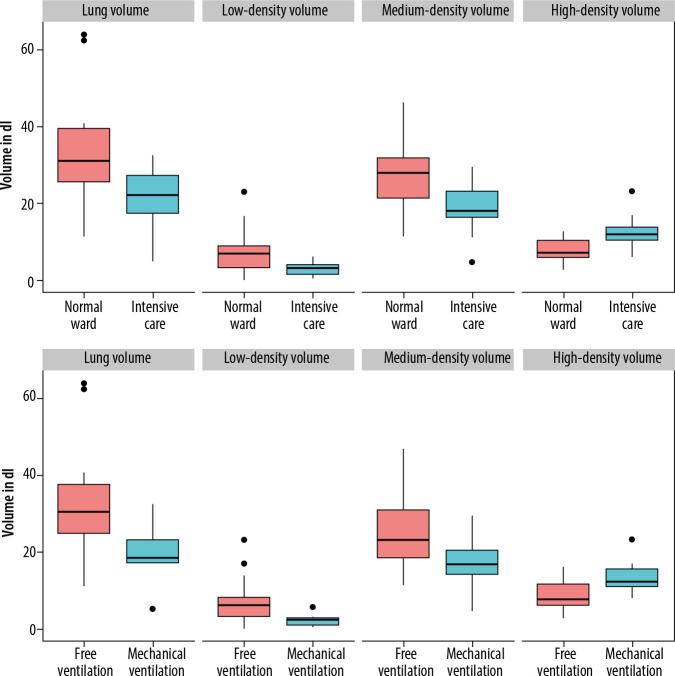
Results: Intensive care unit (ICU) patients or patients requiring mechanical ventilation showed a lower proportion of medium- and low-density lung volume compared to patients on the normal ward, but a significantly larger volume of high-density lung volume (12.26 dl IQR 4.65 dl vs. 7.51 dl vs. IQR 5.39 dl, p = 0.039). In multivariate regression analysis, high-density lung volume was identified as a significant predictor of severe disease.
Conclusions: The amount of high-density lung tissue showed a significant association with severe COVID-19, with odds ratios of 1.42 (95% CI: 1.09-2.00) and 1.37 (95% CI: 1.03-2.11) for requiring intensive care and mechanical ventilation, respectively. Acknowledging our small sample size as an important limitation; our study might thus suggest that high-density lung tissue could serve as a possible predictor of severe COVID-19.




 京公网安备 11010802042870号
京ICP备2023020795号-1
京公网安备 11010802042870号
京ICP备2023020795号-1

 分享
分享
 求助内容:
求助内容: 应助结果提醒方式:
 扫码关注我们
