A Web-Based Mental Health Intervention to Improve Social and Occupational Functioning in Adults With Type 2 Diabetes (The Springboard Trial): 12-Month Outcomes of a Randomized Controlled Trial.
Peter Andrew Baldwin, Samineh Sanatkar, Janine Clarke, Susan Fletcher, Jane Gunn, Kay Wilhelm, Lesley Campbell, Nicholas Zwar, Mark Harris, Helen Lapsley, Dusan Hadzi-Pavlovic, Helen Christensen, Judy Proudfoot
{"title":"A Web-Based Mental Health Intervention to Improve Social and Occupational Functioning in Adults With Type 2 Diabetes (The Springboard Trial): 12-Month Outcomes of a Randomized Controlled Trial.","authors":"Peter Andrew Baldwin, Samineh Sanatkar, Janine Clarke, Susan Fletcher, Jane Gunn, Kay Wilhelm, Lesley Campbell, Nicholas Zwar, Mark Harris, Helen Lapsley, Dusan Hadzi-Pavlovic, Helen Christensen, Judy Proudfoot","doi":"10.2196/16729","DOIUrl":null,"url":null,"abstract":"<p><strong>Background: </strong>People with type 2 diabetes mellitus (T2DM) often experience mental health symptoms that exacerbate illness and increase mortality risk. Access to psychological support is low in people with T2DM. Detection of depression is variable in primary care and can be further hampered by mental health stigma. Electronic mental health (eMH) programs may provide an accessible, private, nonstigmatizing mental health solution for this group.</p><p><strong>Objective: </strong>This study aims to evaluate the efficacy over 12 months of follow-up of an eMH program (myCompass) for improving social and occupational functioning in a community sample of people with T2DM and self-reported mild-to-moderate depressive symptoms. myCompass is a fully automated and self-guided web-based public health program for people with depression or anxiety. The effects of myCompass on depressive symptoms, diabetes-related distress, anxiety symptoms, and self-care behavior were also examined.</p><p><strong>Methods: </strong>Adults with T2DM and mild-to-moderate depressive symptoms (N=780) were recruited via online advertisements, community organizations, and general practices. Screening, consent, and self-report questionnaires were administered online. Eligible participants were randomized to receive either myCompass (n=391) or an attention control generic health literacy program (Healthy Lifestyles; n=379) for 8 weeks. At baseline and at 3, 6, and 12 months postintervention, participants completed the Work and Social Adjustment Scale, the Patient Health Questionnaire-9 item, the Diabetes Distress Scale, the Generalized Anxiety Disorder Questionnaire-7 item, and items from the Self-Management Profile for Type 2 Diabetes. Glycosylated hemoglobin measurements were obtained at baseline and 6 and 12 months postintervention.</p><p><strong>Results: </strong>A total of 38.9% (304/780) of the trial participants completed all postintervention assessments. myCompass users logged in on an average of 6 times and completed an average of 0.29 modules. Healthy Lifestyles users logged in on an average of 4 times and completed an average of 1.37 modules. At baseline, the mean scores on several outcome measures, including the primary outcome of work and social functioning, were close to the normal range, despite a varied and extensive recruitment process. Intention-to-treat analyses revealed slightly greater improvement at 12 months in work and social functioning for the Healthy Lifestyles group relative to the myCompass group. All participants reported equivalent improvements in depression anxiety, diabetes distress, diabetes self-management, and glycemic control across the trial.</p><p><strong>Conclusions: </strong>The Healthy Lifestyles group reported higher ratings of social and occupational functioning than the myCompass group, but no differences were observed for any secondary outcome. Although these findings should be interpreted in light of the near-floor symptom scores at baseline, the trial yields important insights into how people with T2DM might be engaged in eMH programs and the challenges of focusing specifically on mental health. Several avenues emerge for continued investigation into how best to deal with the growing mental health burden in adults with T2DM.</p><p><strong>Trial registration: </strong>Australian New Zealand Clinical Trials Registry Number (ACTRN) 12615000931572; https://www.anzctr.org.au/Trial/Registration/TrialReview.aspx?id=368109&isReview=true.</p>","PeriodicalId":16337,"journal":{"name":"Journal of Medical Internet Research","volume":" ","pages":"e16729"},"PeriodicalIF":6.0000,"publicationDate":"2020-12-01","publicationTypes":"Journal Article","fieldsOfStudy":null,"isOpenAccess":false,"openAccessPdf":"https://www.ncbi.nlm.nih.gov/pmc/articles/PMC7738252/pdf/","citationCount":"9","resultStr":null,"platform":"Semanticscholar","paperid":null,"PeriodicalName":"Journal of Medical Internet Research","FirstCategoryId":"3","ListUrlMain":"https://doi.org/10.2196/16729","RegionNum":2,"RegionCategory":"医学","ArticlePicture":[],"TitleCN":null,"AbstractTextCN":null,"PMCID":null,"EPubDate":"","PubModel":"","JCR":"Q1","JCRName":"HEALTH CARE SCIENCES & SERVICES","Score":null,"Total":0}
引用次数: 9
Abstract
Background: People with type 2 diabetes mellitus (T2DM) often experience mental health symptoms that exacerbate illness and increase mortality risk. Access to psychological support is low in people with T2DM. Detection of depression is variable in primary care and can be further hampered by mental health stigma. Electronic mental health (eMH) programs may provide an accessible, private, nonstigmatizing mental health solution for this group.
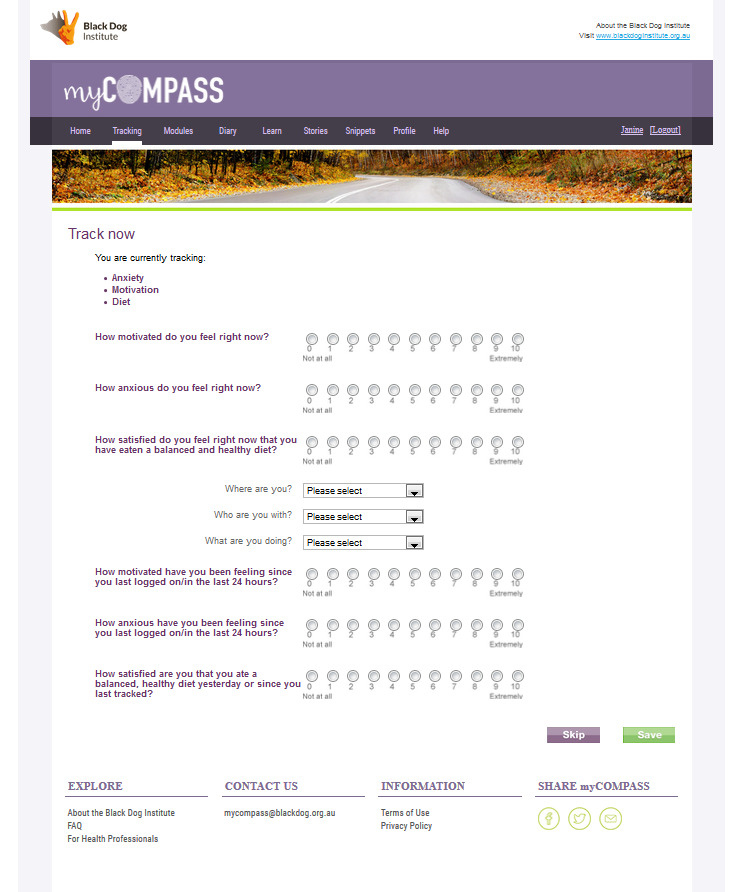
Objective: This study aims to evaluate the efficacy over 12 months of follow-up of an eMH program (myCompass) for improving social and occupational functioning in a community sample of people with T2DM and self-reported mild-to-moderate depressive symptoms. myCompass is a fully automated and self-guided web-based public health program for people with depression or anxiety. The effects of myCompass on depressive symptoms, diabetes-related distress, anxiety symptoms, and self-care behavior were also examined.
Methods: Adults with T2DM and mild-to-moderate depressive symptoms (N=780) were recruited via online advertisements, community organizations, and general practices. Screening, consent, and self-report questionnaires were administered online. Eligible participants were randomized to receive either myCompass (n=391) or an attention control generic health literacy program (Healthy Lifestyles; n=379) for 8 weeks. At baseline and at 3, 6, and 12 months postintervention, participants completed the Work and Social Adjustment Scale, the Patient Health Questionnaire-9 item, the Diabetes Distress Scale, the Generalized Anxiety Disorder Questionnaire-7 item, and items from the Self-Management Profile for Type 2 Diabetes. Glycosylated hemoglobin measurements were obtained at baseline and 6 and 12 months postintervention.
Results: A total of 38.9% (304/780) of the trial participants completed all postintervention assessments. myCompass users logged in on an average of 6 times and completed an average of 0.29 modules. Healthy Lifestyles users logged in on an average of 4 times and completed an average of 1.37 modules. At baseline, the mean scores on several outcome measures, including the primary outcome of work and social functioning, were close to the normal range, despite a varied and extensive recruitment process. Intention-to-treat analyses revealed slightly greater improvement at 12 months in work and social functioning for the Healthy Lifestyles group relative to the myCompass group. All participants reported equivalent improvements in depression anxiety, diabetes distress, diabetes self-management, and glycemic control across the trial.
Conclusions: The Healthy Lifestyles group reported higher ratings of social and occupational functioning than the myCompass group, but no differences were observed for any secondary outcome. Although these findings should be interpreted in light of the near-floor symptom scores at baseline, the trial yields important insights into how people with T2DM might be engaged in eMH programs and the challenges of focusing specifically on mental health. Several avenues emerge for continued investigation into how best to deal with the growing mental health burden in adults with T2DM.
Trial registration: Australian New Zealand Clinical Trials Registry Number (ACTRN) 12615000931572; https://www.anzctr.org.au/Trial/Registration/TrialReview.aspx?id=368109&isReview=true.
期刊介绍:
The Journal of Medical Internet Research (JMIR) is a highly respected publication in the field of health informatics and health services. With a founding date in 1999, JMIR has been a pioneer in the field for over two decades.
As a leader in the industry, the journal focuses on digital health, data science, health informatics, and emerging technologies for health, medicine, and biomedical research. It is recognized as a top publication in these disciplines, ranking in the first quartile (Q1) by Impact Factor.
Notably, JMIR holds the prestigious position of being ranked #1 on Google Scholar within the "Medical Informatics" discipline.





 京公网安备 11010802042870号
京ICP备2023020795号-1
京公网安备 11010802042870号
京ICP备2023020795号-1

 分享
分享

 求助内容:
求助内容: 应助结果提醒方式:
 扫码关注我们
