Denise Battaglini, Pasquale Anania, Patricia R M Rocco, Iole Brunetti, Alessandro Prior, Gianluigi Zona, Paolo Pelosi, Pietro Fiaschi
{"title":"Escalate and De-Escalate Therapies for Intracranial Pressure Control in Traumatic Brain Injury.","authors":"Denise Battaglini, Pasquale Anania, Patricia R M Rocco, Iole Brunetti, Alessandro Prior, Gianluigi Zona, Paolo Pelosi, Pietro Fiaschi","doi":"10.3389/fneur.2020.564751","DOIUrl":null,"url":null,"abstract":"<p><p>Severe traumatic brain injury (TBI) is frequently associated with an elevation of intracranial pressure (ICP), followed by cerebral perfusion pressure (CPP) reduction. Invasive monitoring of ICP is recommended to guide a step-by-step \"staircase approach\" which aims to normalize ICP values and reduce the risks of secondary damage. However, if such monitoring is not available clinical examination and radiological criteria should be used. A major concern is how to taper the therapies employed for ICP control. The aim of this manuscript is to review the criteria for escalating and withdrawing therapies in TBI patients. Each step of the staircase approach carries a risk of adverse effects related to the duration of treatment. Tapering of barbiturates should start once ICP control has been achieved for at least 24 h, although a period of 2-12 days is often required. Administration of hyperosmolar fluids should be avoided if ICP is normal. Sedation should be reduced after at least 24 h of controlled ICP to allow neurological examination. Removal of invasive ICP monitoring is suggested after 72 h of normal ICP. For patients who have undergone surgical decompression, cranioplasty represents the final step, and an earlier cranioplasty (15-90 days after decompression) seems to reduce the rate of infection, seizures, and hydrocephalus.</p>","PeriodicalId":12575,"journal":{"name":"Frontiers in Neurology","volume":" ","pages":"564751"},"PeriodicalIF":2.8000,"publicationDate":"2020-11-24","publicationTypes":"Journal Article","fieldsOfStudy":null,"isOpenAccess":false,"openAccessPdf":"https://sci-hub-pdf.com/10.3389/fneur.2020.564751","citationCount":"7","resultStr":null,"platform":"Semanticscholar","paperid":null,"PeriodicalName":"Frontiers in Neurology","FirstCategoryId":"3","ListUrlMain":"https://doi.org/10.3389/fneur.2020.564751","RegionNum":3,"RegionCategory":"医学","ArticlePicture":[],"TitleCN":null,"AbstractTextCN":null,"PMCID":null,"EPubDate":"2020/1/1 0:00:00","PubModel":"eCollection","JCR":"Q2","JCRName":"CLINICAL NEUROLOGY","Score":null,"Total":0}
引用次数: 7
Abstract
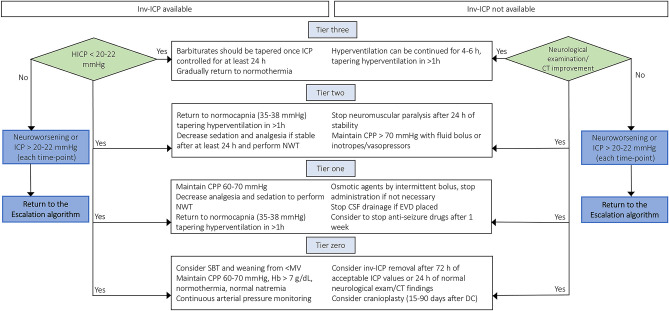
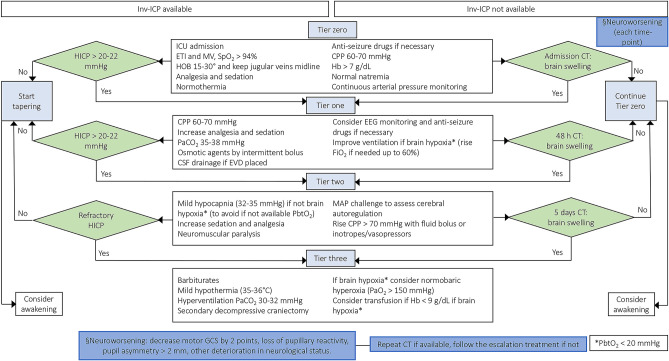
Severe traumatic brain injury (TBI) is frequently associated with an elevation of intracranial pressure (ICP), followed by cerebral perfusion pressure (CPP) reduction. Invasive monitoring of ICP is recommended to guide a step-by-step "staircase approach" which aims to normalize ICP values and reduce the risks of secondary damage. However, if such monitoring is not available clinical examination and radiological criteria should be used. A major concern is how to taper the therapies employed for ICP control. The aim of this manuscript is to review the criteria for escalating and withdrawing therapies in TBI patients. Each step of the staircase approach carries a risk of adverse effects related to the duration of treatment. Tapering of barbiturates should start once ICP control has been achieved for at least 24 h, although a period of 2-12 days is often required. Administration of hyperosmolar fluids should be avoided if ICP is normal. Sedation should be reduced after at least 24 h of controlled ICP to allow neurological examination. Removal of invasive ICP monitoring is suggested after 72 h of normal ICP. For patients who have undergone surgical decompression, cranioplasty represents the final step, and an earlier cranioplasty (15-90 days after decompression) seems to reduce the rate of infection, seizures, and hydrocephalus.
期刊介绍:
The section Stroke aims to quickly and accurately publish important experimental, translational and clinical studies, and reviews that contribute to the knowledge of stroke, its causes, manifestations, diagnosis, and management.




 京公网安备 11010802042870号
京ICP备2023020795号-1
京公网安备 11010802042870号
京ICP备2023020795号-1

 分享
分享
 求助内容:
求助内容: 应助结果提醒方式:
 扫码关注我们
