Nouran Ahmed Abdo Abd El-Hady, Abdelaleim Ismail ElSayed, Sayed Soliman El-Saadany, Paola A Deligios, Luigi Ledda
{"title":"Exogenous Application of Foliar Salicylic Acid and Propolis Enhances Antioxidant Defenses and Growth Parameters in Tomato Plants.","authors":"Nouran Ahmed Abdo Abd El-Hady, Abdelaleim Ismail ElSayed, Sayed Soliman El-Saadany, Paola A Deligios, Luigi Ledda","doi":"10.3390/plants10010074","DOIUrl":null,"url":null,"abstract":"<p><p>Salicylic acid (SA) and propolis (PR) are known to regulate the physiological process and to have a relevant role in bioactive compounds content. Our experiment was designed to evaluate the effect of SA and PR application on the growth, yield, and quality parameters of tomato grown for the fresh market in field conditions in Egypt. We studied the effect of twelve treatments where SA (0.50, 1.00, 1.50, 2.00, and 2.50 mM) and PR (1, 2, 10, 20, and 100 mg propolis mL<sup>-1</sup>) were applied at increasing doses as a sole agent or combined each other (1.50 mM + 10 mg mL<sup>-1</sup> for SA and PR, respectively). An untreated control was also considered. Tomato plants treated with SA (0.50, 1.00, and 1.50 mM) showed a significant effect in all traits especially SA1 (0.50 mM) in growth parameters and SA2 (1.00 mM) in pigment and antioxidant content. Propolis foliar application was more effective than SA as it revealed that raising the concentration of aqueous extract enhanced the growth parameters and pigment in tomato. The best result was obtained by the 10 mg mL<sup>-1</sup> treatment. The effect of propolis on antioxidant enzymes varied as the 10 mg mL<sup>-1</sup> treatment was effective on peroxidases and superoxide dismutase, while 100 mg mL<sup>-1</sup> was more effective on catalase. Salicylic acid and propolis have a positive effect on both preserving tomato plants and on nutrient supply, so the mixed intermediate concentration (1.50 mM + 10 mg mL<sup>-1</sup>) is considered very effective and results in an improvement of all plant traits.</p>","PeriodicalId":56267,"journal":{"name":"Plants-Basel","volume":" ","pages":""},"PeriodicalIF":4.1000,"publicationDate":"2021-01-01","publicationTypes":"Journal Article","fieldsOfStudy":null,"isOpenAccess":false,"openAccessPdf":"https://sci-hub-pdf.com/10.3390/plants10010074","citationCount":"14","resultStr":null,"platform":"Semanticscholar","paperid":null,"PeriodicalName":"Plants-Basel","FirstCategoryId":"99","ListUrlMain":"https://doi.org/10.3390/plants10010074","RegionNum":2,"RegionCategory":"生物学","ArticlePicture":[],"TitleCN":null,"AbstractTextCN":null,"PMCID":null,"EPubDate":"","PubModel":"","JCR":"Q1","JCRName":"PLANT SCIENCES","Score":null,"Total":0}
引用次数: 14
Abstract
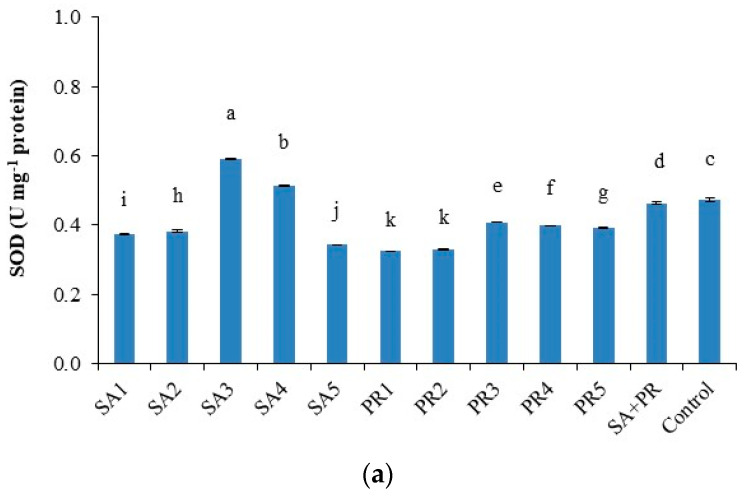
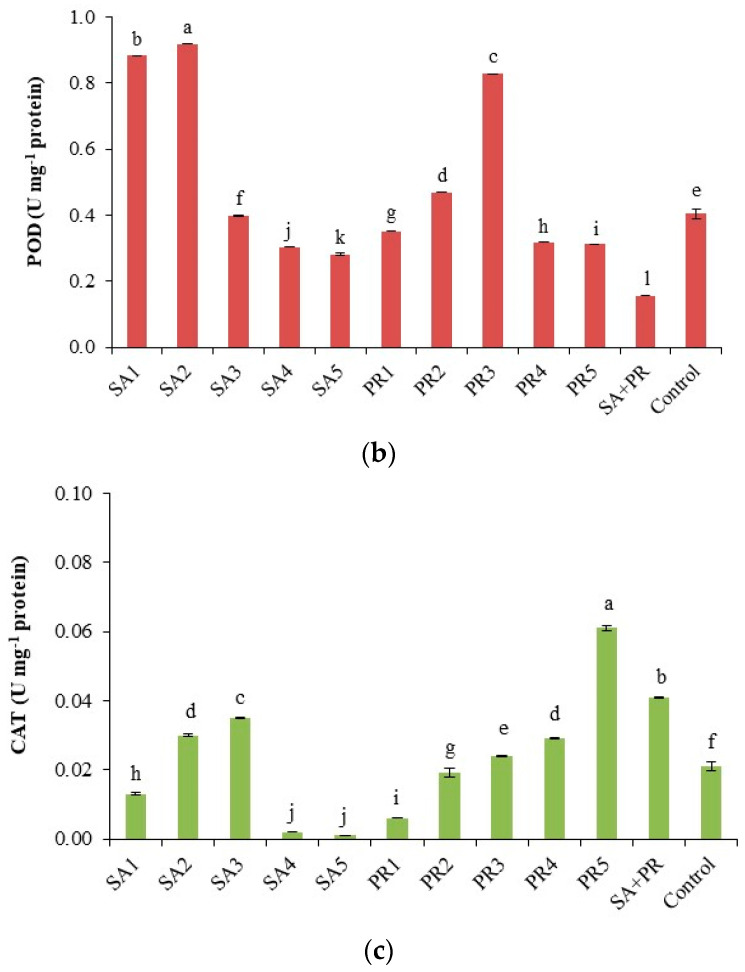
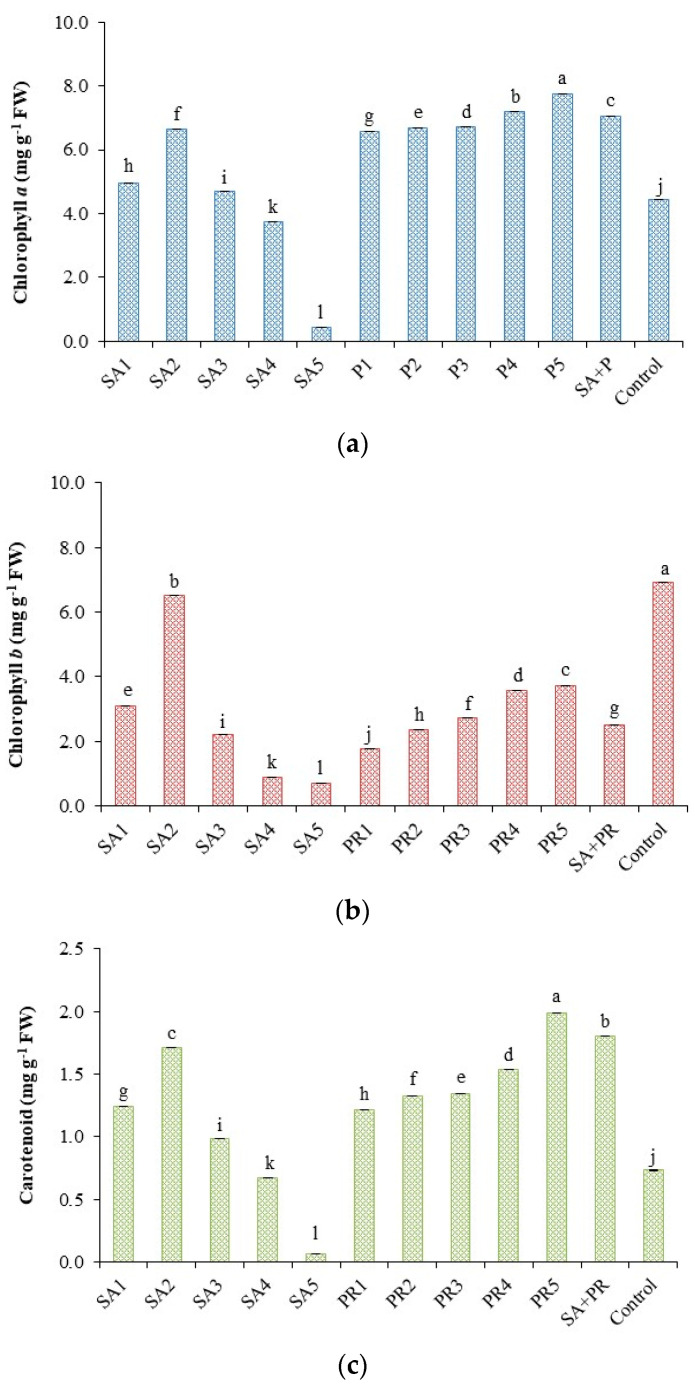
Salicylic acid (SA) and propolis (PR) are known to regulate the physiological process and to have a relevant role in bioactive compounds content. Our experiment was designed to evaluate the effect of SA and PR application on the growth, yield, and quality parameters of tomato grown for the fresh market in field conditions in Egypt. We studied the effect of twelve treatments where SA (0.50, 1.00, 1.50, 2.00, and 2.50 mM) and PR (1, 2, 10, 20, and 100 mg propolis mL-1) were applied at increasing doses as a sole agent or combined each other (1.50 mM + 10 mg mL-1 for SA and PR, respectively). An untreated control was also considered. Tomato plants treated with SA (0.50, 1.00, and 1.50 mM) showed a significant effect in all traits especially SA1 (0.50 mM) in growth parameters and SA2 (1.00 mM) in pigment and antioxidant content. Propolis foliar application was more effective than SA as it revealed that raising the concentration of aqueous extract enhanced the growth parameters and pigment in tomato. The best result was obtained by the 10 mg mL-1 treatment. The effect of propolis on antioxidant enzymes varied as the 10 mg mL-1 treatment was effective on peroxidases and superoxide dismutase, while 100 mg mL-1 was more effective on catalase. Salicylic acid and propolis have a positive effect on both preserving tomato plants and on nutrient supply, so the mixed intermediate concentration (1.50 mM + 10 mg mL-1) is considered very effective and results in an improvement of all plant traits.
Plants-BaselAgricultural and Biological Sciences-Ecology, Evolution, Behavior and Systematics
CiteScore
6.50
自引率
11.10%
发文量
2923
审稿时长
15.4 days
期刊介绍:
Plants (ISSN 2223-7747), is an international and multidisciplinary scientific open access journal that covers all key areas of plant science. It publishes review articles, regular research articles, communications, and short notes in the fields of structural, functional and experimental botany. In addition to fundamental disciplines such as morphology, systematics, physiology and ecology of plants, the journal welcomes all types of articles in the field of applied plant science.



 京公网安备 11010802042870号
京ICP备2023020795号-1
京公网安备 11010802042870号
京ICP备2023020795号-1

 分享
分享
 求助内容:
求助内容: 应助结果提醒方式:
 扫码关注我们
