{"title":"Evaluation of systemic involvement of Coronavirus disease 2019 through spleen; size and texture analysis","authors":"Abdussamet Batur, Abidin Kılınçer, Fatih Ateş, Nazlım Aktuğ Demir, Recai Ergün","doi":"10.3906/sag-2009-270","DOIUrl":null,"url":null,"abstract":"<p><strong>Background/aim: </strong>To investigate the changes in the spleen size, parenchymal heterogeneity, and computed tomography (CT) texture analysis features of patients diagnosed with Coronavirus disease 2019 (COVID-19)</p><p><strong>Materials and methods: </strong>The size and parenchymal structure of the spleen in 91 patients who underwent thoracic CT examination due to COVID-19 were evaluated. For the evaluation of parenchymal heterogeneity, CT texture analysis was performed using dedicated software (Olea Medical, France). The texture analysis of each case consisted of 15 first-order intensity-based features, 17 gray level co- occurrence matrix-based features, and 9 gray level run length matrix-based features.</p><p><strong>Results: </strong>A total of 91 patients (45 males, 46 females) with a mean age of 54.31 ± 16.33 years (range: 18–81) were included in the study. A statistically significant decrease in spleen size was seen in the follow-up CT examinations (p < 0.001) whereas no statistically significant difference was found between the Hounsfield unit (HU) values. The radiomics consisted of first-order intensity-based features such as 90th percentile, maximum, interquartile range, range, mean absolute deviation, standard deviation, and variance, all of which showed statistically significant differences (p-values: < 0.001, < 0.001, 0.001, 0.003, 0.001, 0.001, and 0.004, respectively). “Correlation” as a gray level co-occurrence matrix-based feature and “gray level nonuniformity” as a gray level run length matrix-based feature showed statistically differences (p-values: 0.033 and < 0.001, respectively).</p><p><strong>Conclusions: </strong>Although COVID-19 manifests with lung involvement in the early stage, it can also cause systemic involvement, and the spleen may be one of its target organs. A decrease in the spleen size and parenchymal microstructure changes can be observed in the short follow-up time. It is hoped that the changes in the parenchymal microstructure will be demonstrated by a noninvasive method: texture analysis.</p>","PeriodicalId":23361,"journal":{"name":"Turkish Journal of Medical Sciences","volume":"51 3","pages":"972-980"},"PeriodicalIF":1.0000,"publicationDate":"2021-06-28","publicationTypes":"Journal Article","fieldsOfStudy":null,"isOpenAccess":false,"openAccessPdf":"https://www.ncbi.nlm.nih.gov/pmc/articles/PMC8283514/pdf/","citationCount":"4","resultStr":null,"platform":"Semanticscholar","paperid":null,"PeriodicalName":"Turkish Journal of Medical Sciences","FirstCategoryId":"3","ListUrlMain":"https://doi.org/10.3906/sag-2009-270","RegionNum":4,"RegionCategory":"医学","ArticlePicture":[],"TitleCN":null,"AbstractTextCN":null,"PMCID":null,"EPubDate":"","PubModel":"","JCR":"Q2","JCRName":"MEDICINE, GENERAL & INTERNAL","Score":null,"Total":0}
引用次数: 4
Abstract
Background/aim: To investigate the changes in the spleen size, parenchymal heterogeneity, and computed tomography (CT) texture analysis features of patients diagnosed with Coronavirus disease 2019 (COVID-19)
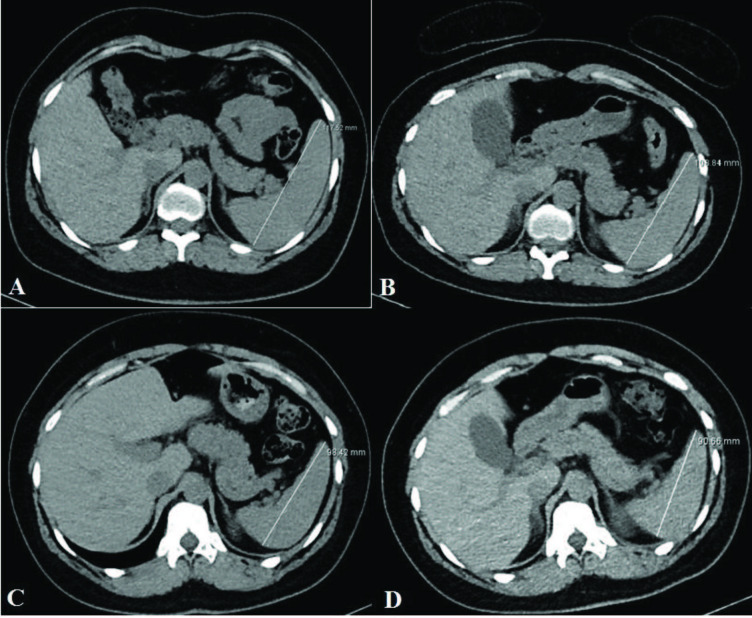
Materials and methods: The size and parenchymal structure of the spleen in 91 patients who underwent thoracic CT examination due to COVID-19 were evaluated. For the evaluation of parenchymal heterogeneity, CT texture analysis was performed using dedicated software (Olea Medical, France). The texture analysis of each case consisted of 15 first-order intensity-based features, 17 gray level co- occurrence matrix-based features, and 9 gray level run length matrix-based features.
Results: A total of 91 patients (45 males, 46 females) with a mean age of 54.31 ± 16.33 years (range: 18–81) were included in the study. A statistically significant decrease in spleen size was seen in the follow-up CT examinations (p < 0.001) whereas no statistically significant difference was found between the Hounsfield unit (HU) values. The radiomics consisted of first-order intensity-based features such as 90th percentile, maximum, interquartile range, range, mean absolute deviation, standard deviation, and variance, all of which showed statistically significant differences (p-values: < 0.001, < 0.001, 0.001, 0.003, 0.001, 0.001, and 0.004, respectively). “Correlation” as a gray level co-occurrence matrix-based feature and “gray level nonuniformity” as a gray level run length matrix-based feature showed statistically differences (p-values: 0.033 and < 0.001, respectively).
Conclusions: Although COVID-19 manifests with lung involvement in the early stage, it can also cause systemic involvement, and the spleen may be one of its target organs. A decrease in the spleen size and parenchymal microstructure changes can be observed in the short follow-up time. It is hoped that the changes in the parenchymal microstructure will be demonstrated by a noninvasive method: texture analysis.
期刊介绍:
Turkish Journal of Medical sciences is a peer-reviewed comprehensive resource that provides critical up-to-date information on the broad spectrum of general medical sciences. The Journal intended to publish original medical scientific papers regarding the priority based on the prominence, significance, and timeliness of the findings. However since the audience of the Journal is not limited to any subspeciality in a wide variety of medical disciplines, the papers focusing on the technical details of a given medical subspeciality may not be evaluated for publication.





 京公网安备 11010802042870号
京ICP备2023020795号-1
京公网安备 11010802042870号
京ICP备2023020795号-1

 分享
分享
 求助内容:
求助内容: 应助结果提醒方式:
 扫码关注我们
