The Activation of Gluteal, Thigh, and Lower Back Muscles in Different Squat Variations Performed by Competitive Bodybuilders: Implications for Resistance Training.
{"title":"The Activation of Gluteal, Thigh, and Lower Back Muscles in Different Squat Variations Performed by Competitive Bodybuilders: Implications for Resistance Training.","authors":"Giuseppe Coratella, Gianpaolo Tornatore, Francesca Caccavale, Stefano Longo, Fabio Esposito, Emiliano Cè","doi":"10.3390/ijerph18020772","DOIUrl":null,"url":null,"abstract":"<p><p>The present study investigated the activation of gluteal, thigh, and lower back muscles in different squat variations. Ten male competitive bodybuilders perform back-squat at full (full-BS) or parallel (parallel-BS) depth, using large feet-stance (sumo-BS), and enhancing the feet external rotation (external-rotated-sumo-BS) and front-squat (FS) at 80% 1-RM. The normalized surface electromyographic root-mean-square (sEMG RMS) amplitude of <i>gluteus maximus, gluteus medius, rectus femoris, vastus lateralis, vastus medialis, adductor longus, longissimus,</i> and <i>iliocostalis</i> was recorded during both the ascending and descending phase of each exercise. During the descending phase, greater sEMG RMS amplitude of <i>gluteus maximus</i> and <i>gluteus medius</i> was found in FS vs. all other exercises (<i>p</i> < 0.05). Additionally, FS elicited <i>iliocostalis</i> more than all other exercises. During the ascending phase, both sumo-BS and external-rotated-sumo-BS showed greater <i>vastus lateralis</i> and <i>adductor longus</i> activation compared to all other exercises (<i>p</i> < 0.05). Moreover, <i>rectus femoris</i> activation was greater in FS compared to full-BS (<i>p</i> < 0.05). No between-exercise difference was found in <i>vastus medialis</i> and <i>longissimus</i> showed no between-exercise difference. FS needs more backward stabilization during the descending phase. Larger feet-stance increases thigh muscles activity, possibly because of their longer length. These findings show how bodybuilders uniquely recruit muscles when performing different squat variations.</p>","PeriodicalId":14044,"journal":{"name":"International Journal of Environmental Research and Public Health","volume":" ","pages":""},"PeriodicalIF":0.0000,"publicationDate":"2021-01-18","publicationTypes":"Journal Article","fieldsOfStudy":null,"isOpenAccess":false,"openAccessPdf":"https://sci-hub-pdf.com/10.3390/ijerph18020772","citationCount":"14","resultStr":null,"platform":"Semanticscholar","paperid":null,"PeriodicalName":"International Journal of Environmental Research and Public Health","FirstCategoryId":"103","ListUrlMain":"https://doi.org/10.3390/ijerph18020772","RegionNum":3,"RegionCategory":"综合性期刊","ArticlePicture":[],"TitleCN":null,"AbstractTextCN":null,"PMCID":null,"EPubDate":"","PubModel":"","JCR":"Q1","JCRName":"Medicine","Score":null,"Total":0}
引用次数: 14
Abstract
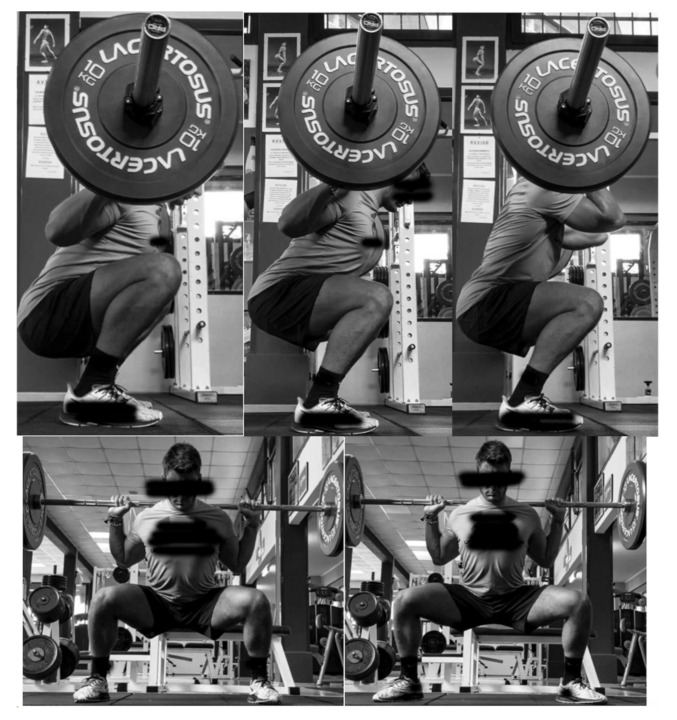
The present study investigated the activation of gluteal, thigh, and lower back muscles in different squat variations. Ten male competitive bodybuilders perform back-squat at full (full-BS) or parallel (parallel-BS) depth, using large feet-stance (sumo-BS), and enhancing the feet external rotation (external-rotated-sumo-BS) and front-squat (FS) at 80% 1-RM. The normalized surface electromyographic root-mean-square (sEMG RMS) amplitude of gluteus maximus, gluteus medius, rectus femoris, vastus lateralis, vastus medialis, adductor longus, longissimus, and iliocostalis was recorded during both the ascending and descending phase of each exercise. During the descending phase, greater sEMG RMS amplitude of gluteus maximus and gluteus medius was found in FS vs. all other exercises (p < 0.05). Additionally, FS elicited iliocostalis more than all other exercises. During the ascending phase, both sumo-BS and external-rotated-sumo-BS showed greater vastus lateralis and adductor longus activation compared to all other exercises (p < 0.05). Moreover, rectus femoris activation was greater in FS compared to full-BS (p < 0.05). No between-exercise difference was found in vastus medialis and longissimus showed no between-exercise difference. FS needs more backward stabilization during the descending phase. Larger feet-stance increases thigh muscles activity, possibly because of their longer length. These findings show how bodybuilders uniquely recruit muscles when performing different squat variations.
期刊介绍:
International Journal of Environmental Research and Public Health (IJERPH) (ISSN 1660-4601) is a peer-reviewed scientific journal that publishes original articles, critical reviews, research notes, and short communications in the interdisciplinary area of environmental health sciences and public health. It links several scientific disciplines including biology, biochemistry, biotechnology, cellular and molecular biology, chemistry, computer science, ecology, engineering, epidemiology, genetics, immunology, microbiology, oncology, pathology, pharmacology, and toxicology, in an integrated fashion, to address critical issues related to environmental quality and public health. Therefore, IJERPH focuses on the publication of scientific and technical information on the impacts of natural phenomena and anthropogenic factors on the quality of our environment, the interrelationships between environmental health and the quality of life, as well as the socio-cultural, political, economic, and legal considerations related to environmental stewardship and public health.
The 2018 IJERPH Outstanding Reviewer Award has been launched! This award acknowledge those who have generously dedicated their time to review manuscripts submitted to IJERPH. See full details at http://www.mdpi.com/journal/ijerph/awards.






 京公网安备 11010802042870号
京ICP备2023020795号-1
京公网安备 11010802042870号
京ICP备2023020795号-1

 分享
分享
 求助内容:
求助内容: 应助结果提醒方式:
 扫码关注我们
