Jaganathan Venkatesh, Arun K Rishi, Kaladhar B Reddy
{"title":"Novel strategies to target chemoresistant triple-negative breast cancer.","authors":"Jaganathan Venkatesh, Arun K Rishi, Kaladhar B Reddy","doi":"10.18632/genesandcancer.204","DOIUrl":null,"url":null,"abstract":"<p><p>Previous studies from our group and others have shown that current drug treatment(s) strategies eliminate bulk of tumor cells (non-CSCs) but it had a minimal effect on cancer stem cells (CSCs) leading to resistance and tumor recurrence. We studied the effects of CFM-4.16 (CARP-1 functional mimetic) and/or cisplatin on four Triple-negative breast cancer (TNBC) MDA-MB-468, MDA-MB-231, CRL-2335 and BR-1126, two cisplatin resistant CisR/MDA-231 and CisR/MDA-468 and cancer stem cells (CSCs) from resistant cell lines. TNBC cells treated with CFM-4.16 plus cisplatin inhibited the expression of FZD8, LRP6 and c-Myc and significantly enhanced cell death in all the cell lines by ~70%-80% compared with the control(s). When Cisplatin resistant CisR/MDA-231 and CisR/MDA-468 were treated with CFM-4.16 plus cisplatin, they also showed a reduction in FZD8 and LRP6 and increased apoptosis compared to control group. Similarly, CFM-4.16 plus cisplatin treatment reduced mammospheres formation abilities of CSCs by 80-90% compared to control group, increased PARP cleavage and apoptosis. Data shows CFM-4.16 plus cisplatin treatment significantly increased apoptosis/cell death in parental, cisplatin resistant and CSCs. Taken together the data suggests that FZD8-mediated Wnt-signaling plays a major role in mediating CSCs growth and resistance to chemotherapy and its inhibition enhances the chemotherapeutic response in TNBC.</p>","PeriodicalId":38987,"journal":{"name":"Genes and Cancer","volume":"11 3-4","pages":"95-105"},"PeriodicalIF":0.0000,"publicationDate":"2020-07-22","publicationTypes":"Journal Article","fieldsOfStudy":null,"isOpenAccess":false,"openAccessPdf":"https://www.ncbi.nlm.nih.gov/pmc/articles/PMC7805540/pdf/","citationCount":"4","resultStr":null,"platform":"Semanticscholar","paperid":null,"PeriodicalName":"Genes and Cancer","FirstCategoryId":"1085","ListUrlMain":"https://doi.org/10.18632/genesandcancer.204","RegionNum":0,"RegionCategory":null,"ArticlePicture":[],"TitleCN":null,"AbstractTextCN":null,"PMCID":null,"EPubDate":"2020/12/31 0:00:00","PubModel":"eCollection","JCR":"Q2","JCRName":"Biochemistry, Genetics and Molecular Biology","Score":null,"Total":0}
引用次数: 4
Abstract
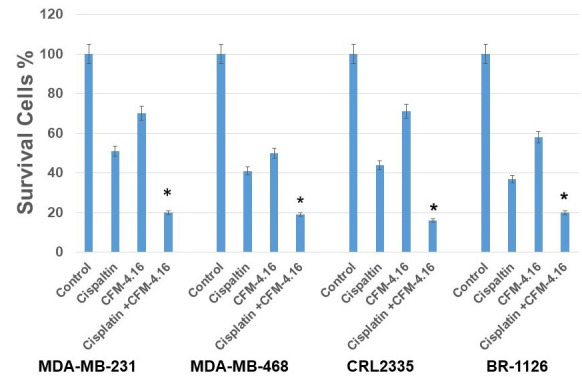
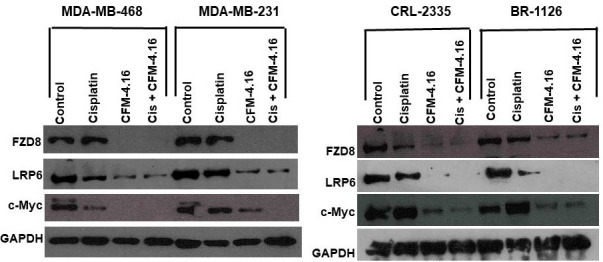
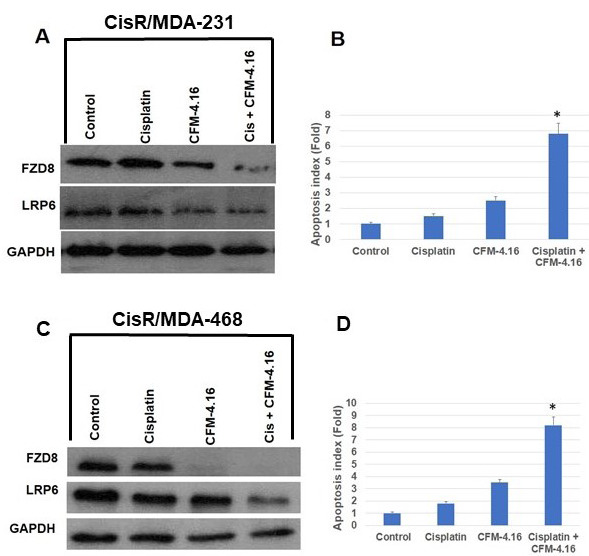
Previous studies from our group and others have shown that current drug treatment(s) strategies eliminate bulk of tumor cells (non-CSCs) but it had a minimal effect on cancer stem cells (CSCs) leading to resistance and tumor recurrence. We studied the effects of CFM-4.16 (CARP-1 functional mimetic) and/or cisplatin on four Triple-negative breast cancer (TNBC) MDA-MB-468, MDA-MB-231, CRL-2335 and BR-1126, two cisplatin resistant CisR/MDA-231 and CisR/MDA-468 and cancer stem cells (CSCs) from resistant cell lines. TNBC cells treated with CFM-4.16 plus cisplatin inhibited the expression of FZD8, LRP6 and c-Myc and significantly enhanced cell death in all the cell lines by ~70%-80% compared with the control(s). When Cisplatin resistant CisR/MDA-231 and CisR/MDA-468 were treated with CFM-4.16 plus cisplatin, they also showed a reduction in FZD8 and LRP6 and increased apoptosis compared to control group. Similarly, CFM-4.16 plus cisplatin treatment reduced mammospheres formation abilities of CSCs by 80-90% compared to control group, increased PARP cleavage and apoptosis. Data shows CFM-4.16 plus cisplatin treatment significantly increased apoptosis/cell death in parental, cisplatin resistant and CSCs. Taken together the data suggests that FZD8-mediated Wnt-signaling plays a major role in mediating CSCs growth and resistance to chemotherapy and its inhibition enhances the chemotherapeutic response in TNBC.




 京公网安备 11010802042870号
京ICP备2023020795号-1
京公网安备 11010802042870号
京ICP备2023020795号-1

 分享
分享
 求助内容:
求助内容: 应助结果提醒方式:
 扫码关注我们
