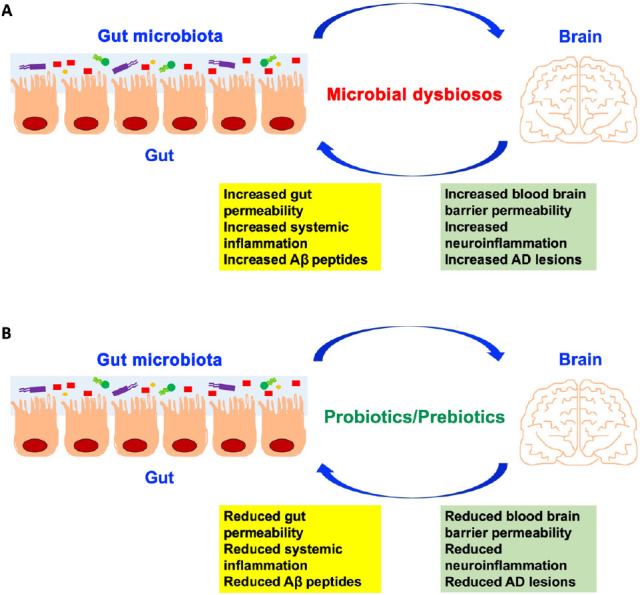
{"title":"Probiotics, prebiotics and their role in Alzheimer's disease.","authors":"Valeria DArgenio, Daniela Sarnataro","doi":"10.4103/1673-5374.306072","DOIUrl":null,"url":null,"abstract":"Accumulation of amyloid and dysfunctional tau proteins in the brain, along with the development of dementia, characterizes Alzheimer ’s disease (AD). Although the cause of AD is currently unknown, i t has been shown that the onset of the disease, with amyloid-beta peptide (Aβ) accumulation, occurs 10–20 years before the development of the clinical signs; to date, several factors, including lifestyle habits (such as diet and exercise), chronic infection and inflammation, have been related to AD pathogenesis and progression (Sochocka et al., 2019). In addition, the gut microbial dysbiosis seems to be a critical feature able to characterize AD and regulate Aβ production. Indeed, imbalances in gut microbiota can induce aberrant immune responses which, in turn, can disrupt the local and systemic homeostasis of the host (Figure 1A). Moreover, it has been proposed that the gut microbiota, represented by intestinal microflora, may participate in the development of the disease through a network called “gut-brain axis,” that is a bidirectional signaling mechanism between the central nervous system and the intestinal tract. Gut has the largest nervous system, outside the central nervous system, that is in close interplay with the microbiome (MB), the other human genome. The extraordinary complexity of the intestinal ecosystem is represented by more than 100 trillion of microbial cells and their interaction with the intestinal epithelium can influence brain functionality and behavior. Likely, human MB is a promising target for prevention and therapeutic interventions. Indeed, several approaches have been employed with the aim to reduce age-related dysbiosis in both experimental model and in clinical studies. These include strategies to regulate MB via the administration of probiotics and prebiotics, and dietary interventions. The progress of research on the role of intestinal MB in the development of AD will dictate the future for the employment of proand prebiotics in the prevention/treatment of AD (D’Argenio and Sarnataro, 2019).","PeriodicalId":19113,"journal":{"name":"Neural Regeneration Research","volume":" ","pages":"1768-1769"},"PeriodicalIF":6.7000,"publicationDate":"2021-09-01","publicationTypes":"Journal Article","fieldsOfStudy":null,"isOpenAccess":false,"openAccessPdf":"https://ftp.ncbi.nlm.nih.gov/pub/pmc/oa_pdf/82/6e/NRR-16-1768.PMC8328749.pdf","citationCount":"10","resultStr":null,"platform":"Semanticscholar","paperid":null,"PeriodicalName":"Neural Regeneration Research","FirstCategoryId":"3","ListUrlMain":"https://doi.org/10.4103/1673-5374.306072","RegionNum":2,"RegionCategory":"医学","ArticlePicture":[],"TitleCN":null,"AbstractTextCN":null,"PMCID":null,"EPubDate":"","PubModel":"","JCR":"Q2","JCRName":"CELL BIOLOGY","Score":null,"Total":0}
引用次数: 10
Abstract
Accumulation of amyloid and dysfunctional tau proteins in the brain, along with the development of dementia, characterizes Alzheimer ’s disease (AD). Although the cause of AD is currently unknown, i t has been shown that the onset of the disease, with amyloid-beta peptide (Aβ) accumulation, occurs 10–20 years before the development of the clinical signs; to date, several factors, including lifestyle habits (such as diet and exercise), chronic infection and inflammation, have been related to AD pathogenesis and progression (Sochocka et al., 2019). In addition, the gut microbial dysbiosis seems to be a critical feature able to characterize AD and regulate Aβ production. Indeed, imbalances in gut microbiota can induce aberrant immune responses which, in turn, can disrupt the local and systemic homeostasis of the host (Figure 1A). Moreover, it has been proposed that the gut microbiota, represented by intestinal microflora, may participate in the development of the disease through a network called “gut-brain axis,” that is a bidirectional signaling mechanism between the central nervous system and the intestinal tract. Gut has the largest nervous system, outside the central nervous system, that is in close interplay with the microbiome (MB), the other human genome. The extraordinary complexity of the intestinal ecosystem is represented by more than 100 trillion of microbial cells and their interaction with the intestinal epithelium can influence brain functionality and behavior. Likely, human MB is a promising target for prevention and therapeutic interventions. Indeed, several approaches have been employed with the aim to reduce age-related dysbiosis in both experimental model and in clinical studies. These include strategies to regulate MB via the administration of probiotics and prebiotics, and dietary interventions. The progress of research on the role of intestinal MB in the development of AD will dictate the future for the employment of proand prebiotics in the prevention/treatment of AD (D’Argenio and Sarnataro, 2019).
期刊介绍:
Neural Regeneration Research (NRR) is the Open Access journal specializing in neural regeneration and indexed by SCI-E and PubMed. The journal is committed to publishing articles on basic pathobiology of injury, repair and protection to the nervous system, while considering preclinical and clinical trials targeted at improving traumatically injuried patients and patients with neurodegenerative diseases.



 京公网安备 11010802042870号
京ICP备2023020795号-1
京公网安备 11010802042870号
京ICP备2023020795号-1

 分享
分享
 求助内容:
求助内容: 应助结果提醒方式:
 扫码关注我们
