Helen Hartley, Bernie Carter, Lisa Bunn, Barry Pizer, Steven Lane, Ram Kumar, Elizabeth Cassidy
{"title":"E-Survey of Current International Physiotherapy Practice for Children with Ataxia Following Surgical Resection of Posterior Fossa Tumour.","authors":"Helen Hartley, Bernie Carter, Lisa Bunn, Barry Pizer, Steven Lane, Ram Kumar, Elizabeth Cassidy","doi":"10.2340/20030711-1000020","DOIUrl":null,"url":null,"abstract":"<p><strong>Objective: </strong>To determine current international practice regarding physiotherapy input for children with ataxia following surgery for posterior fossa tumour. <i>Design:</i> An e-survey covering the following domains: participant demographics, treatment/ intervention, virtual training, intensity/timing of treatment, and aims and outcomes of physiotherapy management.</p><p><strong>Participants: </strong>Physiotherapists involved in the management of children with ataxia following surgical resection of posterior fossa tumour. Participants were contacted via 6 key groups; Paediatric Oncology Physiotherapy Network (POPs), Association of Paediatric Chartered Physiotherapists (APCP), European Paediatric Neurology Society (EPNS), International Society of Paediatric Oncology (SIOP)-Europe Brain Tumour Group, Posterior Fossa Society (PFS), and Pediatric Oncology Special Interest Group (SIG) (American Physical Therapy Association).</p><p><strong>Results: </strong>A total of 96 physiotherapists participated: UK (<i>n</i> =53), rest of Europe (<i>n</i> = 23), USA/ Canada (<i>n</i> = 10), and Australia/NZ (<i>n</i> = 10). The most common physiotherapy interventions used were balance exercises, gait re-education and proximal control activities. The most frequently used adjuncts to treatment were mobility aids and orthotics. Challenges reported regarding physiotherapy treatment were: reduced availability of physiotherapy input following discharge from the acute setting, lack of evidence, impact of adjuvant oncology treatment, and psychosocial impact.</p><p><strong>Conclusion: </strong>This e-survey provides an initial scoping review of international physiotherapy practice in this area. It establishes a foundation for future research on improving rehabilitation of ataxia in this population.</p>","PeriodicalId":73929,"journal":{"name":"Journal of rehabilitation medicine. Clinical communications","volume":"2 ","pages":"1000020"},"PeriodicalIF":0.0000,"publicationDate":"2019-12-30","publicationTypes":"Journal Article","fieldsOfStudy":null,"isOpenAccess":false,"openAccessPdf":"https://ftp.ncbi.nlm.nih.gov/pub/pmc/oa_pdf/10/d8/JRMCC-2-1000020.PMC8008714.pdf","citationCount":"0","resultStr":null,"platform":"Semanticscholar","paperid":null,"PeriodicalName":"Journal of rehabilitation medicine. Clinical communications","FirstCategoryId":"1085","ListUrlMain":"https://doi.org/10.2340/20030711-1000020","RegionNum":0,"RegionCategory":null,"ArticlePicture":[],"TitleCN":null,"AbstractTextCN":null,"PMCID":null,"EPubDate":"2019/1/1 0:00:00","PubModel":"eCollection","JCR":"","JCRName":"","Score":null,"Total":0}
引用次数: 0
Abstract
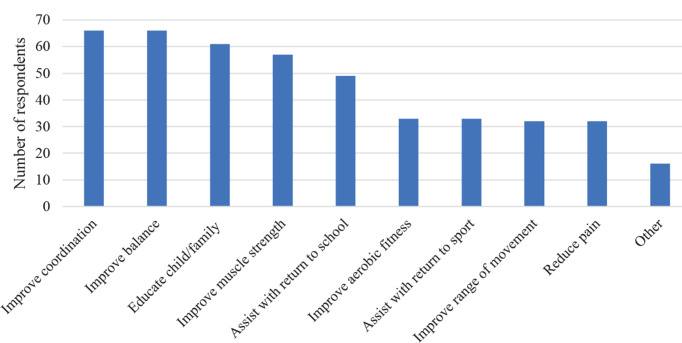
Objective: To determine current international practice regarding physiotherapy input for children with ataxia following surgery for posterior fossa tumour. Design: An e-survey covering the following domains: participant demographics, treatment/ intervention, virtual training, intensity/timing of treatment, and aims and outcomes of physiotherapy management.
Participants: Physiotherapists involved in the management of children with ataxia following surgical resection of posterior fossa tumour. Participants were contacted via 6 key groups; Paediatric Oncology Physiotherapy Network (POPs), Association of Paediatric Chartered Physiotherapists (APCP), European Paediatric Neurology Society (EPNS), International Society of Paediatric Oncology (SIOP)-Europe Brain Tumour Group, Posterior Fossa Society (PFS), and Pediatric Oncology Special Interest Group (SIG) (American Physical Therapy Association).
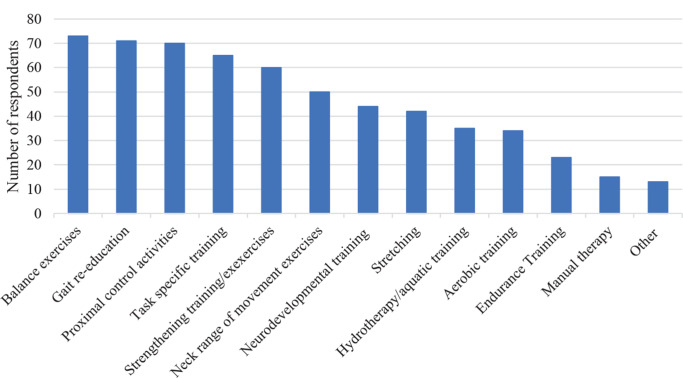
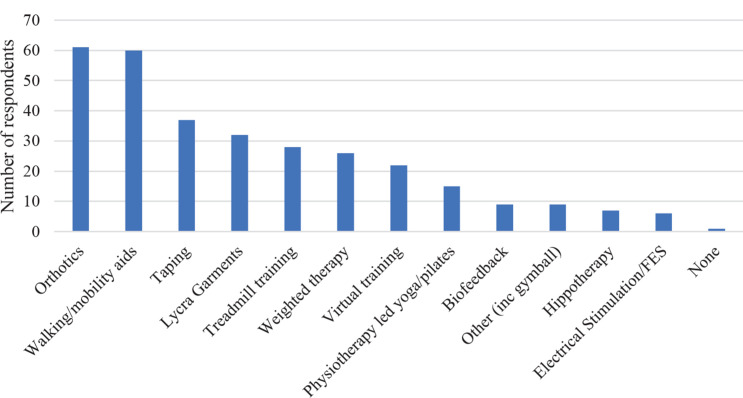
Results: A total of 96 physiotherapists participated: UK (n =53), rest of Europe (n = 23), USA/ Canada (n = 10), and Australia/NZ (n = 10). The most common physiotherapy interventions used were balance exercises, gait re-education and proximal control activities. The most frequently used adjuncts to treatment were mobility aids and orthotics. Challenges reported regarding physiotherapy treatment were: reduced availability of physiotherapy input following discharge from the acute setting, lack of evidence, impact of adjuvant oncology treatment, and psychosocial impact.
Conclusion: This e-survey provides an initial scoping review of international physiotherapy practice in this area. It establishes a foundation for future research on improving rehabilitation of ataxia in this population.



 京公网安备 11010802042870号
京ICP备2023020795号-1
京公网安备 11010802042870号
京ICP备2023020795号-1

 分享
分享

 求助内容:
求助内容: 应助结果提醒方式:
 扫码关注我们
