Hao Li, Xueping Chen, Danqing Shen, Fan Wu, Roser Pleixats and Jianming Pan
{"title":"Functionalized silica nanoparticles: classification, synthetic approaches and recent advances in adsorption applications","authors":"Hao Li, Xueping Chen, Danqing Shen, Fan Wu, Roser Pleixats and Jianming Pan","doi":"10.1039/D1NR04048K","DOIUrl":null,"url":null,"abstract":"<p >Nanotechnology is rapidly sweeping through all the vital fields of science and technology such as electronics, aerospace, defense, medicine, and catalysis. It involves the design, synthesis, characterization, and applications of materials and devices on the nanometer scale. At the nanoscale, physical and chemical properties differ from the properties of the individual atoms and molecules of bulk matter. In particular, the design and development of silica nanomaterials have captivated the attention of several researchers worldwide. The applications of hybrid silicas are still limited by the lack of control on the morphology and particle size. The ability to control both the size and morphology of the materials and to obtain nano-sized silica particles has broadened the spectrum of applications of mesoporous organosilicas and/or has improved their performances. On the other hand, adsorption is a widely used technique for the separation and removal of pollutants (metal ions, dyes, organics,...) from wastewater. Silica nanoparticles have specific advantages over other materials for adsorption applications due to their unique structural characteristics: a stable structure, a high specific surface area, an adjustable pore structure, the presence of silanol groups on the surface which allow easy modification, less environmental harm, simple synthesis, low cost, <em>etc</em>. Silica nanoparticles are potential adsorbents for pollutants. We present herein an overview of the different types of silica nanoparticles going from the definitions to properties, synthetic approaches and the mention of potential applications. We focus mainly on the recent advances in the adsorption of different target substances (metal ions, dyes and other organics).</p>","PeriodicalId":92,"journal":{"name":"Nanoscale","volume":" 38","pages":" 15998-16016"},"PeriodicalIF":5.1000,"publicationDate":"2021-08-26","publicationTypes":"Journal Article","fieldsOfStudy":null,"isOpenAccess":false,"openAccessPdf":"","citationCount":"38","resultStr":null,"platform":"Semanticscholar","paperid":null,"PeriodicalName":"Nanoscale","FirstCategoryId":"88","ListUrlMain":"https://pubs.rsc.org/en/content/articlelanding/2021/nr/d1nr04048k","RegionNum":3,"RegionCategory":"材料科学","ArticlePicture":[],"TitleCN":null,"AbstractTextCN":null,"PMCID":null,"EPubDate":"","PubModel":"","JCR":"Q1","JCRName":"CHEMISTRY, MULTIDISCIPLINARY","Score":null,"Total":0}
引用次数: 38
Abstract
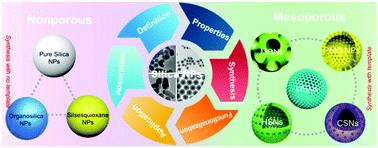
Nanotechnology is rapidly sweeping through all the vital fields of science and technology such as electronics, aerospace, defense, medicine, and catalysis. It involves the design, synthesis, characterization, and applications of materials and devices on the nanometer scale. At the nanoscale, physical and chemical properties differ from the properties of the individual atoms and molecules of bulk matter. In particular, the design and development of silica nanomaterials have captivated the attention of several researchers worldwide. The applications of hybrid silicas are still limited by the lack of control on the morphology and particle size. The ability to control both the size and morphology of the materials and to obtain nano-sized silica particles has broadened the spectrum of applications of mesoporous organosilicas and/or has improved their performances. On the other hand, adsorption is a widely used technique for the separation and removal of pollutants (metal ions, dyes, organics,...) from wastewater. Silica nanoparticles have specific advantages over other materials for adsorption applications due to their unique structural characteristics: a stable structure, a high specific surface area, an adjustable pore structure, the presence of silanol groups on the surface which allow easy modification, less environmental harm, simple synthesis, low cost, etc. Silica nanoparticles are potential adsorbents for pollutants. We present herein an overview of the different types of silica nanoparticles going from the definitions to properties, synthetic approaches and the mention of potential applications. We focus mainly on the recent advances in the adsorption of different target substances (metal ions, dyes and other organics).
期刊介绍:
Nanoscale is a high-impact international journal, publishing high-quality research across nanoscience and nanotechnology. Nanoscale publishes a full mix of research articles on experimental and theoretical work, including reviews, communications, and full papers.Highly interdisciplinary, this journal appeals to scientists, researchers and professionals interested in nanoscience and nanotechnology, quantum materials and quantum technology, including the areas of physics, chemistry, biology, medicine, materials, energy/environment, information technology, detection science, healthcare and drug discovery, and electronics.



 京公网安备 11010802042870号
京ICP备2023020795号-1
京公网安备 11010802042870号
京ICP备2023020795号-1

 分享
分享
 求助内容:
求助内容: 应助结果提醒方式:
 扫码关注我们
