Adriana Linares Ballesteros, Roy Sanguino Lobo, Juan Camilo Villada Valencia, Oscar Arévalo Leal, Diana Constanza Plazas Hernández, Nelson Aponte Barrios, Iván Perdomo Ramírez
{"title":"Early-onset Cardiotoxicity assessment related to anthracycline in children with leukemia. A Prospective Study.","authors":"Adriana Linares Ballesteros, Roy Sanguino Lobo, Juan Camilo Villada Valencia, Oscar Arévalo Leal, Diana Constanza Plazas Hernández, Nelson Aponte Barrios, Iván Perdomo Ramírez","doi":"10.25100/cm.v52i1.4542","DOIUrl":null,"url":null,"abstract":"Abstract Background: Acute leukemias are the most frequent malignancies in children. Advances in treatment have improved the overall survival to 80%. Almost 10% of children with cancer develop clinical cardiac toxicity. Total anthracycline cumulative dose is a risk factor for early-onset cardiotoxicity. Objective: To describe the incidence of early-onset cardiotoxicity in children with acute leukemia treated with chemotherapy. Methods: A prospective descriptive study of patients >1 y and <18 years diagnosed with acute leukemia. Assessed with electrocardiograma, echocardiography, and blood biomarkers at diagnosis and during the follow-up. Results: 94 patients with acute lymphoblastic leukemia and 18 with acute myeloid leukemia were included. 20 patients (17.9%) developed early-onset cardiotoxicity. Statistically significant data was seen after anthracycline dose >150 mg/m2, between the first echocardiographic evaluation and posterior analyses in the left ventricular fraction ejection with Teicholz p 0.05, Simpson p 0.018 and GLS p 0.004. In this study, there was no relation between blood biomarkers and cardiotoxicity. Conclusions: Cancer therapeutic-related cardiac dysfunction is related to anthracycline cumulative dose. In this study, echocardiographic follow-up was useful to predict risk factors for early cardiac dysfunction.","PeriodicalId":72638,"journal":{"name":"","volume":"52 1","pages":"e2034542"},"PeriodicalIF":0.0,"publicationDate":"2021-02-15","publicationTypes":"Journal Article","fieldsOfStudy":null,"isOpenAccess":false,"openAccessPdf":"https://ftp.ncbi.nlm.nih.gov/pub/pmc/oa_pdf/55/6c/1657-9534-cm-52-01-e2034542.PMC8054707.pdf","citationCount":"3","resultStr":null,"platform":"Semanticscholar","paperid":null,"PeriodicalName":"","FirstCategoryId":"3","ListUrlMain":"https://doi.org/10.25100/cm.v52i1.4542","RegionNum":0,"RegionCategory":null,"ArticlePicture":[],"TitleCN":null,"AbstractTextCN":null,"PMCID":null,"EPubDate":"","PubModel":"","JCR":"","JCRName":"","Score":null,"Total":0}
引用次数: 3
Abstract
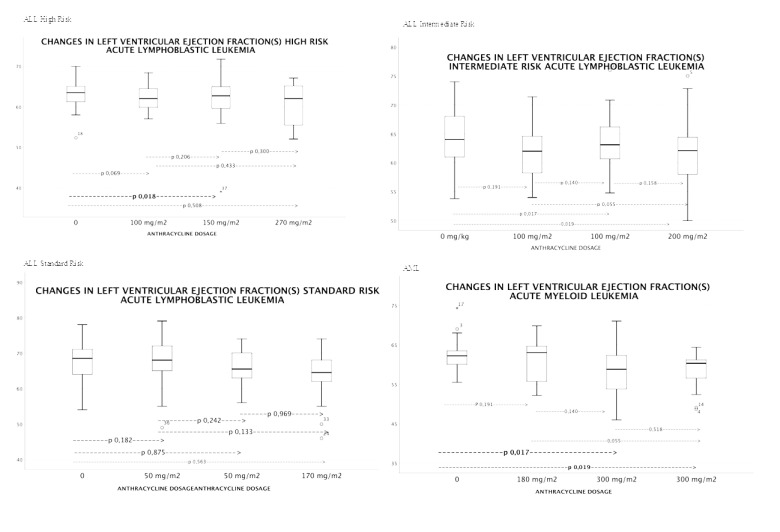
Abstract Background: Acute leukemias are the most frequent malignancies in children. Advances in treatment have improved the overall survival to 80%. Almost 10% of children with cancer develop clinical cardiac toxicity. Total anthracycline cumulative dose is a risk factor for early-onset cardiotoxicity. Objective: To describe the incidence of early-onset cardiotoxicity in children with acute leukemia treated with chemotherapy. Methods: A prospective descriptive study of patients >1 y and <18 years diagnosed with acute leukemia. Assessed with electrocardiograma, echocardiography, and blood biomarkers at diagnosis and during the follow-up. Results: 94 patients with acute lymphoblastic leukemia and 18 with acute myeloid leukemia were included. 20 patients (17.9%) developed early-onset cardiotoxicity. Statistically significant data was seen after anthracycline dose >150 mg/m2, between the first echocardiographic evaluation and posterior analyses in the left ventricular fraction ejection with Teicholz p 0.05, Simpson p 0.018 and GLS p 0.004. In this study, there was no relation between blood biomarkers and cardiotoxicity. Conclusions: Cancer therapeutic-related cardiac dysfunction is related to anthracycline cumulative dose. In this study, echocardiographic follow-up was useful to predict risk factors for early cardiac dysfunction.
背景:急性白血病是儿童最常见的恶性肿瘤。治疗的进步使总生存率提高到80%。几乎10%的儿童癌症患者会出现临床心脏毒性。蒽环类药物总累积剂量是早发性心脏毒性的危险因素。目的:了解急性白血病患儿化疗后早发性心脏毒性的发生率。方法:对年龄>1岁的患者进行前瞻性描述性研究。结果:94例急性淋巴细胞白血病患者和18例急性髓性白血病患者纳入研究。20例(17.9%)出现早发性心脏毒性。蒽环类药物剂量>150 mg/m2后,首次超声心动图评价与后验分析左室射血分数的差异有统计学意义(Teicholz p 0.05, Simpson p 0.018, GLS p 0.004)。在这项研究中,血液生物标志物与心脏毒性之间没有关系。结论:蒽环类药物累积剂量与肿瘤治疗相关性心功能障碍有关。在本研究中,超声心动图随访有助于预测早期心功能障碍的危险因素。



 京公网安备 11010802042870号
京ICP备2023020795号-1
京公网安备 11010802042870号
京ICP备2023020795号-1

 分享
分享
 求助内容:
求助内容: 应助结果提醒方式:
 扫码关注我们
