Integrated knowledge translation to advance noncommunicable disease policy and practice in South Africa: application of the Exploration, Preparation, Implementation, and Sustainment (EPIS) framework.
Nasreen S Jessani, Anke Rohwer, Bey-Marrie Schmidt, Peter Delobelle
{"title":"Integrated knowledge translation to advance noncommunicable disease policy and practice in South Africa: application of the Exploration, Preparation, Implementation, and Sustainment (EPIS) framework.","authors":"Nasreen S Jessani, Anke Rohwer, Bey-Marrie Schmidt, Peter Delobelle","doi":"10.1186/s12961-021-00733-x","DOIUrl":null,"url":null,"abstract":"<p><strong>Background: </strong>In response to the \"know-do\" gap, several initiatives have been implemented to enhance evidence-informed decision-making (EIDM). These include individual training, organizational culture change management, and legislative changes. The importance of relationships and stakeholder engagement in EIDM has led to an evolution of models and approaches including integrated knowledge translation (IKT). IKT has emerged as a key strategy for ensuring that engagement is equitable, demand-driven, and responsive. As a result, the African-German Collaboration for Evidence-Based Healthcare and Public Health in Africa (CEBHA+) incorporated an IKT approach to influence noncommunicable diseases (NCD) policy and practice. We documented the phased process of developing, implementing, and monitoring the IKT approach in South Africa; and explored the appropriateness of using the exploration, preparation, implementation, and sustainment (EPIS) framework for this purpose.</p><p><strong>Methods: </strong>We mapped the South Africa IKT approach onto the EPIS framework using a framework analysis approach. Notes of team meetings, stakeholder matrices, and engagement strategies were analysed and purposefully plotted against the four phases of the framework in order to populate the different constructs. We discussed and finalized the analysis in a series of online iterations until consensus was reached.</p><p><strong>Results: </strong>The mapping exercise revealed an IKT approach that was much more iterative, dynamic, and engaging than initially thought. Several constructs (phase-agnostic) remained important and stable across EPIS phases: stable and supportive funding; committed and competent leadership; skilled and dedicated IKT champions; diverse and established personal networks; a conducive and enabling policy environment; and boundary-spanning intermediaries. Constructs such as \"innovations\" constantly evolved and adapted to the changing inner and outer contexts (phase-specific).</p><p><strong>Conclusions: </strong>Using the EPIS framework to interrogate, reflect on, and document our IKT experiences proved extremely relevant and useful. Phase-agnostic constructs proved critical to ensure resilience and agility of NCD deliberations and policies in the face of highly dynamic and changing local contexts, particularly in view of the current coronavirus disease 2019 (COVID-19) pandemic. Bridging IKT with a framework from implementation science helps to reflect on this process and can guide the development and planning of similar interventions and strategies.</p>","PeriodicalId":12870,"journal":{"name":"Health Research Policy and Systems","volume":" ","pages":"82"},"PeriodicalIF":3.2000,"publicationDate":"2021-05-17","publicationTypes":"Journal Article","fieldsOfStudy":null,"isOpenAccess":false,"openAccessPdf":"https://sci-hub-pdf.com/10.1186/s12961-021-00733-x","citationCount":"9","resultStr":null,"platform":"Semanticscholar","paperid":null,"PeriodicalName":"Health Research Policy and Systems","FirstCategoryId":"3","ListUrlMain":"https://doi.org/10.1186/s12961-021-00733-x","RegionNum":2,"RegionCategory":"医学","ArticlePicture":[],"TitleCN":null,"AbstractTextCN":null,"PMCID":null,"EPubDate":"","PubModel":"","JCR":"Q1","JCRName":"HEALTH POLICY & SERVICES","Score":null,"Total":0}
引用次数: 9
Abstract
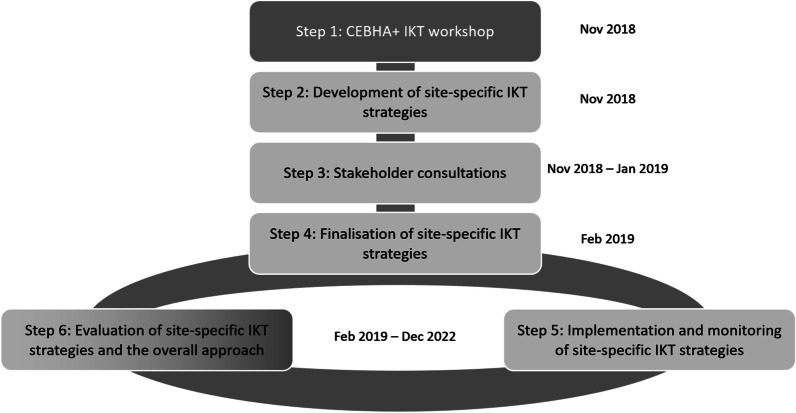
Background: In response to the "know-do" gap, several initiatives have been implemented to enhance evidence-informed decision-making (EIDM). These include individual training, organizational culture change management, and legislative changes. The importance of relationships and stakeholder engagement in EIDM has led to an evolution of models and approaches including integrated knowledge translation (IKT). IKT has emerged as a key strategy for ensuring that engagement is equitable, demand-driven, and responsive. As a result, the African-German Collaboration for Evidence-Based Healthcare and Public Health in Africa (CEBHA+) incorporated an IKT approach to influence noncommunicable diseases (NCD) policy and practice. We documented the phased process of developing, implementing, and monitoring the IKT approach in South Africa; and explored the appropriateness of using the exploration, preparation, implementation, and sustainment (EPIS) framework for this purpose.
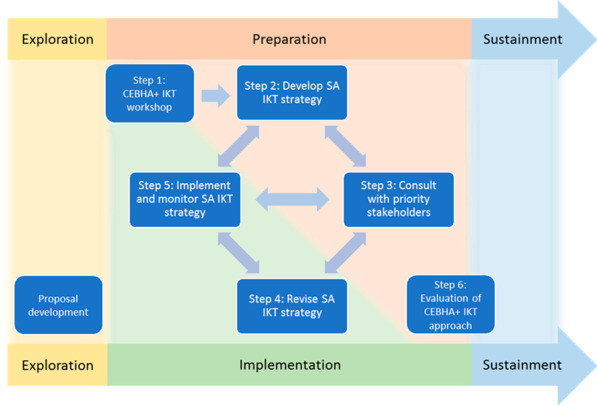
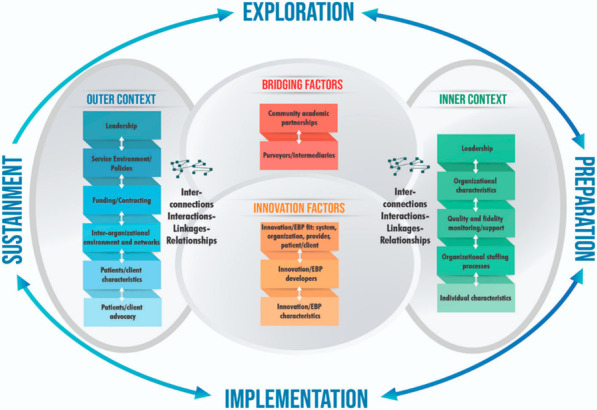
Methods: We mapped the South Africa IKT approach onto the EPIS framework using a framework analysis approach. Notes of team meetings, stakeholder matrices, and engagement strategies were analysed and purposefully plotted against the four phases of the framework in order to populate the different constructs. We discussed and finalized the analysis in a series of online iterations until consensus was reached.
Results: The mapping exercise revealed an IKT approach that was much more iterative, dynamic, and engaging than initially thought. Several constructs (phase-agnostic) remained important and stable across EPIS phases: stable and supportive funding; committed and competent leadership; skilled and dedicated IKT champions; diverse and established personal networks; a conducive and enabling policy environment; and boundary-spanning intermediaries. Constructs such as "innovations" constantly evolved and adapted to the changing inner and outer contexts (phase-specific).
Conclusions: Using the EPIS framework to interrogate, reflect on, and document our IKT experiences proved extremely relevant and useful. Phase-agnostic constructs proved critical to ensure resilience and agility of NCD deliberations and policies in the face of highly dynamic and changing local contexts, particularly in view of the current coronavirus disease 2019 (COVID-19) pandemic. Bridging IKT with a framework from implementation science helps to reflect on this process and can guide the development and planning of similar interventions and strategies.
期刊介绍:
Health Research Policy and Systems is an Open Access, peer-reviewed, online journal that aims to provide a platform for the global research community to share their views, findings, insights and successes. Health Research Policy and Systems considers manuscripts that investigate the role of evidence-based health policy and health research systems in ensuring the efficient utilization and application of knowledge to improve health and health equity, especially in developing countries. Research is the foundation for improvements in public health. The problem is that people involved in different areas of research, together with managers and administrators in charge of research entities, do not communicate sufficiently with each other.



 京公网安备 11010802042870号
京ICP备2023020795号-1
京公网安备 11010802042870号
京ICP备2023020795号-1

 分享
分享
 求助内容:
求助内容: 应助结果提醒方式:
 扫码关注我们
