Body Remains Left by Bird Predators as a Reliable Source for Population Genetic Studies in the Great Capricorn Beetle Cerambyx cerdo, a Veteran Oak Specialist.
Aleksander J Redlarski, Tomasz Klejdysz, Marcin Kadej, Katarzyna Meyza, Cristina Vasilița, Andrzej Oleksa
{"title":"Body Remains Left by Bird Predators as a Reliable Source for Population Genetic Studies in the Great Capricorn Beetle <i>Cerambyx cerdo</i>, a Veteran Oak Specialist.","authors":"Aleksander J Redlarski, Tomasz Klejdysz, Marcin Kadej, Katarzyna Meyza, Cristina Vasilița, Andrzej Oleksa","doi":"10.3390/insects12070574","DOIUrl":null,"url":null,"abstract":"<p><p>Obtaining biological material for DNA extraction is often challenging in organisms of conservation interest. Non-invasive sampling (i.e., sampling without injuring or disturbing an animal) is preferred as it carries no risk to the population's survival. Here, we tested the possibility of using the body remains left by bird predators for microsatellite genotyping in <i>Cerambyx cerdo</i>, a veteran oak specialist. We compared results obtained from such potentially degraded samples with samples of fresh beetle tarsi (i.e., invasive and destructive but non-lethal samples). Using 10 SSR loci, we genotyped 28 fresh, and 28 remains samples. The analysis indicated that PCR amplification efficiency was not influenced by sample type but allele length and individual heterozygosity. Allele frequencies were perfectly correlated for both sample types (<i>R</i><sup>2</sup> = 0.94). Additionally, null allele frequencies and genotyping failure rates were not significantly different from zero. Although the point estimates of individual inbreeding rates (<i>f<sub>i</sub></i>) were higher in remains than fresh samples (medians 0.08 vs. 0.02, respectively), both groups were not significantly different from each other and zero. Our study demonstrated that non-invasive remains samples could provide satisfactory data for population-genetic studies. However, we highlight the problem of biased inbreeding estimates, which may result from samples affected by allelic dropout.</p>","PeriodicalId":13642,"journal":{"name":"Insects","volume":" ","pages":""},"PeriodicalIF":2.9000,"publicationDate":"2021-06-23","publicationTypes":"Journal Article","fieldsOfStudy":null,"isOpenAccess":false,"openAccessPdf":"https://sci-hub-pdf.com/10.3390/insects12070574","citationCount":"2","resultStr":null,"platform":"Semanticscholar","paperid":null,"PeriodicalName":"Insects","FirstCategoryId":"97","ListUrlMain":"https://doi.org/10.3390/insects12070574","RegionNum":2,"RegionCategory":"农林科学","ArticlePicture":[],"TitleCN":null,"AbstractTextCN":null,"PMCID":null,"EPubDate":"","PubModel":"","JCR":"Q1","JCRName":"ENTOMOLOGY","Score":null,"Total":0}
引用次数: 2
Abstract
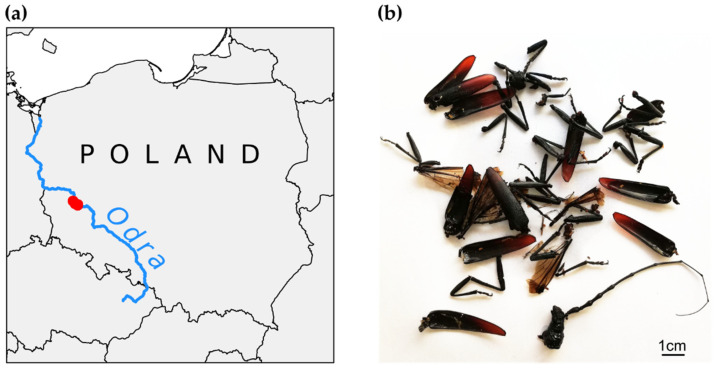
Obtaining biological material for DNA extraction is often challenging in organisms of conservation interest. Non-invasive sampling (i.e., sampling without injuring or disturbing an animal) is preferred as it carries no risk to the population's survival. Here, we tested the possibility of using the body remains left by bird predators for microsatellite genotyping in Cerambyx cerdo, a veteran oak specialist. We compared results obtained from such potentially degraded samples with samples of fresh beetle tarsi (i.e., invasive and destructive but non-lethal samples). Using 10 SSR loci, we genotyped 28 fresh, and 28 remains samples. The analysis indicated that PCR amplification efficiency was not influenced by sample type but allele length and individual heterozygosity. Allele frequencies were perfectly correlated for both sample types (R2 = 0.94). Additionally, null allele frequencies and genotyping failure rates were not significantly different from zero. Although the point estimates of individual inbreeding rates (fi) were higher in remains than fresh samples (medians 0.08 vs. 0.02, respectively), both groups were not significantly different from each other and zero. Our study demonstrated that non-invasive remains samples could provide satisfactory data for population-genetic studies. However, we highlight the problem of biased inbreeding estimates, which may result from samples affected by allelic dropout.
InsectsAgricultural and Biological Sciences-Insect Science
CiteScore
5.10
自引率
10.00%
发文量
1013
审稿时长
21.77 days
期刊介绍:
Insects (ISSN 2075-4450) is an international, peer-reviewed open access journal of entomology published by MDPI online quarterly. It publishes reviews, research papers and communications related to the biology, physiology and the behavior of insects and arthropods. Our aim is to encourage scientists to publish their experimental and theoretical results in as much detail as possible. There is no restriction on the length of the papers. The full experimental details must be provided so that the results can be reproduced. Electronic files regarding the full details of the experimental procedure, if unable to be published in a normal way, can be deposited as supplementary material.





 京公网安备 11010802042870号
京ICP备2023020795号-1
京公网安备 11010802042870号
京ICP备2023020795号-1

 分享
分享
 求助内容:
求助内容: 应助结果提醒方式:
 扫码关注我们
