Valentin Chardonnet, Marcel Hennes, Romain Jarrier, Renaud Delaunay, Nicolas Jaouen, Marion Kuhlmann, Nagitha Ekanayake, Cyril Léveillé, Clemens von Korff Schmising, Daniel Schick, Kelvin Yao, Xuan Liu, Gheorghe S Chiuzbăian, Jan Lüning, Boris Vodungbo, Emmanuelle Jal
{"title":"Toward ultrafast magnetic depth profiling using time-resolved x-ray resonant magnetic reflectivity.","authors":"Valentin Chardonnet, Marcel Hennes, Romain Jarrier, Renaud Delaunay, Nicolas Jaouen, Marion Kuhlmann, Nagitha Ekanayake, Cyril Léveillé, Clemens von Korff Schmising, Daniel Schick, Kelvin Yao, Xuan Liu, Gheorghe S Chiuzbăian, Jan Lüning, Boris Vodungbo, Emmanuelle Jal","doi":"10.1063/4.0000109","DOIUrl":null,"url":null,"abstract":"<p><p>During the last two decades, a variety of models have been developed to explain the ultrafast quenching of magnetization following femtosecond optical excitation. These models can be classified into two broad categories, relying either on a local or a non-local transfer of angular momentum. The acquisition of the magnetic depth profiles with femtosecond resolution, using time-resolved x-ray resonant magnetic reflectivity, can distinguish local and non-local effects. Here, we demonstrate the feasibility of this technique in a pump-probe geometry using a custom-built reflectometer at the FLASH2 free-electron laser (FEL). Although FLASH2 is limited to the production of photons with a fundamental wavelength of 4 nm ( <math><mrow><mo>≃</mo> <mn>310</mn> <mo> </mo> <mtext>eV</mtext></mrow> </math> ), we were able to probe close to the Fe <i>L</i> <sub>3</sub> edge ( <math><mrow><mn>706.8</mn> <mo> </mo> <mtext>eV</mtext></mrow> </math> ) of a magnetic thin film employing the third harmonic of the FEL. Our approach allows us to extract structural and magnetic asymmetry signals revealing two dynamics on different time scales which underpin a non-homogeneous loss of magnetization and a significant dilation of 2 Å of the layer thickness followed by oscillations. Future analysis of the data will pave the way to a full quantitative description of the transient magnetic depth profile combining femtosecond with nanometer resolution, which will provide further insight into the microscopic mechanisms underlying ultrafast demagnetization.</p>","PeriodicalId":74877,"journal":{"name":"","volume":"8 3","pages":"034305"},"PeriodicalIF":0.0,"publicationDate":"2021-06-23","publicationTypes":"Journal Article","fieldsOfStudy":null,"isOpenAccess":false,"openAccessPdf":"https://www.ncbi.nlm.nih.gov/pmc/articles/PMC8225393/pdf/","citationCount":"0","resultStr":null,"platform":"Semanticscholar","paperid":null,"PeriodicalName":"","FirstCategoryId":"101","ListUrlMain":"https://doi.org/10.1063/4.0000109","RegionNum":0,"RegionCategory":null,"ArticlePicture":[],"TitleCN":null,"AbstractTextCN":null,"PMCID":null,"EPubDate":"2021/5/1 0:00:00","PubModel":"eCollection","JCR":"","JCRName":"","Score":null,"Total":0}
引用次数: 0
Abstract
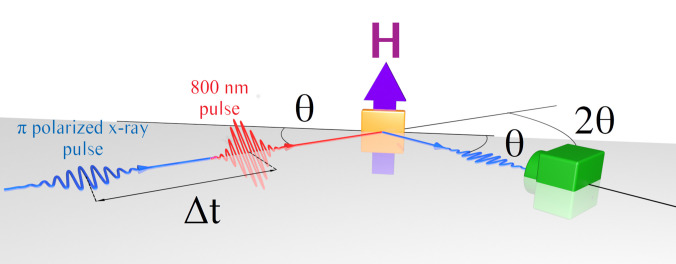
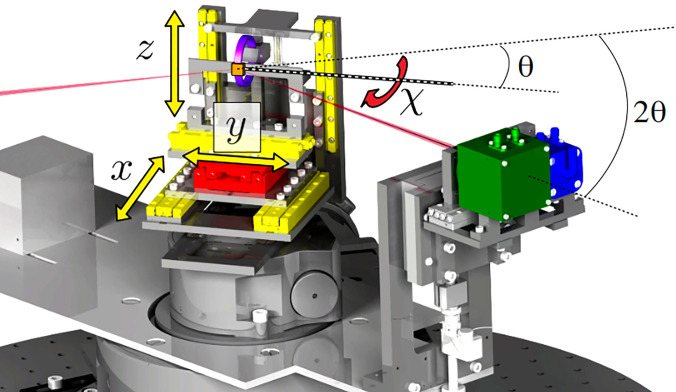
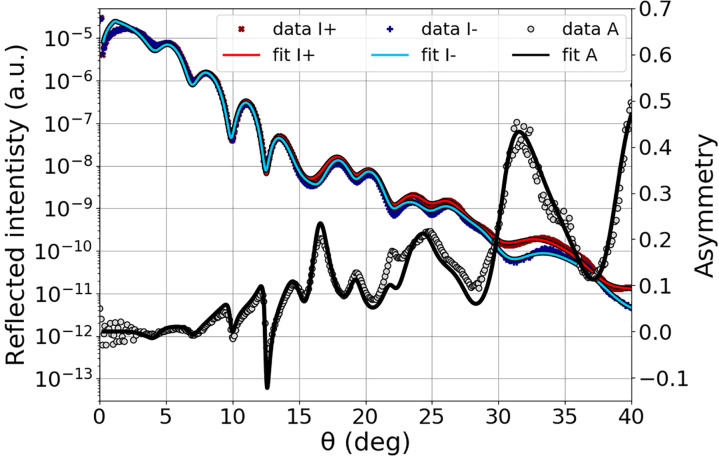
During the last two decades, a variety of models have been developed to explain the ultrafast quenching of magnetization following femtosecond optical excitation. These models can be classified into two broad categories, relying either on a local or a non-local transfer of angular momentum. The acquisition of the magnetic depth profiles with femtosecond resolution, using time-resolved x-ray resonant magnetic reflectivity, can distinguish local and non-local effects. Here, we demonstrate the feasibility of this technique in a pump-probe geometry using a custom-built reflectometer at the FLASH2 free-electron laser (FEL). Although FLASH2 is limited to the production of photons with a fundamental wavelength of 4 nm ( ), we were able to probe close to the Fe L3 edge ( ) of a magnetic thin film employing the third harmonic of the FEL. Our approach allows us to extract structural and magnetic asymmetry signals revealing two dynamics on different time scales which underpin a non-homogeneous loss of magnetization and a significant dilation of 2 Å of the layer thickness followed by oscillations. Future analysis of the data will pave the way to a full quantitative description of the transient magnetic depth profile combining femtosecond with nanometer resolution, which will provide further insight into the microscopic mechanisms underlying ultrafast demagnetization.



 京公网安备 11010802042870号
京ICP备2023020795号-1
京公网安备 11010802042870号
京ICP备2023020795号-1

 分享
分享
 求助内容:
求助内容: 应助结果提醒方式:
 扫码关注我们
